
Stage 1 · Your Journey
The consultation
What happens between your first message and an answer you can act on.
Before you write
You need less than people expect. A few sentences about what bothers you — in your own words, not in the name of a procedure — and photographs if you are willing to send them. Everything else can be asked for later; starting is meant to cost you an evening at most.
Describing the result rather than the operation is genuinely more useful. "My nose looks heavy in photographs from the side" tells a surgeon more than the name of a technique, and it leaves room for the answer to be a different procedure than the one you had in mind — which it often is.
- What bothers you, in your own words
- Photographs in daylight, front and both sides
- Any medication you take, and past surgery
- Roughly when you could travel
The conversation
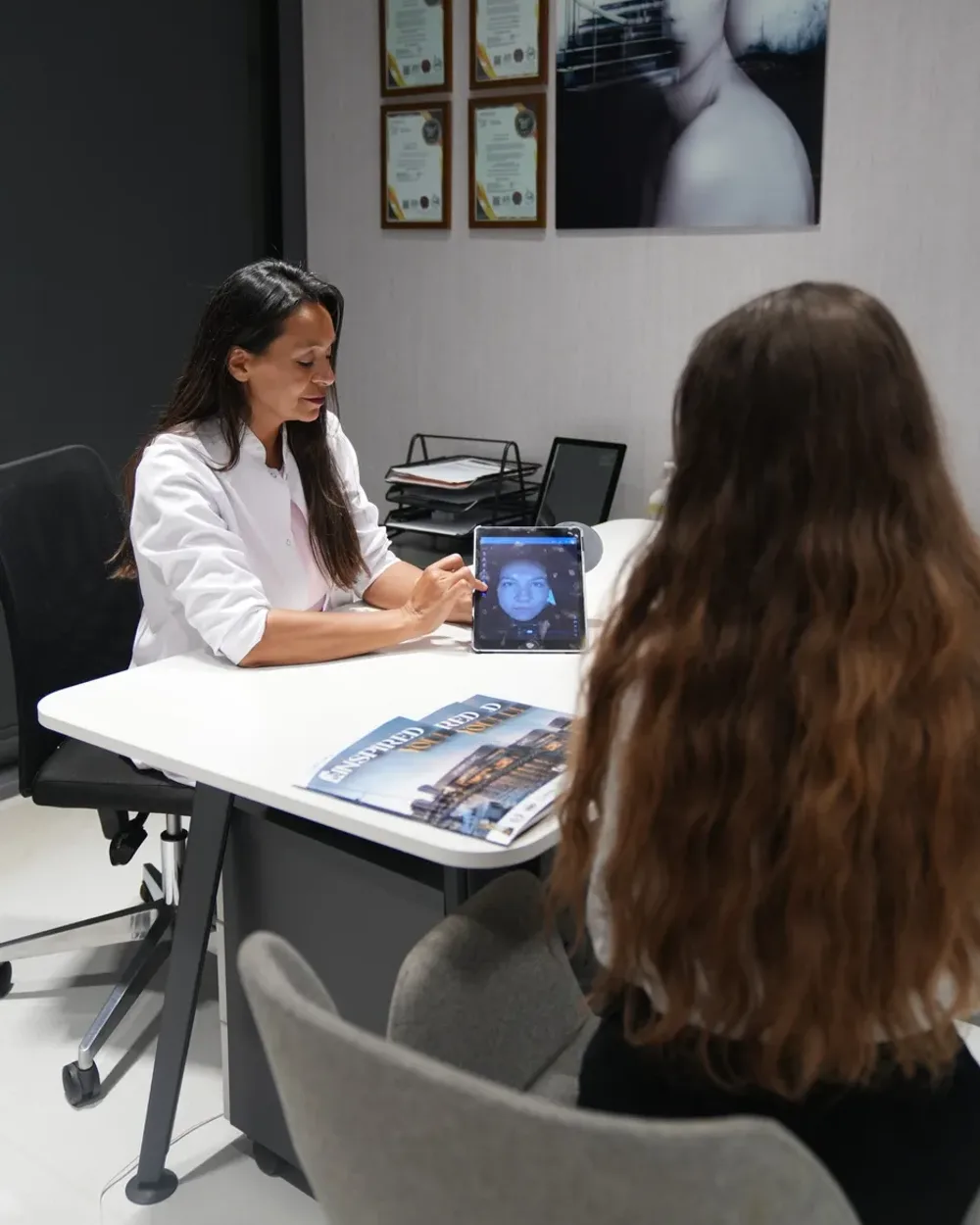
It happens online or in Istanbul, whichever suits you, and it is a conversation rather than an appointment slot. A coordinator who speaks your language is on it from the start — not as a translator between you and someone else, but as the person who will stay with you through everything that follows.
You will be asked about your health, not only about your face: what you take, what you have had done before, whether you smoke, how you heal. Some of it sounds unrelated and none of it is. The questions are the assessment, and a consultation that skips them is not assessing anything.
A clinic that has never told anyone not to have surgery is not assessing anybody.
What the surgeon is looking for
Not whether you would like the result. Whether your anatomy can be made to give it to you, and at what cost — how skin behaves at your age, how thick it is, what a previous operation left behind, how much of what you dislike is bone rather than soft tissue. The same request has different answers on two different faces.
What comes back
An assessment: what is realistic, what it would involve, what it would take from your calendar and your body. Where more than one route exists you are told about both, including the smaller one. Where the honest answer is that nothing should be done, that is the answer you get — a clinic that has never given it to anyone is not giving assessments.
If you decide to go on, the assessment becomes the written plan — procedure, surgeon, dates, stay and cost in one document. If you decide not to, that is the end of it. Nobody calls you back with a better price in three weeks.
This article is general information, not medical advice, and does not replace a consultation. Every procedure carries risk and outcomes vary from person to person.
What does not change
One coordinator, start to finish
The person who answers your first message is the person who answers the one you send from home a month later.
Your own language
Seven of them, spoken by the people you deal with rather than routed to a service — including in the room on the day.
In writing, before you commit
Procedure, surgeon, dates and cost are a document you can read at home, not a number said on a call.
No pressure to book
There is no month-end offer here. People who decide slowly are the ones who arrive certain, which is how we would rather they arrive.
Linspired by you.
Your becoming starts with a conversation.
Tell us what you are considering. A coordinator who speaks your language will come back to you with an honest assessment of what is realistic — not a sales pitch.
Seven languages · No obligation