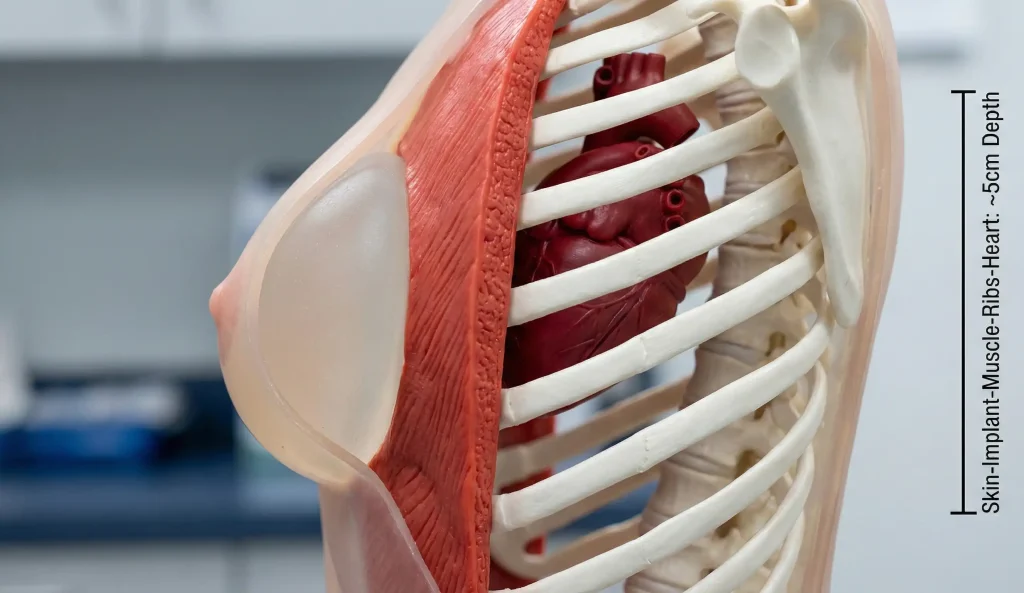
No, breast implants do not put pressure on the heart.
One of the most serious and prevalent concerns that patients bring up during a consultation is related to the heart. There is a tendency for patients to inquire especially if it’s a left breast implant: “If you were to put a silicone bag right on top of my heart, wouldn’t it crush it? Would the heart be able to beat properly if the weight was stopping it? Is that why I have a heavy feeling in my chest?”
It is quite reasonable to have such fears. The heart is the most vital organ in the body, and it just does not seem natural to almost “kill” your survival by placing an alien object close to it. But in brief, breast implants can not physically put pressure on heart, They do not force the cardiac muscle to crush, compress or stop in any way. However, they can lead to some symptoms quite similar to heart problems, e.g. chest tightness, palpitations, and sharp pains, that usually results in a scare unnecessarily. We at Lin Europe Clinic firmly believe that one of the primary keys to a peaceful post-surgery recovery is to realize that there is a physical distance between your “cosmetic chest” and your “vital chest”.
The Anatomical Shield: The Rib Cage
If you want to know why your heart is protected, you need to check the different layers of the chest wall. Your heart is not something that just “floats freely” in the chest cavity. It is enclosed by a very tough and fibrous sac called the pericardium and is situated deep in the thoracic cavity, which is guarded by a bony cage (the ribs) and intercostal muscles.
When a surgeon does a breast augmentation, whether it is Sub-Glandular (on top of the muscle) or Sub-Muscular (under the muscle), the whole procedure is done not inside the rib cage, but outside it.
- The Barrier: The ribs are like an impenetrable wall. The implant lies on top of the pectoralis muscle (or just beneath it) and on top of the ribs. It never goes into the thoracic cavity where the lungs and heart are located.
- The Physics: Even if you opt for gigantic implants, the weight will be spread out across the large area of the chest wall muscles and ribs. The rib cage has been engineered to have the proper structural integrity to hold up against an enormous amount of force (like a car crash or a punch). 400g silicone implant’s weight is something that ribs easily disregard and it exerts no pressure on the organs underneath them.
Why Do You Feel Like Your Heart Is Being Pressured?
If the heart is secure, then why do so many ladies talk about “heart pain” or a feeling of their heart being crushed in the very first couple of weeks? What they actually feel is correct, but the source is the muscular-skeletal system, the heart being excluded.
1. The Pectoralis Muscle Spasm
The most familiar reason why someone would mistake one pain for the other is a spasm of the left pectoralis major muscle. During a sub-muscular breast augmentation, this very muscle gets lifted and stretched. When a muscle spasm occurs (the “Iron Bra” effect), the muscle contracts so tightly that it practically clamps down on the rib cage. Since this muscle lies immediately over the heart, the sharp kind of cramping in the muscle essentially feels like angina (heart attack pain). What distinguishes is that this pain can be repeated – as if you move your arm or press the muscle, it will hurt more. Usually, the heart pain does not get altered with the changing of touch.
2. Costochondritis (Rib Inflammation)
In some cases, the injury (trauma) of the surgery and the continuous pressure of the implant on the ribs might become a reason for Costochondritis – inflammation of the cartilage that connects a rib to the sternum (breastbone). This makes an individual experience a sharp and stabbing pain situated on the left side of the chest that intensifies when one takes a deep breath. Despite the fact that it is very painful, it is a healthy state of inflammation between the bone and cartilage, not the heart itself.
3. Anxiety and Palpitations
Healing is a very demanding process. The combination of pain, narcotic medications, phantom feeling of the implants leading to a big anxiety attack, can all be triggers. Anxiety attacks come from the excessive release of adrenaline, which then produces palpitations (people use the term “palpitation” to describe the feeling of a rapidly beating or skipping heart). Typically, patients misinterpret these palpitations as the heart being “squeezed” by the implant when, in fact, it is simply how the nervous system functions under stress.
EKG Distortion: A Medical Note
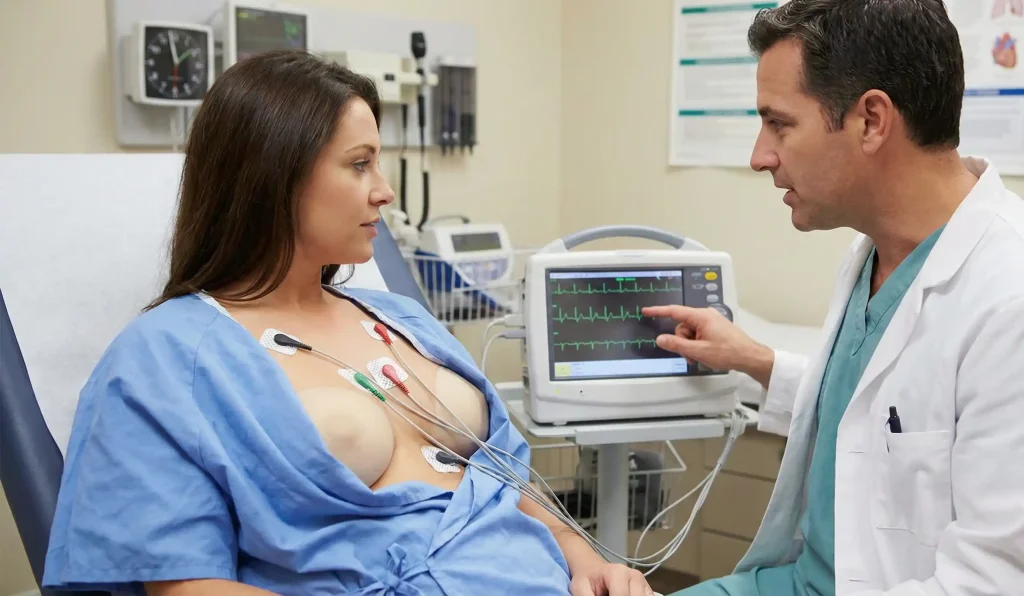
Even though implants do not damage the heart, they can, in a way, mislead doctors when diagnosing heart problems. This is very important information that you definitely want in your medical records for the long run.Breast implants, especially the ones on the left side, can through their physical presence interfere with the recording of heart electrical impulses during an Electrocardiogram (EKG/ECG). Silicone is a very good insulator so it reduces the voltage that can be detected by the EKG leads from the heart.
- The Consequence: This can result in a “false positive” reading that suggests heart disease (like an anterior infarction) where none exists.
- The Solution: Always make sure to inform the technician who is taking an EKG that you have breast implants. It might become necessary for them to reposition the leads (stickers) slightly, or to make a note of the implants in the patient file so that the cardiologist is not misled by the scan. Needless to say, this is not a threat to your health, but rather just an anomaly in the diagnosis.
The “Heavy Chest” Sensation

The feeling of “heaviness” that can last for several months might be just a matter of sensory adaptation. The brain has a sort of image of your chest based on the weighing of it. When 800 grams (which is approximately two implants) are added suddenly, your accessory breathing muscles (in the neck and shoulders) become more activated to help lift the chest wall when inhaling. At first, this extra effort might be rated as shortness of breath or “heart strain”. However, after 6 to 12 weeks, your breathing muscles become stronger and the chest wall is adapted to the loading by them, so the sensation of heaviness is no longer present. Your cardiovascular system does not have to “pump harder” to support the implants; they are avascular (have no blood supply), so they add zero load to your circulation.
Can Implants Hide Heart Problems?
Another common doubt goes on as to whether implants are a hindrance to the heart’s auscultation. Is it possible for a doctor to detect a heart murmur or see a valve problem through the implant?
Absolutely. Stethoscopes are very sophisticated devices. Yes, the implant is a layer of extra thickness but sound wave propagation through liquid and silicone is still very efficient. Hence, a highly-qualified cardiologist would be able to hear heart sounds through an implant very well. In addition, echocardiograms (heart ultrasound) are perfectly doable, although the technician might have to change the probe angle to bypass the implant shadow.
If Left-Side Chest Pain Is an Emergency
Although we try to stress that implants cannot hurt your heart, it is not something that should be spoken lightly when it comes to chest pain following surgery. There is only one uncommon but severe post-operative complication that is related to the heart and lungs: Pulmonary Embolism (PE). Suffering from surgery puts one more vulnerable to the occurrence of leg blood clots (DVT) that eventually can travel to the lungs.
- Red Flags: In case the chest pain comes suddenly and is accompanied by such symptoms as coughing up blood, very severe shortness of breath that does not get better with rest, or rapid heart rate (>100 bpm) during the period of rest, then there is no doubt that you need to go to ER immediately. The problem here is a blood clot, not a muscle spasm.
Frequently Asked Questions About Implants and Heart Health
There is no medical evidence to support that breast implants can cause heart attacks or heart disease. Breast implants are biologically inert, so they don’t interfere with or affect the cardiovascular system in any way.
Most of the time, the answer is no. The wrist-based heart rate monitors such as Apple Watch work by detecting the pulse from the wrist. However, if you are using a chest-strap heart rate monitor, you might have to adjust or tighten it if it is reading through the added volume of the breast to get a clear reading.
Of course, your pacemaker will continue to work; however, the surgery should be planned very carefully. Your surgeon may have to make the incision and create the pocket in a way that is different from the usual procedure in order not to excessively manipulate the pacemaker or its leads, if you have a pacemaker.
This could be the result of “postprandial tachycardia” coupled with recovery fatigue. Eating and digesting food take energy, and your body is already tired from healing; it has nothing to do with the physical pressure of the implants.
Yes, after you have completely healed (usually 6 weeks), it is perfectly fine to do high-intensity cardio. Your breast implants won’t affect your lung capacity or the heart’s ability to pump blood during exercise, but you will have to wear a high-impact sports bra to minimize the bouncing.
Zebrowski, P., et al. (2018). The effect of breast implants on the electrocardiogram. Aesthetic Plastic Surgery.
Chummun, S., et al. (2015). Breast implants and the ECG: A case of pseudo-infarction. BMJ Case Reports.