
Yes, tightness is normal during healing.
The very first 48 hours following breast enhancement, Lin Europe Clinic is bombarded by phone calls. Interestingly, the calls are not about pain or the sight of the incisions, but rather about breathing. Patients often recount a frightening experience: “It feels like an elephant is sitting on my chest,” “I can’t draw a full deep breath,” or “It feels as if I have an iron corset that is two sizes too small.” This intense and deep sensation frequently results in panic attacks that the patient gets convinced that something has gone terribly wrong or even that the implants are too physically big for the body.
The explanation in brief is yes, the tightness is very normal. Actually, it’s the signature symptom of a sub-muscular breast augmentation. There is even a special term for it in the surgical world: “The Iron Bra Effect.” However, the feeling of being suffocated hardly ever signifies respiratory failure. Instead, it is a muscular and physical response caused by the abrupt arrival of volume in a space that was previously only being flat. Hence, if you understand the physiological mechanism behind the squeeze – why your muscles are protesting and your skin is stretching – you will have a considerably easier time calming yourself and getting through the first week of healing.
The “Iron Bra” Effect: Muscle Spasm
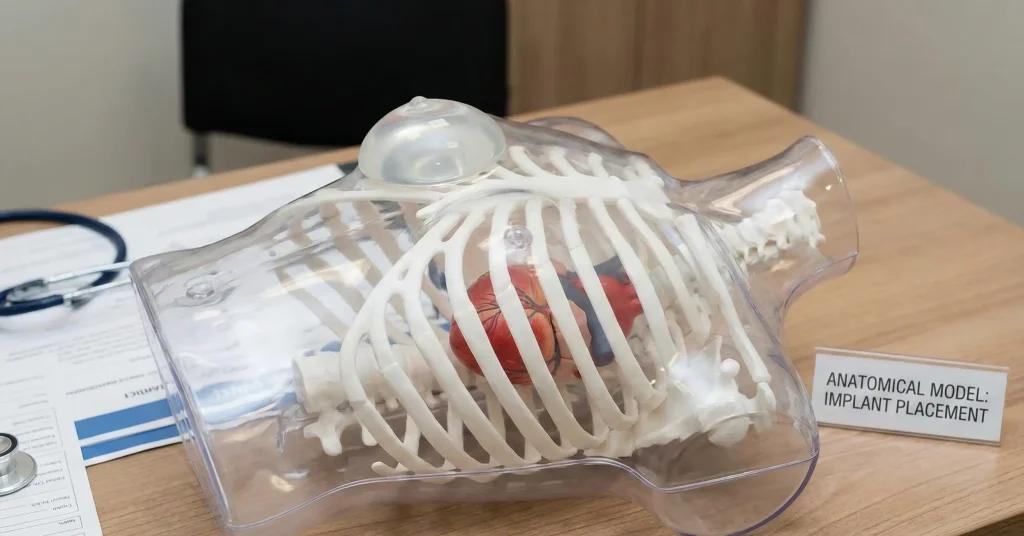
In order to fully comprehend the feeling of tightness, you need to visualize the anatomical structure of the Dual Plane (Sub-Muscular) breast augmentation. To be more precise, the implant had to be placed under the muscle which essentially means that your surgeon separated the muscle from its lower attachments and pushed the implant into the space thus created.
Throughout your life, your chest muscle was lying flat against your ribcage. However, suddenly within the duration of an hour, it gets to be lifted, pulled and forced to tent over a climber that is 3 to 5 centimeters in height. Your muscle is responding to the injury it has received in the only manner it knows: through spasm. The “Iron Bra” feeling is not the implant pressing against your lungs; instead, it is your pectoral muscles involuntarily contracting as a protective reflex. The muscle is attempting to return to a flatter shape against the ribs, but the implant is in its way. The ongoing, very strong contraction causes a sense of pressure in a band along the chest wall that resembles the feeling of being squashed or hugged too tightly. This explains why the tightness is usually at its peak at the moment of waking- your muscles have stiffened following the period of inactivity.
The Skin Envelope: Tumescent Fluid and Edema
In addition to the muscle being the major villain here, the skin covering the breast also plays a significant role in making the patient feel like their skin would burst. To facilitate the process of hemostasis and pain management, your surgeon injected the breast pocket with tumescent fluid – which is a saline solution with added adrenaline and local anesthetic.
After surgery, the patient’s body sends its own natural inflammatory components (lymphatic fluid and leukocytes) to the injured area to set the healing process in motion.
Hence, the breast skin that has been subject to swelling and surgical fluid is a very thin balloon being stuffed with more and more air. It becomes shiny, tight, and very rigid. The elevated internal pressure is exerting force on the skin from one side and the ribcage from the other. Since the skin hasn’t gone through the process of relaxation and stretch yet (which takes weeks), the pressure inside feels sealed and hard, thus adding to the feeling that your chest is “locked” and unable to expand to take in more air.
The Breathing Loop: Pain vs. Panic
This physical symptom has a definite psychological aspect to it as well. Because it is painful to expand the chest wall (as spreading the ribs also lengthens the already irritated pectoral muscles), patients inadvertently start to breathe in a more shallow way. You cease to breathe deeply, filling your belly with air, which fully inflate the lungs, because your brain is attempting to shield you from the sharp “catch” of pain at the top of the breath.
A decrease in oxygen saturation and a sense of “hunger” for air are the results of shallow breathing. This activates the brain’s fear center which then releases adrenaline. Adrenaline causes fast heartbeat and thus you feel that you need more air which in turn leads to panic.
This sets the vicious cycle in motion:
Pain causes shallow breathing -> shallow breathing causes anxiety -> anxiety causes chest tightness -> chest tightness causes more pain.
The stopping of this cycle requires a conscious decision. We remind patients that when they are distressed, they should focus on “diaphragmatic breathing” rather than chest breathing. In doing so, you will be able to fill your lungs without stretching the pectoral muscles and thus terminate suffocation sensation.
When Is Tightness a Red Flag?

Though the “Iron Bra” phenomenon is generally a nice one, there are still times when chest tightness may be a sign of a potential life-threatening situation: Pulmonary Embolism (PE) or Pneumothorax. Moreover, it is necessary to differentiate between muscle tightness and breathing failure.
- Normal “Iron Bra”: The tightness is symmetrical (both sides weigh equally). It is similar to the sensation of being hugged very tightly. If you exert the effort, you can breathe deeply even though it hurts. The feeling stays constant but disappears slightly after taking muscle relaxants.
- Medical Emergency (PE): Pain is frequently sudden, sharp, and may be more severe on one side only. It also manifests as extreme shortness of breath (gasping), rapid heart rate (tachycardia), coughing (possibly with blood), or dizziness. If you experience a stabbing pain during inhalation that makes you unable to breathe or if you feel faint, don’t think that it’s muscle spasm. Call 112/911 immediately.
- Hematoma: Hematoma is where one breast is suddenly rock hard, larger than the other by a significant amount, and very painful and tight but the other breast feels soft. The tightness is caused by blood accumulating at the site of injury under a high pressure.
Management: Muscle Relaxants and Heat
The best way to treat muscle pain is by taking muscle relaxants such as Valium, Diazepam, or Flexeril, which are available in oral forms. One thing you should know is that muscle relaxants, apart from just masking pain like analgesics, will also chemically help to loosen the muscle that has been tight for a long time. Many patients report being able to breathe perfectly only half an hour after taking the muscle relaxant.
Heat also plays a major role. Once the surgeon formally permits (usually after a period of 3-5 days in order not to hinder the healing by bleeding risk), your back and shoulders can be treated with a warm heating pad. (Avoid direct heat application to the breasts as the anesthetized skin is very vulnerable to overheating). By letting go of their back, the chest wall comes next with a little help from the “back muscles,” which is why the feeling of wearing a “corset” is finally gone to the point that you can sleep.
The Timeline of Relief
The tightness usually becomes worst around the period of Day 2 and Day 3 permanently coinciding with the peak of swelling.
- Week 1: The “Iron Bra” is with you the whole day. You may struggle to finish a meal because you would feel too full with a compressed stomach.
- Week 2: You get rid of the constant “Iron Bra” sensation and it changes into intermittent “stiffness,” which you mostly experience in the mornings or after making sudden movements.
- Month 1: spasms of the muscle end. The tightness is only the extent to which the implants are “there”.
- Month 3: Skin relaxes (the “fluff” phase) and the feeling of pressure disappears. The implants have become a part of you rather than being foreign bodies.
Frequently Asked Questions About Chest Tightness
The overwhelming feeling known as the Iron Bra, which is the tightness changing your chest into a solid piece of metal, usually lasts for the first five to seven days after the surgery and then the pain turns into a mild stiffness which can still be there for a few weeks.
The main reason for such a sensation is that the pectoral muscles signal danger and hence go into protective spasm because they have been stretched over the new implants, and this is further intensified by the post-surgical swelling, which causes the internal upsurge of the pressure.
It is not uncommon for doctors to issue prescriptions for muscle relaxants whose mechanisms of actions are completely different from those of standard painkillers therefore, only the drug-given muscle relievers can let chemically the spastic pectoral muscles free hand from the chest wall merely by forcing.
It is perfectly okay for you to feel pain and muscle tightness-related slight trouble in breathing deeply, but sudden and severe shortness of breath along with chest pain or fast heart rate case is a must that doctors should be called immediately.
It is, in fact, very helpful to sleep spaced by a 45-degree angle from a flat surface as it means less pressure of fluids on the chest and the pectoral muscles remain in their natural state at the same time, which totally gets rid of a heavy feeling.
Adams, W. P., Jr. (2008). The process of breast augmentation: four sequential steps for optimizing outcomes. Plastic and Reconstructive Surgery.
Spear, S. L., & Baker, J. L. (2012). Animation deformity in the subpectoral breast augmentation patient. Aesthetic Surgery Journal.
Hidovic-Rowe, D., et al. (2011). The effect of breast augmentation on thoracic spine and posture. Aesthetic Surgery Journal.