Nothing replaces the cervix after its removal.
The Creation of the Vaginal Cuff
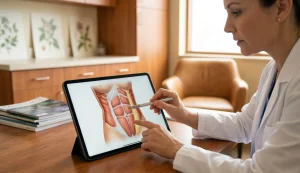
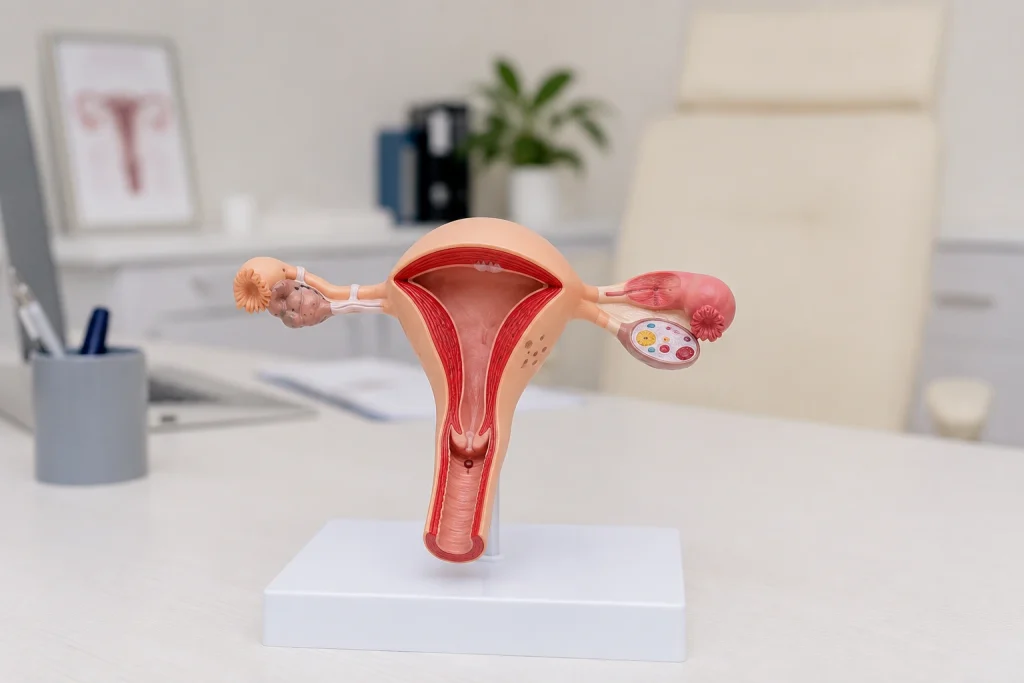
Familiarizing yourself with your internal organs after surgery will help you be fully aware of the changes and be ready for the healing process. If you have been advised or are expecting a total hysterectomy (removal of the womb and cervix), it is quite common for one to question what is left at the upper end of the vaginal canal after removal of the cervix. When you have a total hysterectomy, your cervix is carefully removed while preserving the connection with the vaginal walls. Your surgeon brings together the edges of the vaginal canal at the new top opening created by removing the cervix, and stitches them securely with strong surgical sutures. This results in the formation of a smooth, closed layer over your vagina that completely isolates you from the abdominal cavity and prevents any exposure of your internal organs.
Redefining Pelvic Supports
Your vaginal cuff not only serves the purpose of sealing your internal body and the vagina but also involves restoring your pelvic supports in a very special way. The cervix normally functions as a junction point on which the powerful fibrous ligament structures, i.e., the uterosacral and cardinal ligaments, anchor. These major structures, along with the muscles of the pelvic floor, suspend the entire pelvic contents from the sacrum and the side walls of the pelvis. During a total hysterectomy, your surgical team will not merely cut through these important ligaments like ropes; instead, they will cleverly reattach and tie knots of these ligaments directly into those portions of the new vaginal cuff that are at the corners. This innovative surgical technique of yours allows the vaginal canal to maintain its natural depth and suspension, along with the structural resilience necessary for your pelvic organs, such as the bladder and rectum, which are held up by your pelvic floor so that they do not fall downwards (drooping) or protrude outside (prolapsing).
Bodily Constraints During Healing
You must obey these behavioral limitations if you want to get the best results from your recovering tissues. Since it all depends on microscopic suture lines and only initial fibrin bonds at the wound edges, protection from the physical forces that could possibly stretch or tear the sutures is of utmost importance during the period of first 6 to 8 weeks after surgery. Mechanical stresses caused by such things as abrupt increases of intra-abdominal pressure and direct rubbing of the top of the vagina lead to severe biological costs: the healing tissue edges may tear, with the result of a serious clinical condition referred to as vaginal cuff dehiscence (a wound that comes apart). To safeguard that your newly created pelvic anatomy is locked into place with maximum precision, you should refrain from all activities which lead to vaginal penetration (e.g., sex, use of tampons, douche) and refrain from any activity that lifts weights, involves vigorous exercise, or requires great abdominal effort such as straining when having a bowel movement, for the whole period of time your doctors prescribe it.
The Feel and Sensation After the Vaginal Cuff is Healed
By the time you reach completion of the post-surgery period and the surgical stitches disappear, the vaginal cuff will turn into a sturdy, flexible, and smooth sheet of your tissue. Physically as well as in intimacy, the repaired vaginal vault will work very much like a normal and natural one. The vaginal cuff lining is made up of the same kind of mucous membrane that the rest of your vagina consists of, so you would expect it to behave normally – elasticity and lubrication, of course – during intimacy or sex. You won’t notice any lack of space (a gap) or hardness (an obstacle); your partner, as well as you, won’t feel it. Instead, the vagina’s top, like a soft and smooth pocket’s end, is perfectly comfortable to the touch and gives you a sense of being supported structurally all the time, even at a later stage of your life.
Hysterectomy Surgery in Turkey
Deciding for LIN Europe Clinic means a step to a superior medical haven where your reconstructive surgical procedures, post-operative care, and overall pelvic health are taken care of using top-notch professional skill and compassionate care to the fullest. We know that it is not only an anatomical precision that one has to understand during the post- surgical changes but also it is a matter of internal tissue healing and safeguarding all protective boundaries around a person’s body that one can manage very easily and very effectively only in the case of very sophisticated, fully transparent, and very support- oriented environment which is evidence-based medicine centric, and is at the topmost level of patient safety as its guiding star. Your complete trust will be our greatest privilege at LIN Europe Clinic to monitor your healing milestones and the health of your pelvis with complete diagnostic excellence. From a comprehensive post-operative guidance package to high-tech tissue analysis and a customized healing program that is tailor-made for every individual to help them recover and adapt step by step with their body, the medical excellence of our top team makes sure that your well-being and surgical procedure are protected from all aspects.
FAQ:
An artificial substitute is never employed. Rather, the surgeon uses your own tissue to close the top part of the vaginal canal in the surgery, forming a firmly secured, enclosed wall called a vaginal cuff.
The healed vaginal cuff feels like it has come along without any interruption. As well as being smooth, it is elastic and entirely connected to your vaginal canal. One can just imagine a soft pocket with an end so close yet closed.
Definitely not because, being sewed tightly shut with absorbable sutures, the vaginal cuff heals to a very fine, soft tissue wall that neither you nor your lover will be able to detect that there is a bump or missing space during sexual relations.
The seam opening is uncommon but may occur if a patient has intercourse, does heavy lifting, or participates in vigorous physical exercises too early before the tissue has completely healed. Hence it is vital to follow your 6-week restriction period.
A full hysterectomy when done by an experienced gynaecologist would leave the functional vaginal length intact. The pelvic support ligaments having been re-sutured ensures that the vaginal vault remains in position as a normal anatomical depth.
American College of Obstetricians and Gynecologists (ACOG). (2020). Vaginal Cuff Closure Techniques and Pelvic Organ Support Following Total Hysterectomy. Practice Bulletin No. 218.
DeLancey, J. O. (1992). Anatomic aspects of vaginal eversion after hysterectomy: Managing uterosacral ligament suspension vectors. American Journal of Obstetrics and Gynecology, 166(6), 1717-1724.
Rohrich, R. J., et al. (2014). Advanced Postoperative Care, Micro-Vascular Wound Healing, and Systemic Vasoconstriction Parameters in Pelvic Tissue Recovery. Journal of Aesthetic and Reconstructive Surgery, 34(5), 587-595.