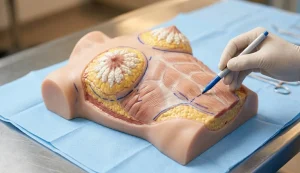
Gentle arm movement and walking.
The “high and tight” phase is something that almost every breast augmentation patient complains about. You find yourself after surgery looking down to see that your breasts are very high up on your chest and almost seem to be touching your collarbones. They are square, swollen, and, to be very honest, “fake.” People who have experienced such a phase call it “Frankentits” or “Torpedo Boobs”. Your doctor reassures you that it will happen, but the waiting can be quite painful. Of course, patients want to have a say in their recovery and they say, “Is there an exercise to push them down quicker?”
The answer is a little bit of both, yes and no. You need to change your whole attitude towards “exercise”. When talking about breast implants, especially if they are Sub-Muscular (Dual Plane) implants, exercise should not be about strengthening, building, or pumping the muscle. Actually, it is the muscular strengthening that you want to avoid. The pectoral muscle is the “bad guy” at the moment as it is the reason why your implant is still in a high position. So the “exercises” that allow implants to drop are in fact relaxation techniques, passive stretches, and mechanical displacement maneuvers which aim to make the pectoral muscle lose energy and increase in length so that it loosens its hold and the implant settles in the lower part of the pocket.
The Physiology of the “High” Implant
In order to find out which exercises will work, you need to figure out what mechanical struggle goes on inside your chest.
The surgeon separates the pectoralis major muscle from its lower attachments when inserting an implant under the muscle. The muscle is shocked not only by the release of the attachments but also by the sudden stretch from the implant’s volume. Hence, it goes into contraction (spasm) as a way to protect itself. This contraction is essentially a shortening as the muscle tightens in order to pull the implant up toward the shoulder.
While the muscle stays in this shortened and tight state, the implant will be high. The “Drop and Fluff” process is the process of the pectoral muscle giving up bit by bit. It gradually, along with its thinning, loosens and lengthens over the implant. Therefore any activity that causes muscle growth or tightens the muscle (like the push-up) will make the drop longer. Conversely, any movement that induces the muscles to stretch and open will speed the drop. Your task is to allow your nervous system to realize that it is ok to release the tension in the chest wall.
The “Anti-Workout”: What to Avoid
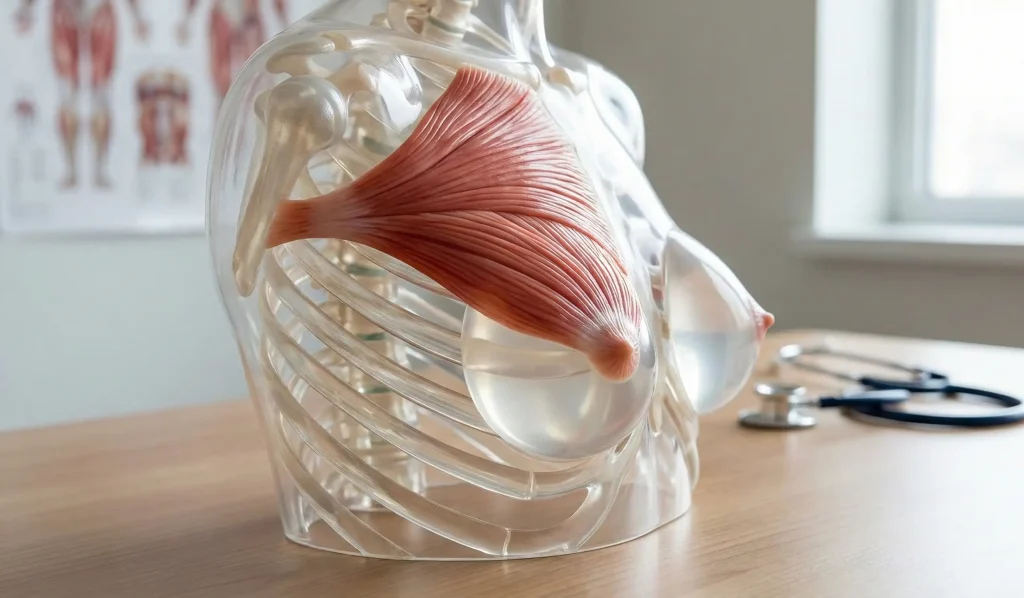
It is a must to clearly mention the wrong things before we even get into right-for-you stuff. Women who keep fit tend to fall for this misconception that if they do chest presses or push-ups in high reps it will “move” the implants down. Unfortunately, this is a major mistake. Resistance training of the chest leads to the shortness of the muscle contraction. When you bench pressed during the first six weeks, you were training the pectoral muscle to keep the implant high. You were proving the existence of the “Iron Bra.” Abstain from all forms of direct chest isolation exercises (push-ups, flyes, presses, dips) for at least 6 to 12 weeks, or until the implants have fully dropped into their natural position.
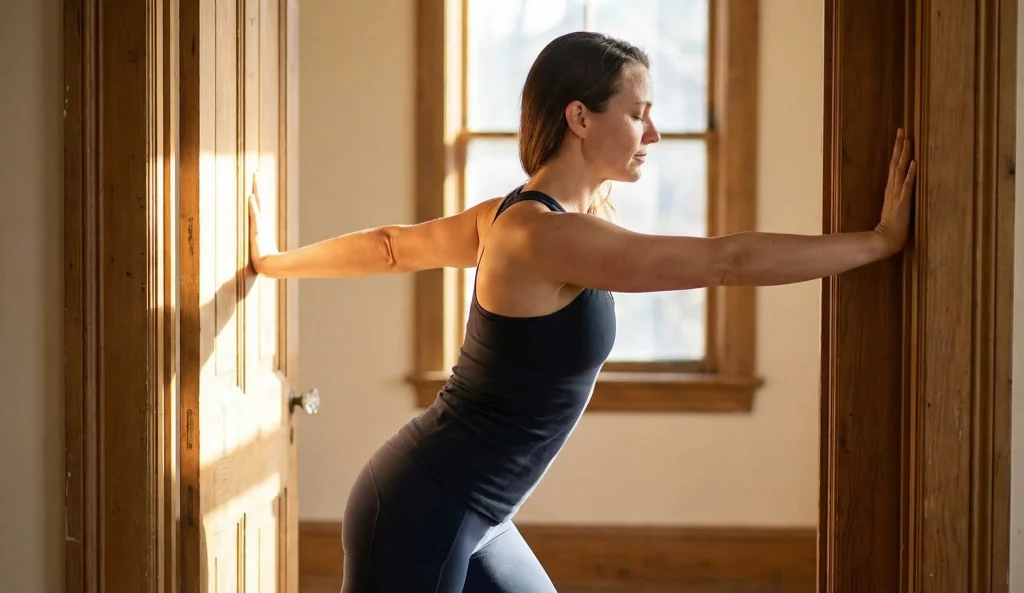
Exercise 1: The Pectoral Doorway Stretch
Doorway Stretch is probably the most popular and effective stretch of all for the drop. It uses a passive lever i.e. doorway to open the chest wall and this happens with very little involvement of the muscle on the patient’s part.
- Technique: Put yourself in a doorway standing. Move your arms to the “goalpost” position (in other words, bend your elbows at 90 degrees and make the upper parts of the arms parallel to the floor). Your forearms should be lying on the doorframe flat.
- Action: Place one foot forwards through the doorway and step lightly. Let your body weight go forward. You will encounter the sensation of the stretch in the very front of your shoulder and the chest area.
- Important: No need to push hard. This is supposed to be a pleasant feeling, not painful. Take the time and hold the stretch for half a minute to a minute and inhale deeply. Deep breathing is very important since the expansion of the ribcage from inside facilitates the stretch. You can repeat it 3-4 times a day. It is a manual way to stretch the muscle fibers that are trapping the implant.
Exercise 2: The Foam Roller Chest Opener
In case a long foam roller is available, this is a wonderful passive one which basically lets the gravity come into play. It also combats the slumped posture that can be seen in most patients after the surgery (and which leads to the pectoral and chest muscles remaining tight).
- Technique: Position yourself in such a way that your spine is parallel to the foam roller thus it will serve as a good support for your head and tailbone. For keeping balance, your knees should be bent and feet flat on the floor.
- Action: Put your hands by your sides with fingers pointing upwards, or keep your hands in “W” form so that the backs of your hands are touching the floor.
- Advantage: Just lie there for 5-10 minutes and let gravity do its work. Your shoulders will be pulled down gradually by the gravitational force which means that the pectoral muscles will be expanding and opening to a degree. Since your body is supported by the roller, it is impossible for you to cause any damage to the area of the incision by overstretching your chest wall.
Exercise 3: Implant Displacement Massage (The “Squeeze”)
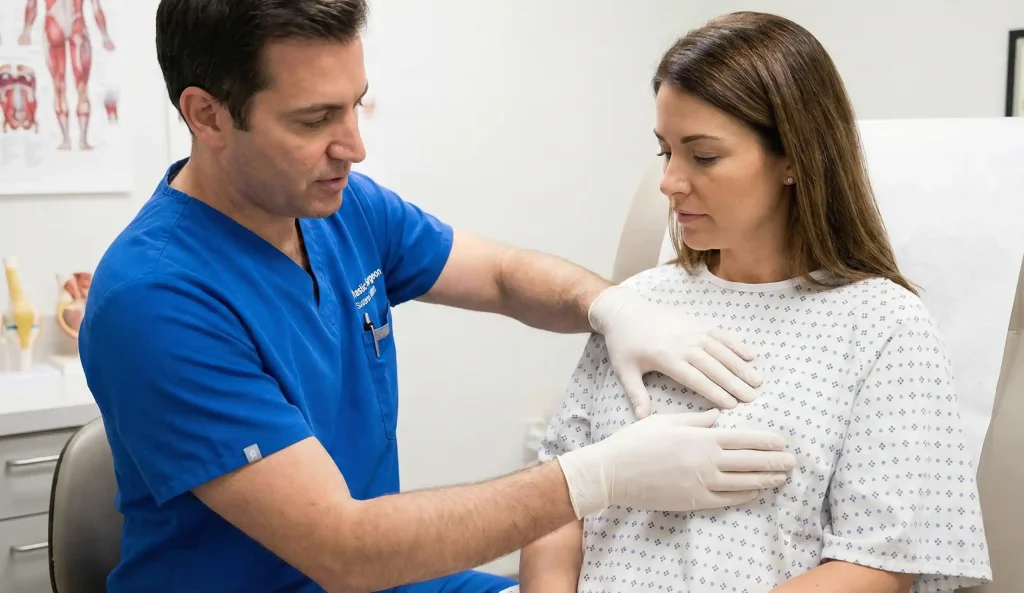
The Implant Displacement Massage ‘the squeeze’ is the most physically demanding and effective ‘workout’ for your breast pocket even though it is not a gym exercise. For your safety, you should be given the permission by your surgeon to do it (usually at about week 2 or 3).
- Technique: Take the hand on your breast to the upper pole if you are going to do one breast at a time. The other hand, which gives the support, should be placed on the fold.
- The Action: With a slow and firm downward motion of the fingers, the implant is pushed down against the ribs. This is a way of fighting the muscle since you hold the implant in the “forced down” position for 10-15 seconds and then release.
- The Frequency: Do 10-15 times, breast method, 3 times a day, is the requirement of most protocols. The pocket’s bottom is physically expanded by the mechanical pressure. It also refers to the muscle fatigue aspect, for which the body is taught the location of the implant.
Exercise 4: The Stabilizer Band “Workout”
Patients are often advised to consider the Stabilizer Band (breast band) as one of the workout tools. It is giving you a steady, light, static stretch. Figure out in what way braces function on teeth. They do not rush the teeth shoving but rather by using a gentle, continuous pressure for a few months. The band provides a steady downward pressure on top of the implant. If the band is worn (‘high and tight’), the 24-hour ‘push-down exercise’ is what you are essentially doing. Manually massaging your breasts less may be possible if you are really committed to using the band. On the other hand, if you don’t use the band then you are basically taking away the muscle spasm overcoming the force which is constant in nature.
The Role of Posture
In the end, the correction of your posture can be regarded as a simple “exercise”. As a result of the pain after surgery, one tends to fold his/her upper body and thus round the shoulders. This is exactly the time when the pectoral muscles get shortened.
Go through the experiment of Scapular Retractions: bring your shoulder blades further and lower the back. Picture your shoulder blades going into the back pockets. Doing so 20 times per hour keeps the chest open and serves as prevention of pectorals from healing in the contracted, shortened state.
Frequently Asked Questions About Dropping Exercises
Doing chest opening exercises that are passive, like the doorway stretch and foam roller extensions, are very effective to pectoral muscle relaxation as well as breast implants dropping naturally.
Absolutely not, you should never do push-ups or chest presses because when the pectoral muscle gets stronger it also gets tighter and shorter, thus it will keep the breast implants at the top and will delay the dropping process.
In case your plastic surgeon decides on displacement massage treatment, generally, you should push down on your breast implants for 5 to 10 minutes, three times a day, to physically stretch the lower implant pocket.
You are going to notice a great deal of changes within the first six weeks; however, the full “drop and fluff” of the breast implants, i.e., when they find their final permanent place, can take from three to six months.
It is a typical thing that the more dominant side (usually right) will drop slower because the pectoral muscle on that side is stronger and tighter thus, it resists the weight of the breast implants more fiercely.
Derby, L. D., & Codner, M. A. (2012). Textured silicone breast implant use in primary augmentation: Core data and review. Plastic and Reconstructive Surgery.
Bengtson, B. P. (2004). Complications, unwanted results, and revision surgery in breast augmentation. Clinics in Plastic Surgery.