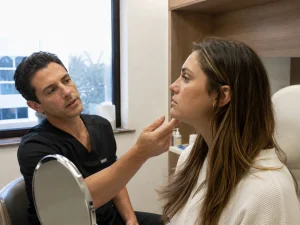
Use saline spray and avoid pressure.
The Biometrics of Post-Operative Hemostasis
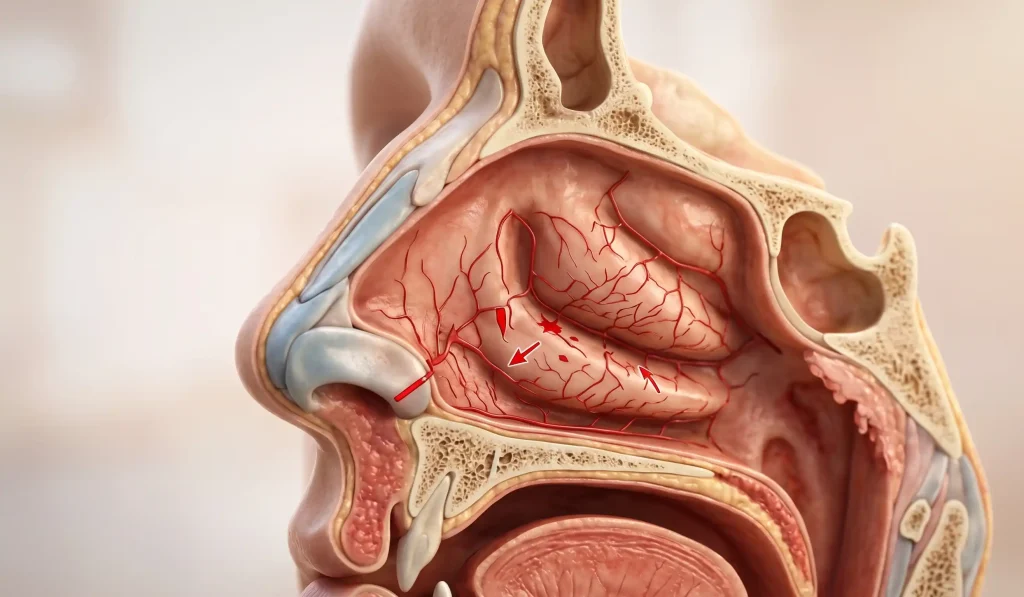
In the specialized discipline of nasal restoration, the management of the nasal mucosa and its intricate vascular network is a primary clinical priority. From a biometric perspective, a rhinoplasty involves the delicate manipulation of both the osseocartilaginous framework and the overlying soft tissue envelope. This surgical intervention temporarily disrupts the capillaries within Kiesselbach’s plexus—the highly vascularized region of the anterior septum. Consequently, minor oozing or “drip-bleeding” is a standard biometric response during the first 24 to 72 hours, reflecting the body’s initial phase of inflammatory repair.
At LIN Europe Clinic, we explain that achieving the absolute pinnacle of hemostasis requires a sophisticated understanding of localized pressure dynamics. While the internal structures are still in a state of biological balance during the immediate maturation phase, the nasal lining remains hyper-reactive. Minor nosebleeds are often a sign of the body’s systemic vitality as it redirects blood flow to the healing tissues. Nevertheless, safeguarding the structural harmony of the newly fashioned nose necessitates the patient to be in a state of “nasal stillness.”
The “45-Degree Strategy” and Localized Pressure Management

Getting surgical brilliance after a rhinoplasty mostly depends on how someone handles gravity and blood pressure inside the body. Clinically, the best biometric step to stop or avoid a nosebleed is to keep your head elevated. During the first five to seven days, it is a doctor’s instruction to keep your head raised at an angle of at least 45 degrees, even when sleeping. The position makes use of gravity to get the venous blood out and lowers the hydrostatic pressure in the nasal capillaries, thus greatly decreasing the chance of a blood vessel “leak.“
Besides elevation, dealing with the local pressure entails using the “drip pad” or mustache dressing properly. At our sanctuary, we teach that this dressing must be changed with professional care so as not to disturb the nasal tip. If a nosebleed happens, a cold compress to the bridge of the nose or the back of the neck may cause a biometric vasoconstriction reflex. This cooling effect not only decelerates the heart rate but also narrows the peripheral vessels, thereby aiding the restoration of a stable, sculpted baseline. One has to resist the urge to “pinch” the nose because this mechanical pressure can break the structural harmony of the fragile cartilage grafts and also the internal sutures.
Systemic Vitality and the Regulation of Blood Pressure
The stability of your recovery roadmap is directly influenced by your systemic health and your body’s sympathetic nervous system response. From a biometric standpoint, any increase in blood pressure—whether due to physical effort, sudden movements, or even emotional stress—can rupture the delicate, healing vessels inside the nasal cavity. That’s the reason why physical activity of a “professional level” is completely ruled out for two weeks. It is very important to refrain from lifting heavy objects, bending over, or doing any form of aggressive cardiovascular exercise in order to maintain a stable vascular environment.
At LIN Europe Clinic, we also discuss the pharmacologic biometrics of recovery. The absolute pinnacle of biological balance is attained by a complete abstinence from substances that inhibit platelet aggregation, like aspirin, NSAIDs, or certain herbal supplements such as Vitamin E and garlic. Such drugs counteract the body’s natural “plugging” mechanism, making a minor nosebleed very difficult to stop. Through prioritizing systemic vitality by means of a clean and controlled nutritional plan and keeping a calm and low-stress environment, you make sure that the surgical brilliance of the operation is protected against the internal turbulence that causes post-operative bleeding.
Environmental Biometrics: Humidity and Mucosal Integrity
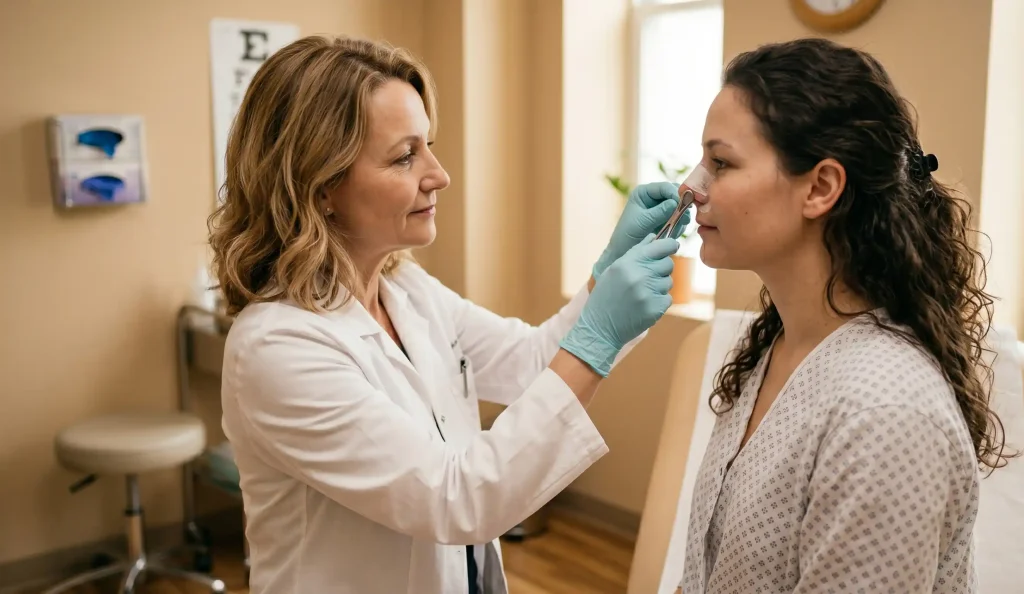
Maintaining the structural harmony of the nasal interior is a highly sensitive issue for the nasal mucosa in terms of the humidity of the air you breathe. Dry, indoor air can make the healing membranes brittle and prone to cracking, which leads to spontaneous nosebleeds during the first month of recovery. This is a common biometric problem that can be controlled by the use of medical innovations, such as saline sprays and room humidifiers.
At LIN Europe Clinic, we have a very detailed plan for the hydration of the mucosa. The use of a mild saline spray that is pH-balanced will help to keep the internal biometrics of the nose soft, thereby preventing the development of hard crusts that, once dislodged, trigger bleeding. In addition, keeping a firm focus on hydration not only from the outside but also from the inside contributes to sustaining an elastic dermal matrix. By maintaining a moist and stable environment for the nasal lining, you welcome faster cellular remodeling and guarantee a comfortable transition to a fully matured and symmetrical profile.
Rhinoplasty in Turkey
Choosing LIN Europe Clinic means entering a global sanctuary where the complexities of facial architecture and vascular biology are managed with elite clinical mastery. We see that the path to a polished, radiant appearance is a very sensitive transformational period that demands flawless precision in both the surgical technique and the aftercare management. The location of At LIN Europe Clinic is a hallmark of surgical brilliance, offering a luxurious setting where every aspect of your recovery is carefully planned to yield stable and symmetric results that are in line with your systemic health.
When you choose LIN Europe Clinic, you are entrusting your medical care to a system that combines anatomical science and patient-centered safety in the best possible way. We oversee your transition with professional care, giving you the high-definition instructions needed to deal with any biometric changes during the healing period. Take advantage of the elegant, natural care of At LIN Europe Clinic and get a profile that is the epitome of biological balance. Your path to a refined, functional, and confident appearance is handled with absolute precision right in the heart of Turkey, making sure that your results are not only stable but also breathtaking.
FAQ:
A slight amount of bleeding is considered normal up to 48 hours after surgery. This small discharge is one of the signs of the healing process right after surgery.
So, you should be sitting with your upper body straight, and tilt your head down a little bit, keeping it elevated at the same time. This way, blood will not flow down to the throat, and at the same time, nasal pressure will be lessened.
You can place an ice pack on your forehead or neck as it will help the blood vessels to get narrower. However, this is a way of stabilizing blood vessels without putting direct pressure on the nose.
No, it is forbidden to blow your nose during the first three weeks. The power of blowing could damage your grafts in such a way that it would set the campaign of their destruction in motion as the structural disarray would be severe.
If the bleeding is severe or you are unable to stop it after 15 minutes, give us a call. This is for the rare occurrence of a vascular incident, and we want to make sure that your systemic health is professionally taken care of.
Tebbetts, J. B. (2002). Systemic Vitality and Surgical Precision in Nasal Procedures. Saunders Elsevier.
Gunter, J. P., et al. (2002). Dallas Rhinoplasty: Nasal Surgery by the Masters. Quality Medical Publishing.
Janis, J. E., et al. (2005). Nasal Anatomy and Biometrics: Implications for Post-Operative Hemostasis. Plastic and Reconstructive Surgery.
Nahai, F. (2011). The Art of Aesthetic Surgery: Principles and Professional Rigor in Rhinoplasty. Quality Medical Publishing.
Stuzin, J. M. (2008). Biological Balance and Medical Innovation in Facial Restoration. Plastic and Reconstructive Surgery.