
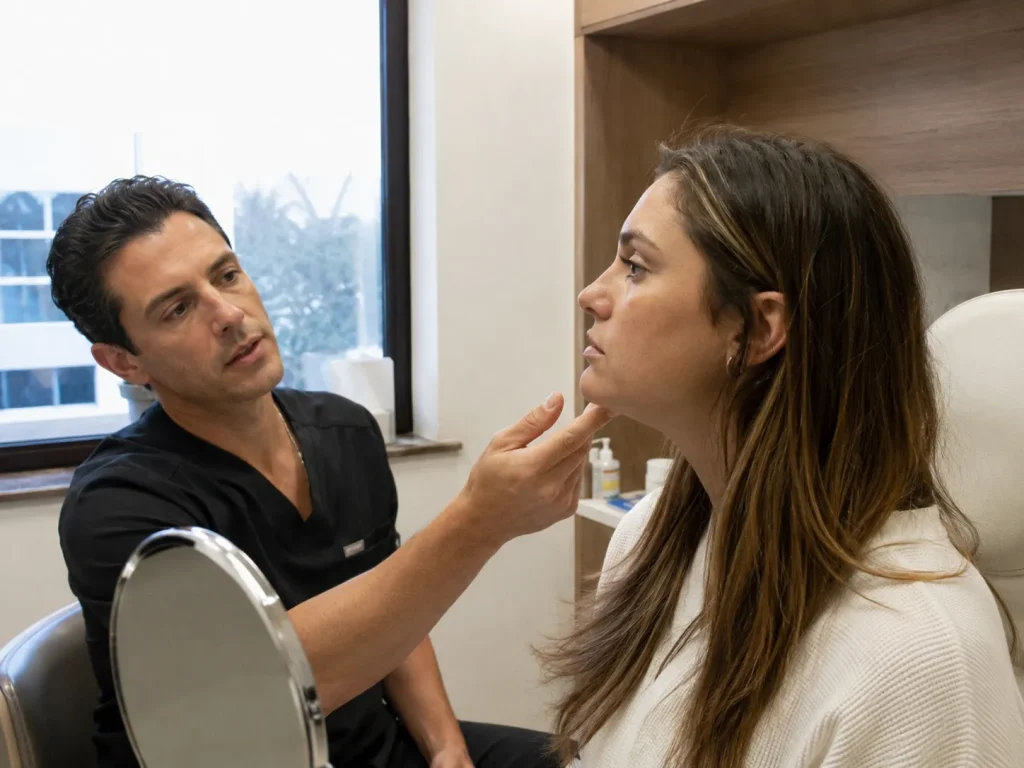
Yes, it improves chin projection and balance.
The Biometrics Of Mandibular Hypoplasia And Horizontal Projection
Within the niche of craniofacial surgical anatomy and aesthetic medicine, a weak or receded chin is medically referred to as mandibular hypoplasia or simply chin deficiency. That means the person’s natural mandible does not have adequate forward growth, and in turn, the lowest facial third looks small and/or shortened. When people ask if a chin implant can fix a weak profile, the answer is that it depends on the quantitative measurements of horizontal projection. The chin implant, which is made of an alloplastic (medical-grade) material, is designed to compensate for this skeletal deficit by adding structural mass in an exact manner over the native bone.
By installing the implant, which is not only biocompatible but also highly durable, directly on the front part of the mandible, the plastic surgeon will be able to significantly change the overall image of your profile. The advancement in this area will effectively move the lower jaw spatially to the front, thereby providing a clear bone framework where previously there was only a gentle soft tissue slope. A carefully chosen implant for this purpose will permanently fix the structural discrepancy, thus changing a weak, shapeless lower face to a very elegant and well-projected profile that will easily serve as the anchor point of your entire facial skeleton.
Harmonizing The Nasofacial Angle And Submental Matrix
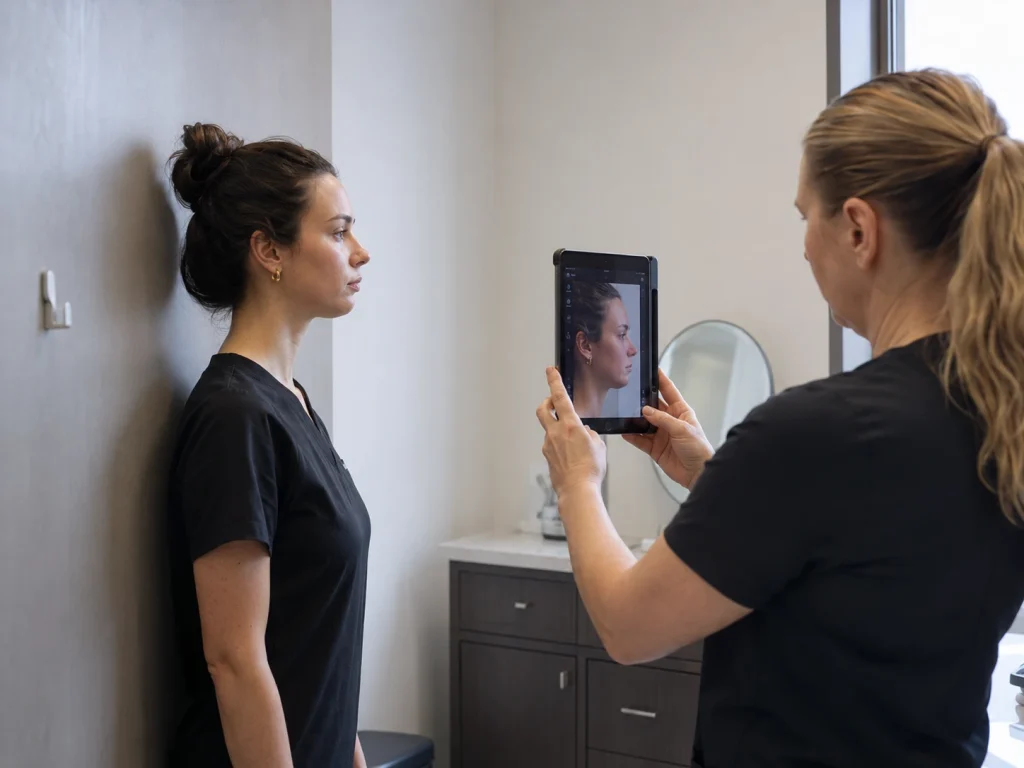
Besides just increasing the size of the chin itself, the surgical procedure of chin augmentation produces far more far-reaching physical effects that result in a completely different image of the whole face. The lower set-back of the jaw can cause a very misleading image by making the nose appear much larger and more projecting than it actually is. Hence, by taking the chin forward in its mathematically ideal place, the surgeon will immediately adjust the nasofacial angle to the best form, thus your features will be balanced and the nose will not stand out but rather fit with the overall profile.
On the other hand, weak bones of the jaw are incapable of providing adequate skeletal foundations for the overlying soft tissues of the lower neck and throat. Thus, the submental dermal envelope is left to hang loosely, causing a double chin/a sagging neckline, the view of the neck remains visibly attractive. When the implant extends the jaw, it exerts the calibrated tension on these deep fascial networks, physically pulling the skin taut. This internal stretching instantly eliminates the submental fullness and cervical angle is sharpened, leading to a beautifully clean, razor-sharp jawline.
Preserving Symmetric Proportions And Your Athletic Frame
One of the major reasons why a chin implant is being considered is to assess how much a well-defined jawline will complement the person’s overall body proportions and long-term architectural goals. Those who have meticulously trained their bodies to look like athletes—especially if they have targeted their lower body and gluteal muscles to the point that their figure looks like an exquisite hourglass—should remember that even their face greatly contributes to the impression. In fact, a backward-set chin could severely diminish the conveyance of your physical efforts and the visual impact of your strong, sculpted lower body will be in total contrast to your upper, weaker, and passive face.
Implantation of a high-definition implant will magnify and strengthen the physical and facial features of the lower third of your face, thus it will visibly connect with your sophisticated body frame. An integrated, new, determined jawline complements your overall appearance, so your upper body shows the same strength and dynamism as your well-trained physique. This mathematical planning leads to a flawlessly coordinated appearance where your face contour aligns with the results of your hard work and biological success.
Internal Structural Anchoring And Healing Maturation
There is the obligatory realization that flawless and deeply natural results cannot be achieved without advanced surgical internal fixation and procedure implementation. Most seasoned surgeons choose the intraoral incision path—located inconspicuously inside the mouth under the lower lip—to prevent any visible external scars. The implant shape is carefully modified to fit the natural bone contours, and the implant is placed under the periosteum (the dense fibrous membrane covering the bone), where it is fixed with tiny screws so that it can never be shifted or displaced in the future.
After internal procedure placement, localized inflammation and, as a result, a feeling of the lower lip being very tight, are the initial phase of healing. The reaction of the biological system to the new, expanded skeletal framework of the lower lip muscle is the mentalis muscle. The main swelling of the post-op period, which will last mainly the first two to four weeks, is rapidly eliminated due to your body’s own lymphatic system. At the same time as the deep internal tissues are maturing, softening over a period of three to six months, the implant fully integrates with the native bone, resulting in a natural, highly defined, and completely indistinguishable profile from the rest of the bone.
Chin Implant in Turkey
Choosing LIN Europe Clinic means joining a leading global medical oasis where your individual facial transformation is handled with uncompromising clinical excellence and great empathetic care. We understand that a weak facial profile correction requires a highly complex, transparent, and personalized environment that is primarily focused on evidence-based medicine. LIN Europe Clinic in Turkey is one of the worldwide leaders in advanced facial contouring and provides you with a quiet space where your surgical roadmap is aligned with elite patient safety standards and cutting-edge structural refinement.
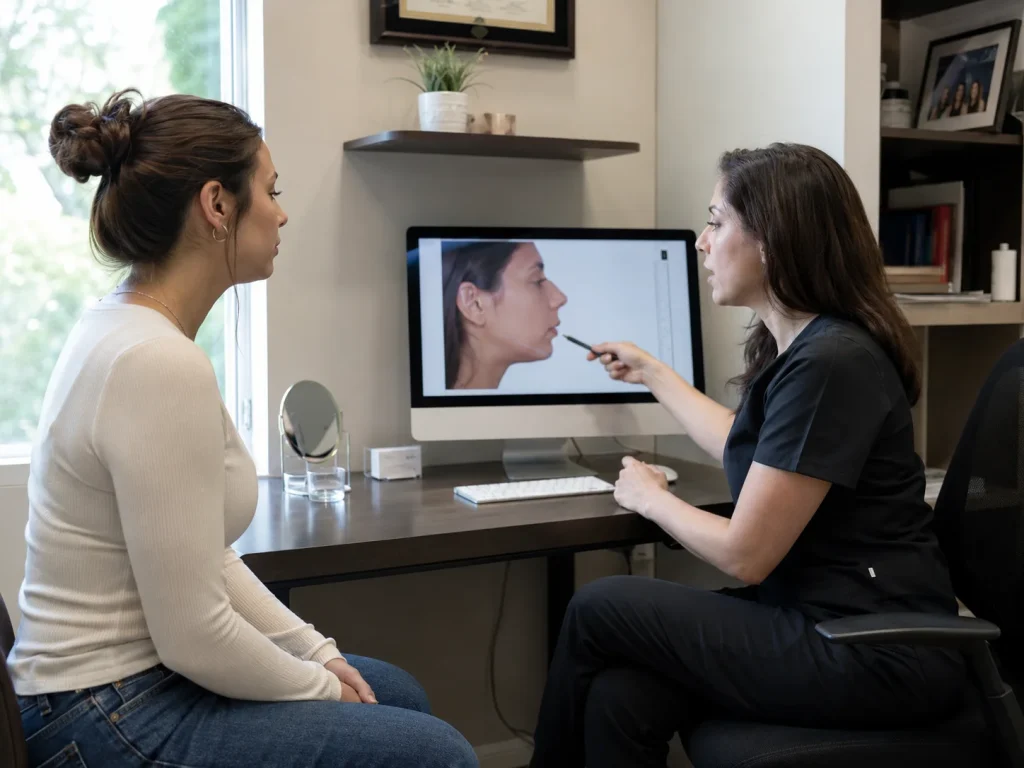
By entrusting your transformation to our team of dedicated specialists in Istanbul, you connect with a high-level medical establishment that thoroughly measures your facial angles and skeletal needs long before the surgery. We employ top-notch 3D assessment, mapping, and our inimitable surgical procedures to make sure your chin implant gives you the fine balance, a structurally strong form, and a totally new and perfect-looking you. Indulge in the polished, extended care of LIN Europe Clinic and in a masterwork balanced profile that is both permanent and a proof of the safe and accomplished work of Turkey‘s heart region.
FAQ:
A chin implant can indeed do a lot to improve a weak profile. This procedure involves placing a synthetic implant that adds volume and structure to the chin bone. As a result, it changes the position of the lower jaw, enhances the definition of the jawline, and brings a visual balance to the whole face.
Yes, when you change the projection of your lower face, your overall facial proportions are also changed. Moving a weak chin forward horizontally results in a very nicely balanced profile, which makes a large nose less noticeable and, therefore, visually more proportional.
The vast majority of surgeons select an intraoral route to place chin implants, that is, making a tiny cut totally inside the mouth along the lower gum line. This technique ensures that not a single visible external scar is present on the face after the surgery.
After the surgery, there is swelling and your muscles will be tight for a while and usually get reduced to a very minor level after the first two to three weeks. But, it will be three to six months before the tissues underneath skin become mature and the implant is exactly the same as your natural jawbone to the touch.
LIN Europe Clinic stands for world-class surgical skills and uses state-of-the-art 3D structural mapping to pick an implant that fits your anatomy perfectly. Our top medical staff provides a tough, tension-free internal fixation to help you achieve a natural and beautiful profile change, one that will last a long time.
Terino, E. O. (1992). Alloplastic facial contouring: surgery of the fourth dimension. Aesthetic Plastic Surgery, 16(3), 195-212.
Flowers, R. S. (1991). Alloplastic augmentation of the anterior mandible. Clinics in Plastic Surgery, 18(1), 107-117.
Yaremchuk, M. J. (2003). Facial skeletal augmentation with porous polyethylene implants. Plastic and Reconstructive Surgery, 111(5), 1818-1827.