

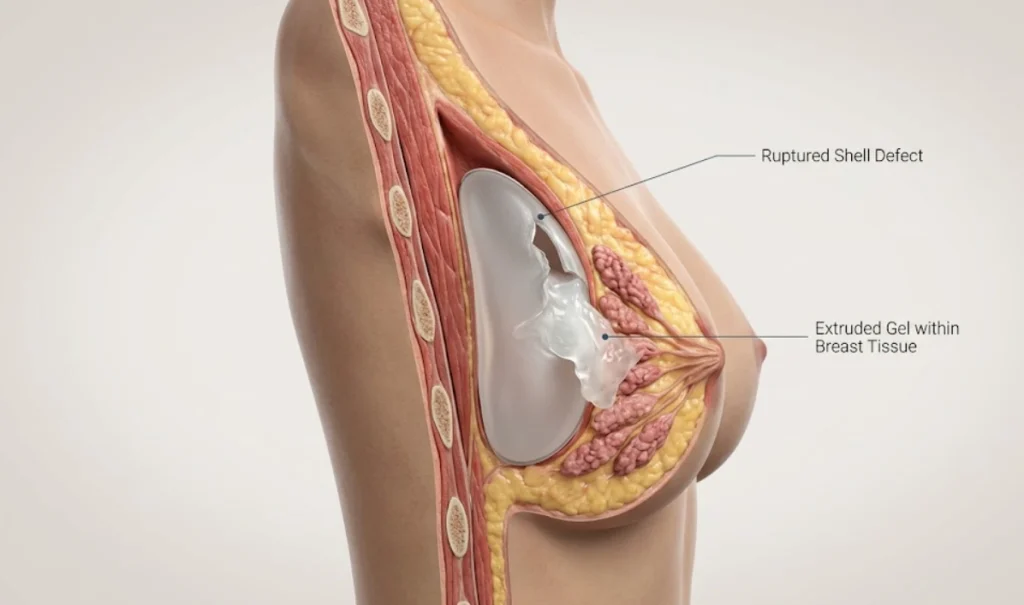
Ruptures are often painless and silent.
The Biometrics of Cohesive Silicone Gel and Silent Ruptures
When it comes to the highly specialized area of body architecture and aesthetic medicine, knowledge of the physical properties of medical devices is a critical factor for the long-term safety of patients. A common and quite rational worry of our clients is whether they will experience pain if the implant shell is ruptured. According to clinical evidence, in fact, ruptures of most modern breast implants are not accompanied by any serious pain at all. This type of rupture is sometimes called a silent rupture in medicine. This can be explained by the fact that the advanced cohesive silicone gel used in nowadays plastic surgeries has no running or spreading properties as do liquids; therefore, the nearby sensory nerves are not brought into action immediately after a volume change is felt.
Older versions of implants, especially liquid saline types, would deflate instantly once ruptured, leading to a dramatic and sometimes physically uncomfortable change of the breast envelope. Meanwhile, the gels widely used today, such as those termed ‘gummy bear’ implants, continue to hold their exact anatomical shape even if the outward elastomer shell has a very tiny tear or a larger mechanical fracture, according to the manufacturers. Since the gel is still contained within the surgical pocket and the nerve endings are not irritated, it is possible for patients to remain pain-free for years and to not realize that a failure has occurred in the structure of the implant.
Tissue Inflammation and Capsular Contracture Symptoms

Even though the very first microscopic crack that happens in the silicone shell is completely painless, the body, after a while, finds that the cohesive gel has been exposed to the native biological environment. The immune cells may, over a very long time period, start a localized low-level inflammatory reaction, trying to separate the exposed silicone matrix. In the end, this biological delayed reaction might give rise to a condition called capsular contracture in which the natural scar tissue envelope that forms around the implant thickens, tightens, and contracts in an aggressive manner.
It is this secondary physiological response and not the rupture that will eventually produce the feeling of physical pain, alert the patient to a problem, and drive them towards seeking a solution. When the capsule constricts, the breast might feel quite hard, and the patient could feel a continuous dull pain or a sharp sensation when moving. Moreover, this aggressive tissue contraction results in a distorted appearance, which, among other things, includes the breast being positioned very high on the chest wall or losing its natural slope; thus, the whole structural harmony of the person is disrupted.
High-Definition Diagnostics and Routine Clinical Monitoring
Since painful symptoms are not generally associated with ruptured cohesive silicone implants, these types of implant failures also do not lead to a sudden volume loss in the breasts. Because of this, the best and only sure way of determining one’s overall health and well-being is indeed through consistent and regular check-ups. Just based on symptoms and physical exams, it will be very difficult to find small implant shell defects. Medical boards around the world have issued strong recommendations that patients should have imaging performed to determine if there are breaches in the implant shell, making sure that any microscopic wear will be detected long before it leads to tissue inflammation.
To obtain these low levels of diagnostic precision, the best among elite health care providers lean towards breast ultrasounds with a very high resolution or magnetic resonance imaging. These two sophisticated methods are able to literally look through a woman’s natural breast tissue to know exactly what is the condition of the silicone elastomer shell and the capsule. It is usually advised that you get your first diagnostic examination five to seven years following the initial operation and then have regular visits every two to three years so that your investment in aesthetics remains well protected and life-wise sound.
Preserving Athletic Proportions and Upper Body Symmetry
For those who put a lot of effort into shaping their bodies, especially if they focus on the lower body’s growth and maintain the upper part of the body in a slender and streamlined manner, one of the things they should do is to make sure that their implant symmetries are also well preserved. An unnoticed breast implant rupture, which leads to capsular contracture, can completely ruin the beautiful, feminine curves of an athletic body. In fact, as the scar tissue tightens, it can pull the breast into such a distorted and unnatural position that it becomes a very visible asymmetry that stands out in contrast to the patient’s mostly well-developed lower body proportions.
Aside from the visual issue, the pulling sensation and the corresponding dull throb that come along with the tight capsule can have a very disabling effect in terms of sports engagements and overall upper body mobility. The tension that the mechanical forces exert on the chest wall can make one alter his/her natural position and posture, which when continued unconsciously, leads to the secondary strains of muscles in the back and shoulders. By keeping a close eye on your implants and taking care of any silent rupture before the contracture has gone too far, you are actually doing a great job in preserving your beautiful and balanced aesthetic as well as your physical functionality, which is not impacted in any negative way.
Breast Implants in Turkey
When you opt for the services of LIN Europe Clinic, you are going to a world-class medical oasis where your physical health for a long period of time and beauty will be kept face-to-face with clinical experts without any compromise. We understand that augmentation of breasts is like a lifetime architectural partnership that needs a very advanced interaction with the assisted initial surgery to be maintained not only for a few years but also for the decades that follow.
Located in Turkey, our newly built, precious medical facility is one of the greatest body contouring and diagnostic excellence centers in the world, working with very strict evidence-based guidelines in a highly transparent manner. As a member of the professional community in Istanbul and by choosing to place your confidence in our team of specialists, you are also betting on a great medical system that continually engages in the routine monitoring and preemptive management of tissue. We are making use of top-notch diagnostic imaging and the latest revision techniques in order to ensure that your augmentation is in perfect harmony with beauty and that it is structurally safe throughout your entire life.
Visit LIN Europe Clinic and see for yourself how the top-notch team of experts masterfully provides you with reliable and complete assistance. With their help, you will be able to maintain a beautifully balanced profile consistently reflecting the highest level of biological success, safely and expertly reached in the very heart of Turkey.
FAQ:
Generally, a rupture of a silicone implant nowadays is actually not accompanied by any pain at all. That’s why they are often called silent ruptures – because even though there is a gel leak, the gel remains within the shell and thus does not trigger any nerve reaction.
Due to the scarcity of pain in most cases, advanced imaging tests are the only reliable method for rupture detection. To visualize the tiny rupture, a high-definition ultrasound or magnetic resonance imaging (MRI) scan is necessary according to clinical guidelines.
An ignored rupture can eventually fool your immune system into producing fibrous scar tissue layers. This delayed and undesired immune response is the underlying cause of capsular contracture, where the breast becomes not only firm but also painful.
There is no imminent danger to your life if a silicone implant ruptures. In fact, you can take your time and plan a safe, non-urgent surgical removal and replacement of the implant, as well as thorough cleaning of the tissue pocket.
The experts’ opinion is that you should arrange your very first scan for implant check-up only five to seven years post your initial surgery. Further to this primary inspection, you are supposed to undertake regular scans every two to three years for the monitoring of implant safety on a long-term basis.
Hölmich, L. R., et al. (2001). Incidence of silicone breast implant rupture. Archives of Surgery, 138(7), 801-806.
Brown, S. L., et al. (2000). Silicone gel breast implant rupture, extracapsular silicone, and health status in a population of women. The Journal of Rheumatology, 28(5), 996-1003.
Maxwell, G. P., & Gabriel, A. (2014). The evolution of breast implants. Plastic and Reconstructive Surgery, 134(1 Suppl), 12S-17S.
McGuire, P., Reisman, N. R., & Murphy, D. K. (2019). Risk Factor Analysis for Capsular Contracture, Malposition, and Late Seroma in Subjects Receiving Natrelle 410 Form-Stable Silicone Breast Implants. Plastic and Reconstructive Surgery, 143(1), 9-19.