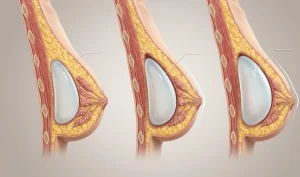
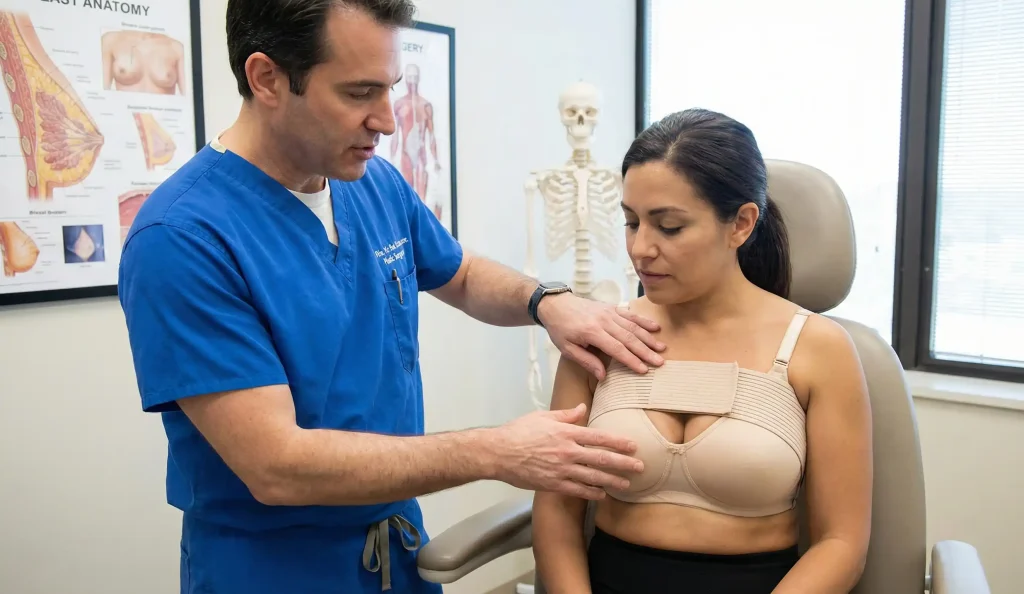
It keep implants in the correct position while healing.
Out of all the post-operative instructions that we provide at Lin Europe Clinic, doing the “Stabilizer Band” (also called compression strap or breast band) is the one that our patients universally dislike the most.
They often complain to us about the band being itchy, uncomfortable, causing an unflattering bulge under the clothes, and ruining the look of their new and expensive sports bra. “Can I please take this thing off?” is the question we get a lot. Unfortunately, the answer is a definite no. Even though it may seem like a hassle, this simple piece of elastic is probably the most important implement for the final shaping of your breasts.
It is good to remember that the surgery is the “building” stage and the stabilizer band is the “setting” stage. Just like concrete needs a mold to keep its shape till it dries, your breast implants need to be guided while your internal tissues heal. The band resists the body’s natural tendency to push the implants up, thus ensuring that the implants will acquire the natural, teardrop shape you want rather than being stuck on top of your chest.
The Enemy: The Pectoralis Muscle

In order to understand why the band is a medical necessity, you have to understand the anatomy of a Sub-Muscular (Dual Plane) breast augmentation. When placing the implant under the pectoralis major muscle, we are basically stretching a muscle that has been lying flat against your ribs for your whole life. One of the things a muscle does naturally is that when it is stretched or irritated, it spasms and contracts.
The pectoralis muscle is the one which exerts the force upward naturally, hence it pulls up towards the shoulder and collarbone. So, during the first few weeks post-operative, the chest muscles will be constantly working to push the implants up into the armpit or crook of the collarbone area. The stabilizer band helps to fight this enormously strong muscle by exerting a mechanical force in the opposite direction. The band keeps pressing down on the upper part of the breast surface, thus completely neutralizing the muscle’s upward pull and making the implant remain in the pocket until the muscle relaxes and the problem object is accepted.
Dropping and Fluffing
It is quite usual that immediately after surgery the lower part of your breast skin is tight and restricted. The stabilizer band helps to release the tightness and allow the skin to “drop” and “fluff”.
The band aids this process by depressing the implant into the skin, which, as mentioned earlier, is tight and therefore comprises the lower part of your breasts. This unceasing force causes the skin to get bigger and rounder. The absence of the band will most probably mean the implant going high and the lower part of the breast remaining flat, plus empty. In essence, the band is like a mold that guides the implant to open up the lower part of the breast and thus make the much-desired curve at the bottom behind the breast and the natural slope that are indications of a masterpiece result.
Vital Part in Capsule Formation
Besides muscle memory, the band also has a very essential part to play in the formation of internal scar tissue. Within the first few days and for a few weeks, your body forms a “capsule” of scar tissue around the foreign object (implant) after any surgery. The stabilizer band guarantees that the capsule will be created with the implant in the correct, lower position. The assistant of the muscle to the implant towards a higher position during this critical time will result in the capsule forming at the elevated place around the implant. When the formation solidifies, it secures the implant in that ” fake”, high position forever. Then the band concludes its uselessness and only a surgical operation can unfasten the capsule.
Addressing Asymmetry and Risks of High-Riding

The band can also be used to tidy up early asymmetry after work. Generally, one breast returns to a drop position slower than the other, primarily when the pectoral muscle of your dominant side (for instance, the right side of a right-handed person) is stronger and tighter. When a person refuses to wear the band, in such a case, the stronger muscle can pull one implant so high that the breasts end up uneven. Consistent use of the band is a good way to make friends. You bring the most dominant, thus, the toughest muscle to the state of rest by handing it over; hence, both breasts will be even in the end.
Without such treatment, you become vulnerable to High-Riding Implants, resulting in a “bolted-on” or a masculine look where the nipple is facing downward (snoopy nose deformity). A few weeks of wearing the band looks like a minor inconvenience that hardly can be compared to the cost, agony, and downtime of a revision surgery for lowering the pockets manually.
Proper Positioning and Wearing Time
Wearing the band is of no use if the implants are displaced sideways because you were wearing it incorrectly. The band has to be positioned high and tight, running under the armpits and fastening above the breasts like a shelf. The breasts should feel like they are being pushed down rather than smashed in. Giving a slight skin mark can be said to be one of the signs of the right tightness level, but it should not be so tight that it will cut off the blood flow or cause severe pain.
Our usual protocol at Lin Europe Clinic is that the band has to be worn 24/7 for the first 2 to 4 weeks with the only exception of shower time. Post the first month, it is our frequent recommendation for the patients to wear the band only at night for another 2 to 4 weeks. This schedule is tailored according to the muscle relaxation speed. In case of a fast implant drop, the band will be discontinued early as it is to prevent the implant from dropping too low; if stubborn muscles, the band duration will be extended.
Frequently Asked Questions About the Stabilizer Band
The stabilizer band keeps constant pressure downwards on the breast implants so they cannot move up toward the collarbone. This external force makes the implants go down, thereby giving the breasts a natural look.
Usually, the patients are advised to wear the stabilizer band both day and night for the first month so that their breasts can settle properly. Later on, doctors typically permit the patients to wear it just at night for another month.
You should put the stabilizer band at the lower edge of the upper chest line to make sure that your breast implants are pushed down gently. It should be tight enough to cause a shelf, but not too tight to prevent breathing.
A chest binder should never be used as it does not target breasts only but applies compression to the entire chest equally, which can either flatten or displace breast implants. In order to get the proper shaping, you should only use the surgical bra and stabilizing band that have been prescribed.
Failure to rub your breast implants as per the doctor’s instructions might lead to the development of hardened tissue that tightly surrounds your indistinguishable from smooth breast implants. The regular movement of the pocket ensures that the results remain soft, natural and the pocket stays open.
Derby, L. D., & Codner, M. A. (2012). Textured silicone breast implant use in primary augmentation: Core data and review. Plastic and Reconstructive Surgery.
Bengtson, B. P. (2004). Complications, unwanted results, and revision surgery in breast augmentation. Clinics in Plastic Surgery.