Yes, if follicles are permanently damaged.
The Biometrics of Traction-Induced Follicular Damage
In the area of hair restoration, traction alopecia is understood as a unique form of hair loss that occurs when hair strands are traumatically pulled so that the follicle is damaged, leading to the loss of the hair. Often, the reason why the hair suffers this type of damage is tight hairstyles such as braids, buns, and extensions. From a biometric point of view, the tension that is kept for a long time causes “follicular miniaturization” and eventually leads to scarring (cicatricial alopecia). Continuous tension blocks the circulation and the overall health of the scalp, so that at a certain stage, the follicles are totally incapable of generating healthy hair.
At Lin Health Europe Clinic, we approach traction alopecia as a realignment problem. Unlike hereditary hair loss, which is systemic, traction alopecia is local and usually the hairline and temples are the areas that suffer the effects most. Our expert team in Istanbul uses clinical mastery to assess the stage of the hair loss to see if it has become “permanent.” If the follicles have been substituted by scar tissue, then the hair transplant is the highest level of medical intervention that can restore to you the structural harmony of your body.
Surgical Brilliance: Restoring the Hairline with FUE and DHI
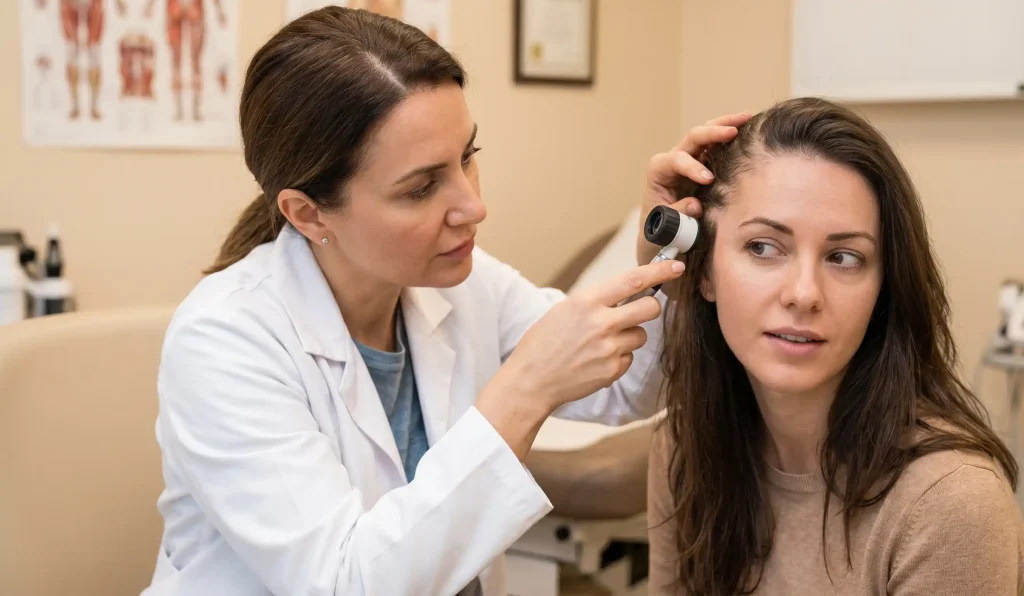
The main concern of many people is whether the scar tissue generated by traction alopecia is capable of supporting new hair growth. What makes hair transplant possible in such cases is the surgical brilliance of the surgeon. Thanks to the most recent techniques, such as FUE (Follicular Unit Extraction) or DHI (Direct Hair Implantation), we take the healthy follicles that are resistant to tension from the donor area and transplant them to the sites of the appearance of female pattern hair loss or male pattern baldness. On top of that, the follicle that we transplant comes from the back of the scalp, which is a region not affected by the tension before, so the follicle will maintain its original biological strength.
The professional rigor exercised both in Lin Health Europe Clinic and Turkey ensures that the recipient sites will be planned with the highest accuracy. Our medical staff in Istanbul adopts medical innovation to produce a high-definition density that is the natural hairline distribution. When you control the depth and angle of each hair follicle tip to a minute degree, the new hair will blend perfectly with the old one, and structural harmony can be restored even after a long period of mechanical stress.
High-Definition Design and Structural Harmony
When treating traction alopecia, simply putting hair in the holes doesn’t really constitute the restoration. Also, the hairline is the greatest biometric indicator of the face; its design requires a thorough understanding of facial proportions. So to get a high-definition appearance, the surgeon should recreate the “transition zone”—the hairline’s front edge that is soft and irregular—which should not look artificial and “pluggy” at all.
We perform a clinical mastery at Lin Health Europe Clinic to create a hairline that corresponds to your own facial biometrics. A structural harmony is the top priority in our hair restoration, so we first make sure that hair density is the highest where hair loss was the most severe, while at the same time, the hair is getting rarer naturally as it reaches the forehead. This surgical brilliance allows you to style your hair freely, giving a stable and lasting silhouette that highlights your natural beauty and restores systemic vitality.
Professional Rigor: Ensuring the Cause Is Corrected
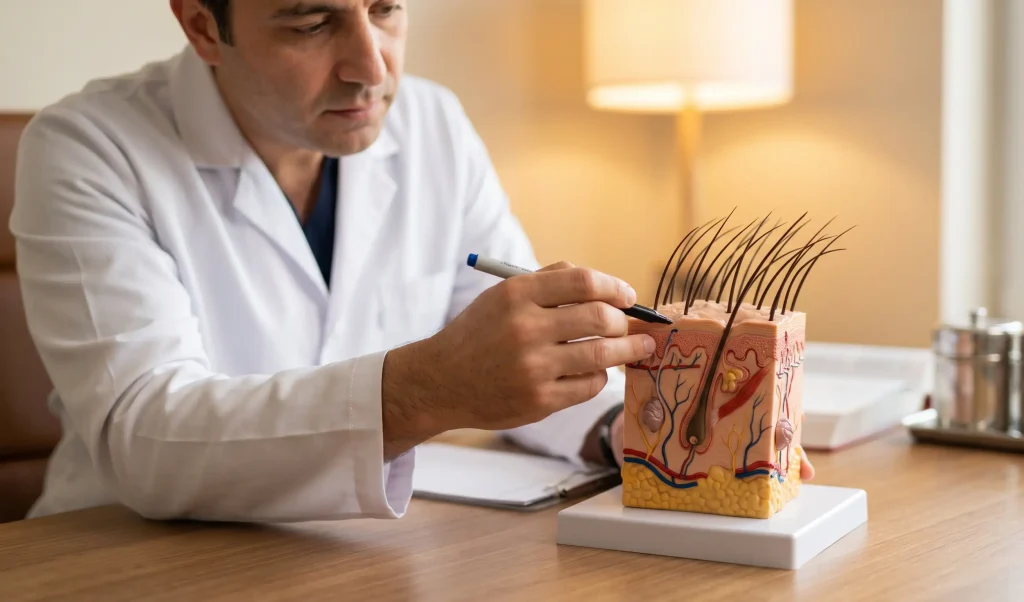
To reach the peak of results, one must maintain professional rigor before as well as after the procedure. Damages caused by a hair transplant operation for traction alopecia can be repaired, but a hair transplant operation cannot prevent further damage if the root cause—the tension—remains. Our distinguished team during the pre-operation phase in Istanbul double-checks and makes sure that the patient has changed his/her hair habits in line with the systemic health of existing and new follicles.
After the transplant, utmost care must be given to the new follicles. We offer our international patients a detailed and well-structured post-op care guide so that they understand how to keep off from any tension-inducing hairstyles for a few months. This medical innovation-based post-operative care is the key to the success and full maturity of grafts. By safeguarding the structural harmony of your scalp within the first year, you can rest assured that your high-definition results will be lasting and healthy for the rest of your life.
Hair Transplant in Turkey
Choosing Lin Health Europe Clinic for your restoration process is to choose a global hub of safety and quality work. Our center in Turkey not only leads in medical innovation, but it is also the place where procedures are based on the highest safety standards that are JCI-accredited. We realize how much of a ticklish problem traction alopecia can be emotionally, and we take on your treatment process with full clinical mastery and compassion.
By entrusting your needs to our clinic in Istanbul, you choose a health care setting that is both technically and biologically proficient in the field of hair restoration. Using surgical brilliance, our qualified team will ensure your progress to a thicker, younger-looking hairline with professional rigor. Throughout your time in Istanbul, you get to experience the detailed care of Lin Health Europe Clinic, which is the epitome of aesthetic and biological balance. With precision in the heart of Turkey, your path to a renewed, high-definition look is well taken care of.
FAQ:
Yes, transplant moves healthy follicles to the places that are thinned out because of the tension. If these follicles become structurally compatible with the scalp, then they will grow forever, after the original cause of tension is removed.
If more than a year has passed since you stopped doing tight hairstyles and hair has still not regrown in one area, then the biometrics indicate that the hair follicles have probably been replaced with scar tissue. Our clinical expertise in Istanbul can determine this through a high definition analysis.
FUE or DHI, the surgical techniques, do not change, but here, we are primarily concerned with high restoration of hairline. We work with utmost professionalism to ensure the survival of grafts even in scarred areas.
After 3 months, you will have the earliest indication of growth. Full high-definition volume and structural balance will be reached by 12 months. This is the natural timeline of follicle growth.
Turkey is one of the leading cities in the world in terms of the medical innovations made in hair restoration. At Lin Health Europe, we not only provide you with this professional level of hair restoration but also a luxury sanctuary experience to make sure that your journey will be stable, successful, and life-changing.
Unger, W. P., and Shapiro, R. (2010). Hair Restoration Surgery: Biometrics and Procedural Mastery. Informa Healthcare.
Bernstein, R. M., and Rassman, W. R. (2002). Follicular Unit Extraction: Achieving Structural Harmony and Graft Security. Dermatologic Surgery.
Tebbetts, J. B. (2002). Systemic Vitality and Surgical Precision in Regenerative Procedures. Saunders Elsevier.
Janis, J. E., et al. (2005). Scalp Anatomy and Biometrics: Implications for Traction Alopecia Restoration. Plastic and Reconstructive Surgery.
Callender, V. D., et al. (2014). Traction Alopecia: The Role of Professional Rigor and Clinical Mastery in Treatment. Dermatologic Clinics.