
Hardness occurs when scar tissue tightens around the implant.
You’ve done all the necessary research, picked the size that suits you, and even had the operation done. During the first few months, everything looks perfect. Your breasts have a nice, soft, round shape, and are healing well. However, gradually, you realize something is changing. One breast feels firmer and firmer, and eventually, it can be hard, and even the form can change or it can get lifted. So, you’ve met the nightmare of breast enhancement: Capsular Contracture.
The first source of fear is always the unknown, that is why at Lin Europe Clinic, we want to share our knowledge so fear won’t rule you anymore.Capsular Contracture is the leading cause for re-operation in breast augmentation but it is not an unknown phenomenon. It is merely a biological reaction which we can explain, prevent and correct. The main thing is to get to the bottom of why the body is reacting like this, and you will be safe that your breast will stay soft and very natural for a long time.
The Body’s Natural Defense: The Capsule
The concept of the “capsule” is essential to grasp before moving on to how the contracture happens. When a foreign object is implanted in the body, the body immediately identifies it as “not self”. Since it is not possible to digest the silicone implant or to get rid of it by pushing it out, the body decides to isolate it. To achieve this, it produces a layer of collagen fibers and wraps the implant with it so that the implant becomes separated from the rest of your tissues. The living envelope of scar tissue that constitutes this layer is called the capsule. In a healthy augmentation, the capsule is very thin and pliable. Actually, it is good for the implant as it aids to hold it in position and prevents it from sliding. Each patient has a capsule; it is a natural and necessary part of healing.
When Good Healing Goes Bad: The Squeeze
Capsular Contracture is the excessive production and the over-accumulation of scar tissues, how the body in this case is producing too much of its natural wall around the implant, thus making this wound scar to become thick and hard over time. The implant is softly squished, since the scar tissue hardens and the implant is compressed, the implant becomes a hard ball. It may be more obvious in a few ways: the implant is more high up in the chest, looking distorted, and in some very bad cases, becomes painful when touched. It is not a defect in the implant; in fact, it is the problem with the space where the implant lives.
The 4 Stages of Hardness (The Baker Scale)
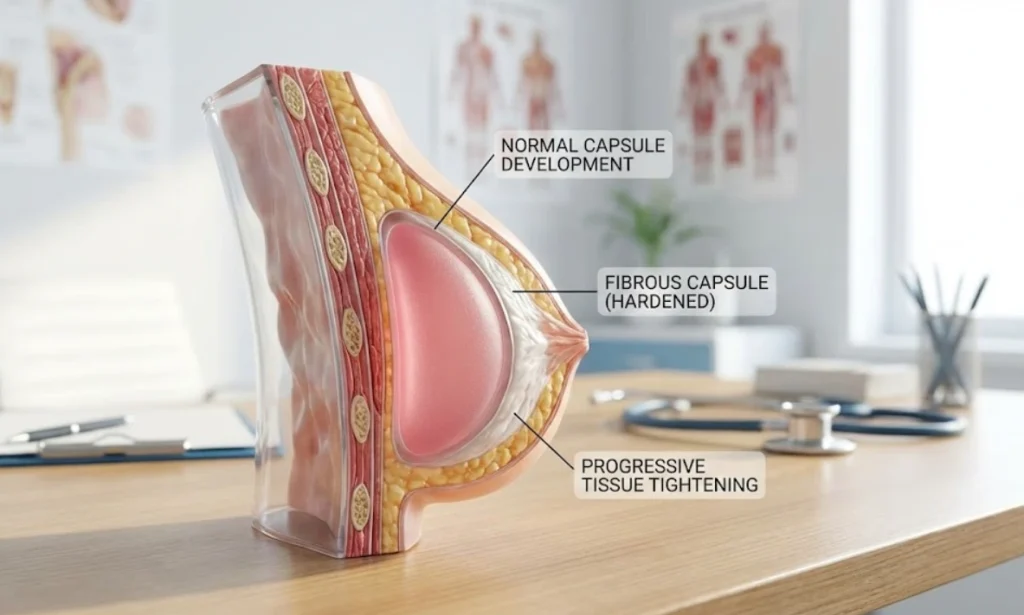
Doctors determine the level of seriousness of the disease by using the Baker Scale which goes from very mild to very severe.
Grade I corresponds to the breast which remains soft, looks completely natural, and the outcome is as ideal as it gets because the capsule is there but not felt. Later on, the skin starts to appear slightly firm when pressed, but the matte remains normal as if nothing changed outside (Grade II). The contracture becomes visible at Grade III; the breast feels hard plus the breast changes visually appearing too round or it is raised very high on the chest. At Grade IV the breast, besides being hard and cold, also becomes distorted and you feel pain by touching the breast. Surgery is then inevitable.
Why Does It Happen? The Biofilm Theory
Until now, both scientists and surgeons have been figuring out why only a few women get contracture after breast implant surgery. At present, the main scientific explanation is that a biofilm is involved. A biofilm is an extremely thin and barely visible layer of bacteria. You will not have a fever as if you were physically ill, but in fact, you will have a low-grade bacterial infection on your implant’s surface. When bacteria land on the implant’s shell, the immune system of the person will react and initiate a fight against these bacteria. Over time, the inflammation will be so potent as to convince the body to construct a thicker, stronger wall as a shelter to the bacteria. This bacteria may have been coming from the patient’s skin, the milk ducts, or even the air in the operating room at the time the implant is exposed briefly during unpacking.
Prevention: The No-Touch Technique in Turkey
Because we understand the fact that it is bacteria that cause us to be their enemy, all the action to prevent contracture deals with achieving a sterile environment. We at Lin Europe Clinic in Istanbul, Turkey, resort to the “Keller Funnel” No-Touch Technique. We do not put the implant using hands, which may carry bacteria from skin, but instead, make use of a sterile, pastry-bag-shaped funnel through which the implant is propelled straight into the breast pocket without coming into contact with the skin or the incision.
Furthermore, implant placement submuscularly (under the muscle) drastically reduces the contracture rate because the continual motion and the massage of the pectoral muscle keep the pocket open and inhibit the scar tissue from tightening.
Can It Be Fixed?
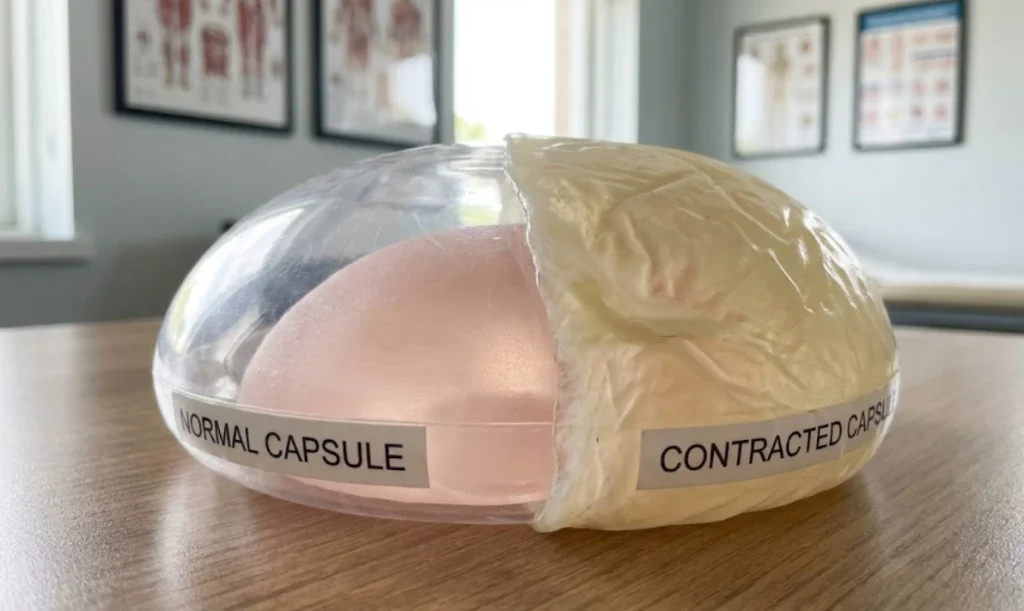
Massage or medication will be of no use if you have contracture of Grade III or IV. Surgery is the only way. A Capsulectomy operation is involved in this case. The implant is taken out and the entire scar capsule is carefully peeled back much like the way you would peel an orange rind. Thereafter, we usually put in the new implant. In the case of recurrence, a switch to a specialized polyurethane-coated implant may be made or to a textured surface as it has been medically proven that the texture indeed has less risk of contracture compared to the smooth surface.
Breast Implant in Turkey
It is very important to choose the right partner when you want to undergo breast augmentation because it will be an entirely different life in the end. Turkey is one of the best places in the world for a cosmetic operation because it offers excellent medical services at a fraction of the price of other countries. We are a symbol of quality and safety in Istanbul, at Lin Europe Clinic. Our work is not limited to creating beautiful things; your long-term well-being is our priority. We have implemented strict sterile protocols and advanced surgical techniques to minimize the possibility of capsular contracture and other complications. We are cloths, shoes, and earrings but when we wish beauty, it is the face and the body that come to our mind. Just as a beautiful face and body reflect an image of good health, so the same is true of harmony between the two. Give us the opportunity to beautify your life and bring you health that goes beyond the skin deep.
Frequently Asked Questions About Capsular Contracture
It is a complication in which the scar tissue that normally forms around the breast implant becomes so thick and tight that it squeezes the implant, thus making the breast hard and distorted.
It is not a condition that threatens life, and it is not cancer-related. However, if the capsular contracture is very severe, it may cause pain and deform the appearance. In such cases, surgery is required to resolve the problem.
The most obvious signs of capsular contracture are a feeling of firmness or that one breast is harder than the other, a change in the shape (becoming round or “stuck on”), and the implant being positioned higher on the chest.
A massage may prevent capsular contracture for smooth implants by helping to maintain the pocket space, but it is not able to reverse the condition once the scar tissue has become hardened.
Yes. Capsular contracture can be effectively treated with a capsulectomy (removal of the scar tissue) and an implant exchange. Changing the type of implant can be one of the ways to keep it from happening again.
Adams, W. P. (2008). The process of breast augmentation: Four phases of care. Plastic and Reconstructive Surgery.
Headon, H., et al. (2015). Capsular contracture after breast augmentation: An update for clinical practice. Archives of Plastic Surgery.