It just causes mild discomfort during recovery. That’s it.
Our eyes probably show most of our emotions if not all. And at the same time, they are probably the most sensitive part of our body. I guess we all know the feeling of the discomfort with the tear formation when an eyelash goes into the eyes or happens to be the soap was accidentally splashed. Therefore, it is totally understandable that patients contemplating eyelid surgery (blepharoplasty) to lift their saggy eyelids and get rid of puffy bags often scare themselves with their thoughts. The very idea of a scalpel being used near the eye, the body is going to trigger a deep instinct of self-preservation.
The number one question in our consultation rooms that patients ask is not about the scar or the price but about the feeling: “Is eyelid surgery painful?” At Lin Europe Clinic, we enjoy responding to this question because the reaction is almost always quite the opposite of what one would expect. Patients consistently rank Blepharoplasty as one of the least painful procedures in all cosmetic surgery, even though bruising is very evident dramatically when one looks in the mirror.
Anatomy 101: Why It Hurts Less Than You Think
Where does this fear come from that is so out of sync with reality? It really boils down to the special anatomy of the face. The eyelid skin is the single thinnest skin throughout the entire human body. Normally, a tummy tuck or a breast augmentation include cutting through thick fascia, stretching heavily muscular layers and the implants’ weight is borne by these muscles.
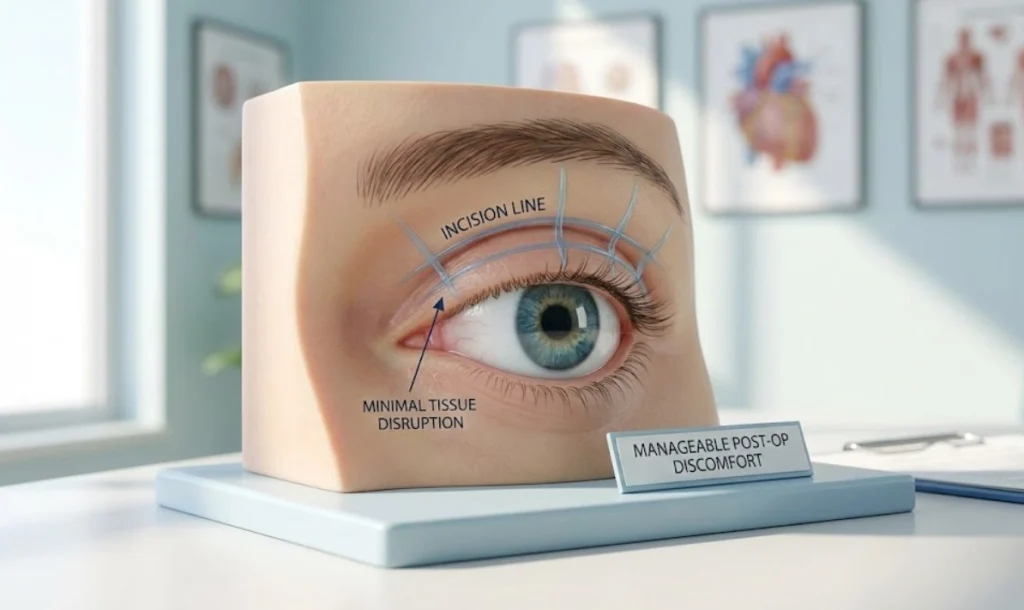
It is fairly easy to numb the nerves in the eyelids, and as a result, the damage to the tissue is very little. Most of the patients say that post-surgery they don’t feel “pain” in the usual way of the word, i.e., throbbing or deep aching. They use words like “tightness,” “heaviness,” and “discomfort” to describe the feeling, resulting from the surgery. Our patients average between a 1 and a 3 when rating their post-operative discomfort on a scale of 1 to 10. Many patients even cease taking prescription painkillers and rely solely on simple Tylenol (Paracetamol) within the first 24 hours.”
The “Sand in the Eye” Sensation

Although it is barely possible for you to experience sharp pain, definitely, you will experience the feeling of something. The most common post-blepharoplasty complaint is the sensation of having “grit” in the eyes.
Gritty eyes, at first, is a direct consequence of swelling and tightness of tissues around the eyes. What happens is that the eyelids don’t close fully and hence, blink efficiently to move the tear film only in the next couple of days. Therefore, the inner surface of the eye gets dry. Patients often describe feeling like they have sand, dust or an eyelash in their eyes.
- The Fix: It can be easily taken care of with artificial tears and keeping the head elevated. A mild irritation is what the feeling lasts, rather than severe pain. It is quite similar to wearing contact lenses for too long after a sleepless night.
Upper vs. Lower: Is One More Painful?
The pain will slightly vary depending on which eyelids you are surgically altering:
- Upper Blepharoplasty: This is the simplest one in terms of recovery. One just needs to take away a piece of the same skin and a little amount of the bulging fat. So, that it is safe even under the local anesthesia (awake but numbed) is already an indicator of how well-tolerated it is.
- Lower Blepharoplasty: This usually requires more detailed steps. For instance, if the surgeon is relocating the fat of the pads to the hollows (tear troughs) or firming up the muscle of the lower lid (canthopexy), the patient may feel more sore or “bruised” along the cheekbone. However, this is rarely associated with sharp pain.
Looking vs. Feeling: The “Boxer” Effect
Often, it is the psychological side of the recovery that proves to be more difficult than the physical one. Among the causes of blepharoplasty are pretty severe, bright-color bruises. The day after the operation, you are going to look as if you have been in a boxing fight of 12 rounds– swollen, purple and blue– just around your eyes.
This looks may upset you quite a bit since the mind interprets these as signs of pain and, therefore, expects the presence of pain, which cannot be found. We often tell patients, “You will look like a boxer but feel like you just have a head cold.” Don’t trust your reflection; your bruised appearance will disappear within 7 to 14 days, a period that is much shorter than the time necessary for deep-tissue healing.
The Foggy View: Ointment and Vision
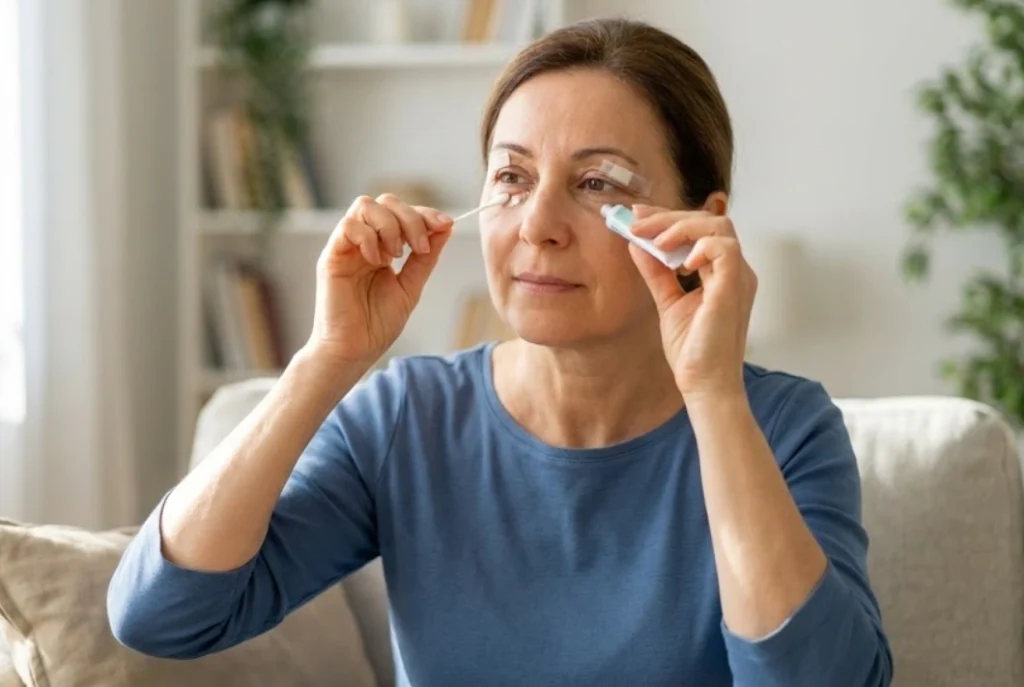
Blurred vision is another feeling that causes patients to be anxious. The cause of it is rarely the operation itself, but the post-operative care. The precaution for infection and the eye moisturizing while the patient is sleeping are the reasons why the ointment is applied on the inside of the eye.
The ointment forms a layer on the cornea, hence, after the application, your vision will be as if you are underwater or looking through vaseline. It is very normal to be confused at first, but this unpleasant incident will not last. Your eyes will clear up eventually when you change to using eye drops during the daytime.
Precision Care in Turkey
The reason why the surgeon’s skill is of utmost importance is that the eyes are very fragile. A substandard performance results in an increase in the swelling and the patient’s discomfort.
Our surgeons are experts in oculoplastic surgery at Lin Europe Clinic in Istanbul, Turkey.
The first one is radiofrequency scalpels (electrocautery), and the other one is microsurgical instruments that we utilize. The electrocautery method cuts and simultaneously seals the blood vessels. The result is that the tissues are less traumatized, which is only one of the several benefits of “bloodless” surgery. If a patient has less bleeding during the operation, then he or she will get less bruised and less painful after the operation. By selecting Istanbul to obtain your eyelid rejuvenation, you are deciding to have a comfort-oriented recovery which allows you to have the first look of your refreshed new face with barely any distress.
Frequently Asked Questions About Eyelid Surgery Pain
The effects of lower eyelid surgery are pretty much permanent. That’s because the fat pads removed don’t grow back. On the other hand, an upper eyelid surgery generally works like a “clock reset”; the skin will gradually get old again, after about 5 to 7 years.
Insurance companies usually consider eyelid surgery a cosmetic procedure, and therefore you shouldn’t expect them to cover your costs. If your eyelids droop so much that they seriously block your eyesight, then there might be a case for an exception, but these situations are extremely rare.
There is no set “best” age for eyelid surgery since even 20-something young adults sometimes want to surgically correct genetic under-eye bags. We, however, still see the majority of patients opting for the procedure to deal with the signs of aging in their 40s or 50s.
Structural eyelid bags are removed by eyelid surgery, thus eliminating the dark shadows that these bags cause, which typically results in running a nice touch on the circles as well. However, your skin’s pigmentation or color is untouched by the procedure.
An upper eyelid operation is often done under just local anesthesia where you are awake but your eyelids are numb. The more advanced types of lower eyelid surgery, on the other hand, will generally call for sedation and/or general anesthesia so that your level of comfort can be maintained.
Codner, M. A., & Mejia, J. D. (2010). Upper and lower eyelid reconstruction. Plastic and Reconstructive Surgery.
Hester, T. R., et al. (2010). Transorbital lower eyelid rejuvenation. Aesthetic Surgery Journal.
Rohrich, R. J., & Coberly, D. M. (2009). Upper eyelid blepharoplasty. Plastic and Reconstructive Surgery.