Usually not until your surgeon approves.
The Day 14 Frame and Lateral Compression
At the expertly skilled level of advanced rhinoplasty and facial bone remodeling, careful decisions on your post-surgery sleep postures carry out the necessary anatomical caution without hesitation. The repositioned nasal bony framework and supporting cartilage framework, after careful surgery, are stabilized by microscopic stitches and initial tissue adhesion. The most clinically accurate reply is that it is advisable not to sleep on your side directly 2 weeks after rhinoplasty.
The rigid external cast has already been removed, while the structural framework is still in its sensitive, semi-soft state at this time. The repositioning of the nose bones and grafting of cartilage during surgery need time—6 to 8 weeks approximately—for complete bone healing and fusion at the joint level of bone. Sleeping on the side for 2 weeks can potentially lead to accidents when the nose gets pressed into the pillow and even causing the repositioned or healing bones to move around, the delicate cartilage to get twisted, or the nose to become misshapen permanently.
Biological Hazards of Early Side Sleeping
Sleeping in a horizontal position with a low head and then going to sleep on your side so early is not recommended as it leads to many unwanted changes in the biology of your body that could spoil the aesthetic results you wanted:
- Unequal Fluid Accumulation: When you sleep in a side position, the force of gravity pulls the fluid between cells and downwards into the side part of your face where there is weight. If the nose is only 2 weeks into its recovery process, this unequal pooling results in a very swollen condition (edema) affecting one side severely while the other side remains unaffected; it could also make the nasal bridge appear misaligned temporarily.
- Friction and unintended Impact: Side sleeping places direct contact of your face with your bedding during sleep. The movement of your nose through rubbing or accidentally getting hit against the pillow can result in micro-tears on your columellar incisions because your incisions are especially vulnerable at this time.
- Stuffiness in the Nasal Airway: Lateral sleep posture increases blood flow in the mucous lining of the internal parts of the nose, which in turn blocks your already narrowed airways and makes it much harder to inhale through your nose. Mouth breathing would worsen and lead to a dry mouth and throat at night.
Protecting Shape and Sleeping Habits after Recovery

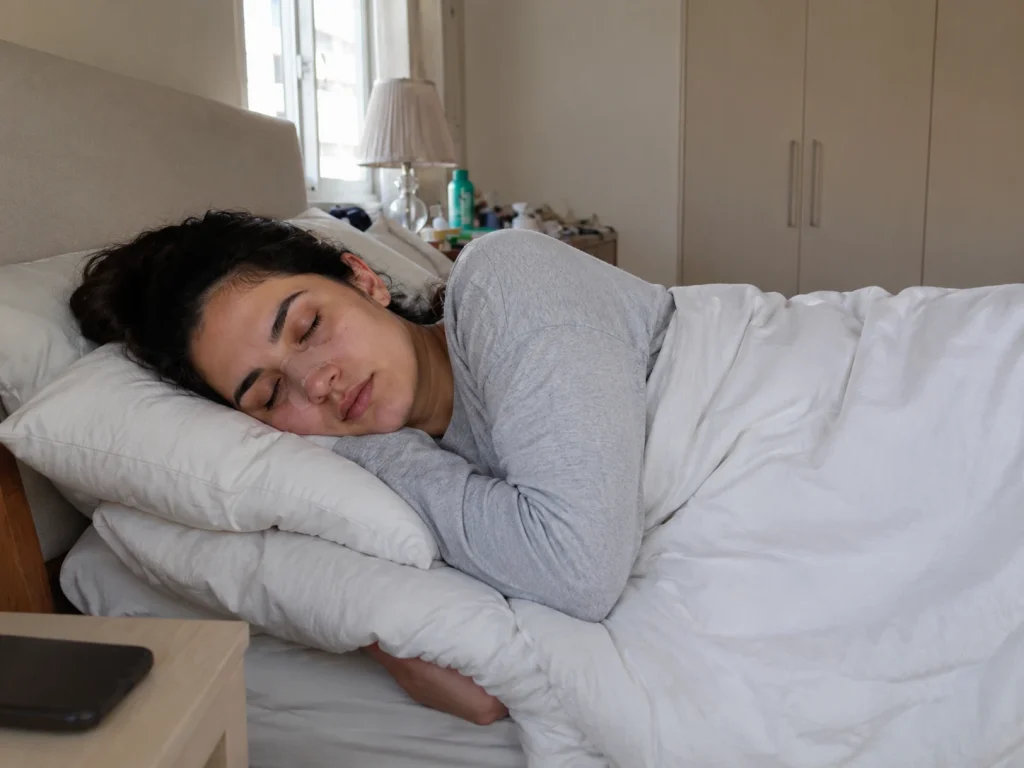
You must sleep in a way as dictated by medical experts and protect yourself from all possible threats at night when your nasal structure is entirely free of support and, by that, very susceptible to gravity-induced shifts. Without protecting this framework during its healing period, there is no guarantee you will keep the shape you desired. The only way is to sleep on your back with the head lifted at a 30-degree to 45-degree angle to prevent any displacement of bones and keep the new shape as desired.
In order to sleep in such a position and get up refreshed while not accidentally overturning during the night, you should use the specially designed U-shaped travel neck pillow or place supportive firm pillows on either side of your torso. Besides that, giving up smoking, either regular or any form, at this stage is a must. Smoking restricts blood flow in the capillaries by causing the arteries, and therefore vessels of the nose’s skin and bones, to constrict which results in the tissues getting deprived of an adequate supply of oxygen and blood which is vital for effective tissue repair at the cellular level and in the night.
Scheduled Transition of Sleeping Habits
When you understand the time taken for the nasal bone to fully calcify and the tissue changes after the surgery, it becomes easier for the patients who want to revert to their usual sleep routine without any worries.
| Recovery Milestone | Approved Sleeping Position | Structural Rationale |
| Weeks 1–2 | Strictly on your back; head elevated 30°–45° | Controls acute swelling; prevents cast displacement. |
| Weeks 3–4 | On your back; flat or slightly elevated | Swelling drops; incisions close, but bones are still semi-pliable. |
| Week 4 (Day 28+) | Cautious side sleeping approved by surgeon | Early bone bonds form; minor pillow contact will not alter shape. |
| Week 8+ | Full freedom (including stomach sleeping) | Nasal bones achieve solid bony fusion and pre-surgery strength. |
Nasal Surgery in Turkey
LIN Europe Clinic offers the patient a unique opportunity to become part of a high-standard, world-class clinic that can manage your nasal changes, facial bone modification, and all related surgical procedures to perfection and with full dedication. At the same time, you are being treated and supported in a warm and caring manner by the clinicians and the whole staff. The level of understanding and attention offered in dealing with the physical and emotional suffering and the demands for a strict recovery regimen after nose surgery is beyond ordinary but is what is expected from the leading professionals in this field. At LIN Europe Clinic, we have all the luxury medical facilities and are recognized internationally among the top specialists in cosmetic face reshaping and post-treatment plastic surgery. We are proud of having designed a space for healing where your progress will be a top priority, monitored by world patient safety standards.
Putting your total faith in our highly qualified medical professionals at LIN Europe Clinic in Istanbul, it will be a pleasure and a pleasure. All your healing progress details will be checked thoroughly for accuracy. Through the delivery of the post-op instructions as a whole package, together with regular follow-ups, we will keep you motivated through your recovery, as our expert team of doctors and their assistants will be your support network 24/7 to give you the latest updates, medical advice, and reassurance. Our team of professionals will keep track of your body contouring, general health, and your system health so your beauty transformation, together with safety, comes out as a win for all of us.
FAQ:
No, you should avoid sleeping on your side at 2 weeks. The nasal bones and cartilage grafts are still fragile and can shift or heal unevenly if pressed against a pillow.
If you wake up on your side and feel no sharp pain or bleeding, you likely haven’t damaged the structure. However, you may notice a sudden, temporary increase in uneven swelling on that side of your nose.
You must keep your head elevated on pillows for at least 10 to 14 days to control intense swelling, and continue sleeping flat on your back for a minimum of 4 weeks until the bones stabilize.
Using a U-shaped travel neck pillow keeps your head securely centered, while placing large, firm body pillows on either side of your waist creates a physical barrier that prevents rolling.
Stomach sleeping should be avoided for at least 8 weeks post-surgery. This position places direct, heavy pressure on the face, which can severely disrupt your newly sculpted nasal framework.
Rohrich, R. J., et al. (2011). The rhinoplasty recovery matrix: Analyzing operational parameters, sleep elevation vectors, and tissue adherence standards. Plastic and Reconstructive Surgery, 127(4), 1651-1663.
Toriumi, D. M. (2007). Structure rhinoplasty: Managing the external skin envelope, gravity-induced edema, and long-term osteotomy stabilization. Clinics in Plastic Surgery, 34(1), 119-126.
Gunter, J. P., et al. (2014). Advanced postoperative care, managing nocturnal tissue tension, and structural stability in secondary facial contouring. Aesthetic Surgery Journal, 34(5), 587-595.