Yes, minor surgery can reduce areola size.
Even though the size and shape of the breast are the most commonly discussed in plastic surgery, the Nipple-Areola Complex (NAC) is usually the secret reason behind the patient’s insecurity. So many women complain about their pigmented skin around the nipple, i.e., they say that their areolas look too big compared to the rest of their breasts, thus take up too much of the breast surface. If this “fried egg” effect is created, then the breast mound will appear to be smaller than it really is because the boundary will be undefined. Enlarged areolas that have resulted either from puberty, rapid weight changes, or extreme stretching due to pregnancy and breastfeeding can make a beautiful breast look old or heavy if one just happens to be looking at the size of the areolas alone.
Precisely, the question “Can you reduce the size of the areola?” is answered with a straightforward yes. Areola reduction (Areoloplasty) is an extremely accurate, small-scale operation that is focused on the delicate fibrovascular pigmented tissue and practically “trims” the diameter of the pigmented skin. If a patient decides to have a Breast Lift or Reduction, an areola reduction might be done at the same time. However, it can also be a day-case procedure performed under local anesthesia at Lin Europe Clinic. We at Lin Health Europe Clinic treat the areola as the “frame” of the breast; just as a frame should never overshadow the painting, the areola must be in mathematical proportion to the breast mound to produce a pleasing, young-looking outcome.
Everything About Expansion: Why Do They Grow?
In order to comprehend how we reduce the areola, it is essential to know the exact reasons for its increase in size in the first place. The areola skin differs biologically from the skin around it in many aspects; it is thinner and more elastic and since it also has numerous hormone receptors, it is highly sensitive to hormonal changes. During puberty and pregnancy, surges in estrogen and progesterone signal the areola to darken and increase in size in preparation for lactation.
What is more, the main culprit of the enlarged areola is stretching; mechanical stretching is the chief factor. When at the breast-feed-time, the breast fills with milk and stretches out the skin like a balloon. Once the milk dries up and the breast volume reduces, the elastic fibers that make up the areola skin often do not have enough “spring” in them to return to their original size. In which case, the patient will get stretched saucer-sized areolas on a deflated breast. Because the problem lies with the elastin fibers in the dermis, neither cream nor laser will be able to take care of it. The redundant tissue must be surgically removed if the patient wants the diameter to go back to normal.
Operation Method: The “Donut Lift”
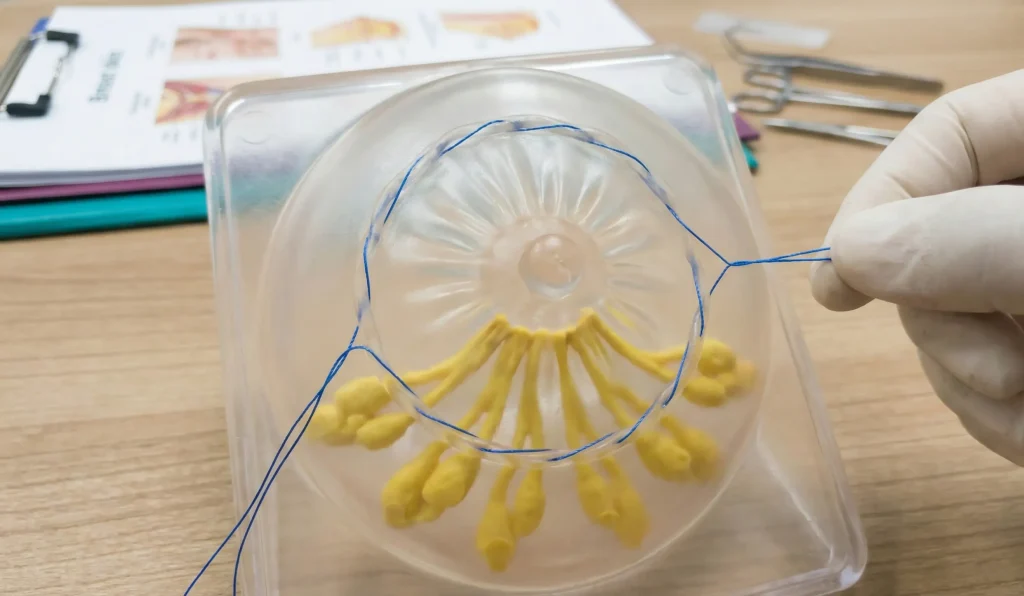
The most popular procedure for areola reduction is widely known as benelli lift, or more familiarly, “Donut Mastopexy.” The point is theoretically very clear but requires great precision in practice. We treat the areola like a target with a bullseye.
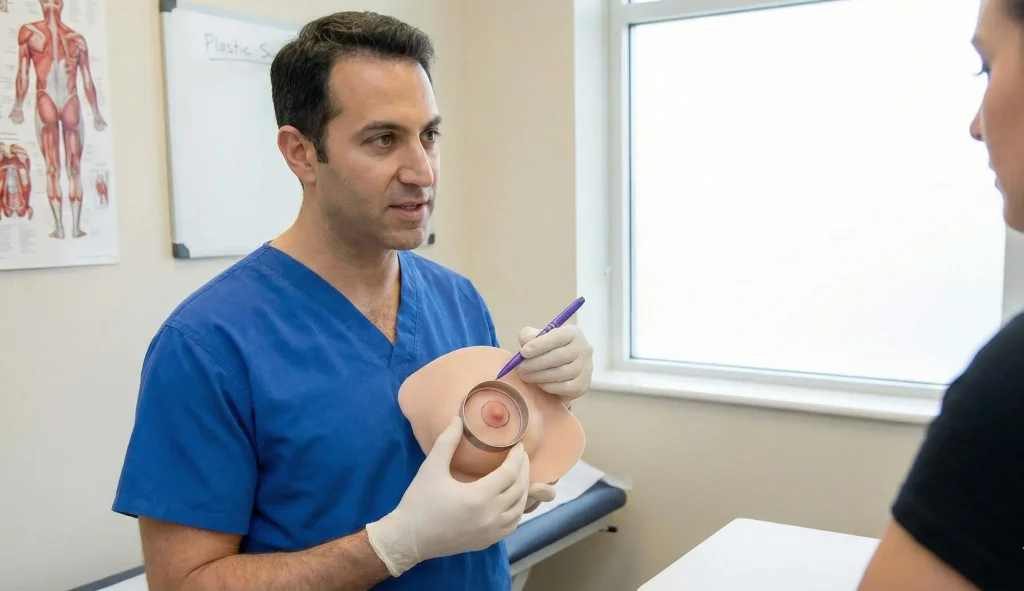
The surgeon draws two concentric circles around the nipple. The smaller one shows the new areola size, desired and achieved during the surgery (typically 40mm to 42mm). The bigger one depicts the extent of the areola that needs to be removed. The band of skin that lies between these two circles—the “donut”—is excised. The skin of the outer circle is then pulled inward and sutured to the inner circle. This resembles a drawstring bag being tightened; the surrounding breast skin is drawn toward the nipple, which results in the pigmented area being reduced in diameter. This method is also popular because it gives a slight lift to the local breast tissue, thus helping to tighten mild skin laxity without the necessity of making a vertical scar.
The Perfect Ratio: The 42mm Norm
In plastic surgery for breasts, the issue of the mathematical perfection of areola size is considered a basic principle of beauty. Since everyone is unique, the textbook standard for a youthful, attractive areola diameter lies between 38 and 42 millimeters.
However, at Lin Health Europe Clinic, we do not simply apply a cookie-cutter stencil. We focus on the Breast-to-Areola Ratio. If one looks at a massive areola on a small A-cup breast, one immediately gets the feeling that the areola is overpowering the breast; however, if one takes a tiny areola on a DD-cup breast, one can conclude that such a tiny areola is unbalanced with the big breast. The main goal is proportion. We take exact measurements of the base width of the breast and from the calculation, we get the diameter that will roughly cover the central third of the mound. Thus the result looks absolutely natural on your own anatomy, which is the “operated” look that the areola is too small or constricted compared to the breast volume.
Marks and Feeling: What Are We Giving Up?

When any of the patients think of undergoing areola reduction, the first thing that they are worried about is their scars. We cut skin, and for this reason, a scar is unavoidable. Nevertheless, the periareolar incision (around the edge of the areola) is probably the least “visible” scar in breast surgery.
The scar is located exactly where the darker areola skin meets the lighter breast skin. This naturally occurring borderline serves as a camouflage and hides the transition line. Over a period of 12 months, such a scar usually becomes a thin white line, blending with the pigment change. As far as sensation is concerned, incisions are made superficially—only the top layer of skin (epidermis and dermis) is removed—and thus, nipple sensation is preserved in almost all cases. Moreover, glands remain intact in case a standalone operation is conducted, hence, a woman will not be prevented from breastfeeding in the future (unlike in a full breast reduction where this might happen).
Men and Gynecomastia: The Puffy Nipple
Areola reduction is only one part of the whole procedure, which is one that some men need to undergo as well, after all. The majority of male patients who come to us have gynecomastia surgery as well as this. Enlarged areolas in males often get a “puffy” look because the glandular tissue is pushing is thus creating a dome that leads directly to the pleated appearance of the nipple.
Our male patients have a totally different objective, to say the least. We are aiming at a smaller, more oval or horizontal shape that imitates the masculine pectoral contour, usually setting the diameter to be between 25mm and 28mm. Most of the time we go for a combined approach, i.e., besides a skin excision, the removal of the gland underneath is carried out as well to get a totally flat chest wall. This takes a feminized, conical chest and turns it into a masculine wall that is not only flat but also strong enough to go shirtless confidently at the beach or gym.
Frequently Asked Questions About Areola Reduction
Indeed, skin that is taken off cannot regenerate. However, if the area of the areola that is left has been stretched, it can stretch again due to major weight gain or pregnancy.
Really, very little chance. Since the operation only cuts out the skin of the outer ring and the nipple is not separated from the nerves thus the sensation is normally kept.
Definitely. Areola reduction only surgery leaves the milk ducts intact. in principle, the ability to breastfeed is not affected but sometimes, scarring can slightly reduce the flow of milk.
As far as appearance is concerned, the length of the diameter of 38 to 42 millimeters is said to be the ideal size for a normal-sized breast. The perfect diameter for male is notably smaller that is usually about 25 to 28 millimeters.
Yes, it is possible. local anesthesia is enough to perform the procedure comfortably and within a short time if the areola reduction without surgery of a full breast lift or implant is the only thing that you are undergoing.
Hammond, D. C. (2014). Periareolar mastopexy: the Benelli technique. Clinics in Plastic Surgery.
Spear, S. L., et al. (2009). The biology of the nipple-areola complex. Plastic and Reconstructive Surgery.
Mofid, M. M. (2007). Areola reduction: a review of techniques and outcomes. Aesthetic Surgery Journal.