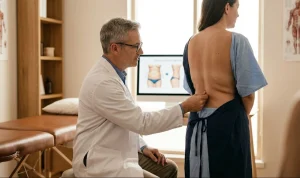

Ptosis surgery tightens the eyelid muscle.
There is a remark that you might have been told a thousand times already and the annoying part of it never goes away: “Wake up, you look tired!” or “Were you not able to sleep last night?” You may be feeling perfectly energetic, rested and alert but your eyes are telling a completely different story. You might unconsciously be lifting your eyebrows all the time in an attempt to see better which in turn leads to deep forehead wrinkles. Alternatively, you might realise that in pictures your one eye appears much smaller, sleepier or more “lazy” than the other one.
The medical term for this condition is Ptosis (pronounced toe-sis), but most patients just say that they have “sleepy eyes.” It is not a mere cosmetic problem; it is a structural, mechanical failure. On the one hand, many people mistake it for the presence of extra skin; on the other, ptosis is basically a weakness of the muscle that serves as the motor for the eyelid. We at Lin Europe Clinic deal with helping people to tell these two differences apart which is often difficult but crucial. If you have “sleepy eyes,” an ordinary eyelid lift will not be able to help you. In fact, you need a very specific type of operation whose purpose is to retighten the inner eye mechanism.
The Curtain vs. The Rod: Understanding the Anatomy
To understand what is the surgery for sleepy eyes, you first need to be aware of the anatomy of the upper lid. Let’s say that your eyelid is a heavy velvet curtain and the muscle that lifts it (the levator muscle) is the curtain rod mechanism.
- Dermatochalasis (Baggy Eyelids): This is when you have too much fabric (excess skin) hanging down the edge which is the heavy additional skin. The curtain rod works fine, but the curtain is just too long. The solution to this is Blepharoplasty (trimming the fabric).
- Ptosis (Sleepy Eyelids): This is the case when the curtain rod itself is broken or the rubber band inside has stretched out. No matter how much fabric you trim, the curtain will still be hanging extremely low because the lifting device is weak. The solution to this is Ptosis Repair.
If a patient with ptosis has a normal blepharoplasty procedure, the effect will be far from satisfactory. Even though the skin will no longer be loose, the eye will still be half-closed looking like a “tired deer”. This is the very reason why the most important step is an accurate diagnosis.
Why Did This Happen? The Contact Lens Connection

Ptosis can be hereditary (you have been born with it), but acquired ptosis in adults is very frequent. Besides aging which is the main factor, one of the most surprising factors is contact lenses.
Repeatedly pulling on the eyelid to remove or put in rigid or soft lenses can be responsible for stretching the delicate tendon (the levator aponeurosis) that connects the muscle to the eyelid plate. This actually results in the motor being disconnected from the door. Gradually, this tendon loses so much of its tightness that the muscle is not able to lift the eyelid altogether anymore. Dark circles and a previous eye operation are other common causes of the problem. The muscle is still active but due to a loose connection the eye cannot open fully.
The Procedure: Tightening the Rubber Band
So, what is the surgery for sleepy eyes? The Levator Advancement is undoubtedly the most common and efficient method. That is, by shortening a stretched-out rubber band, it snaps back with better tension, thus the goal is to pull the muscle that lifts the lid tighter.
The surgeon cuts the skin along the natural eyelid crease (the very same place used for a cosmetic eyelid lift, so the scar is not visible.) They go further down after the incision to find the levator muscle that has usually slipped back. The surgeon then reattaches the muscle by placing internal permanent sutures. They do this either by folding the muscle or reattaching it thereby physically shortening it. This mechanically raises the eyelid margin which in turn reveals more of the iris color and the window of the eye is opened. The resulting image of the eye is a bright one, the gaze is lively, and the pupil appears to be bigger.
The “Sit Up” Test: Why You Are Awake
One of the things that make surgery for sleepy eyes different from other surgeries is the way a patient is anaesthetized. People usually sleep throughout a cosmetic procedure; however, ptosis repair may down at least require a patient to be aware and to cooperate.
We at Lin Europe Clinic, for the most part carry out this operation with local anesthesia that is light sedation. The point is to block the pain completely so that you can feel no discomfort, while at the same time, you should be able to take instructions. At the crucial moment during the operation, your surgeon will literally put you on top of the operating table. What for? Because the effect of gravity is different in different positions. Your eyelids look different when you are lying down and when you are standing up. By placing you in a sit-up position, the surgeon will be able to fine-tune the eyelid height while you do the different movements of your eyes used to check this out these are looking up, looking down, and looking ahead. Since a millimeter difference in symmetry is such a big difference, this interactive method guarantees that your eyes will truly be not only open but also even.
The “Scarless” Option: Internal Approach

In situations where sleepy eyes are mild or where a patient feels good after using a certain test drop (phenylephrine), a method without a visible scar called Muller’s Muscle Resection is available.
There is no skin cut at all in this method. Surgeons turn the eyelid to the inside and operate from the conjunctiva which is the pink, moist underside of the lid. An inner tightening of the second lifting muscle (Muller’s muscle) can raise the eyelid by a millimeter or two without scarring externally. Recovery from this will be terribly fast which makes it perfect for young patients who want a quick solution for their “drowsy” or “stoned” look without having to go under a knife and having a downtime of a full incision.
Risks: The “Stare” and The “Blink”
By tightening the muscle, the likelihood of the over-correction is increased. The eyes can look very surprised or “staring,” as a result of an excessive tightening of the muscle, and you may not be able to close them comfortably overnight (lagophthalmos). This explains why the intra-operative adjustment (the “sit up” test) is extremely important. It helps us to find the “Goldilocks” situation that is fluid enough to be not too low or not too high but just proportionate.
Frequently Asked Questions About Surgery for Sleepy Eyes
In fact, there is surgery for tired eyes; however, the exact operation varies depending on the reason. In case the tired eyes appearance is due to excess skin, a blepharoplasty is carried out, whereas if the eyelid muscle is weak, a ptosis repair is the solution.
Sleepy eyes can be fixed through a surgical procedure called ptosis repair. “This operation restores the aperture of the eyelid to a wider, more alert state by mechanically shortening the stretched tendon that lifts the eyelid”, explains Dr. Namburi.
When done by a board-certified plastic surgeon, blepharoplasty is a low-risk procedure. The risk of a serious complication is very low, and most side effects such as bruising or dry eyes are temporary and can be easily managed.
If you want to know how to fix a sleepy eyelid, the answer is that it requires surgical intervention. A surgeon can perform the corrective procedure that involves tightening the levator muscle. He or she usually chooses to make the incision at the natural eyelid crease or lifts the margin through an incision from underneath the lid.
The only way to fix a sleepy eye is by surgery. The procedure involves reattaching or shortening the muscle that controls the eyelid lift. Hence, when the eyelid opens wider, the eye looks larger and is perfectly symmetrical with the other side.
Finsterer, J. (2003). Ptosis: Causes, presentation, and management. Aesthetic Plastic Surgery.
Anderson, R. L., & Dixon, R. S. (1979). Aponeurotic ptosis surgery. Archives of Ophthalmology.
Putterman, A. M., & Urist, M. J. (1975). Müller muscle-conjunctiva resection: Technique for treatment of blepharoptosis. Archives of Ophthalmology.