It takes extreme pressure to rupture an implant.
It is a scenario that most women looking into breast enhancement have probably imagined in their mind at one time or another. You imagine yourself falling backwards and landing on your chest, a friend giving you such a big hug that it’s almost too tight and very enthusiastic, or maybe the seat belt pressing against your chest in a sudden stop. The very next question running through your mind is: Did I just rupture it?
This worry arises from the misconception that breast implants are fragile, balloon-like objects that will burst from the smallest pressure. At Lin Europe Clinic, we try to explain that this is a myth over and over again. The fact is that breast implants nowadays are not only very attractive but also very well engineered to be able to withstand rigorous and extreme use. Although they cannot be considered as indestructible, the answer to the question “How much force does it take to rupture a breast implant?” is most probably much, much higher than what you imagine.
The Crush Test: Stronger Than a Car Tire?
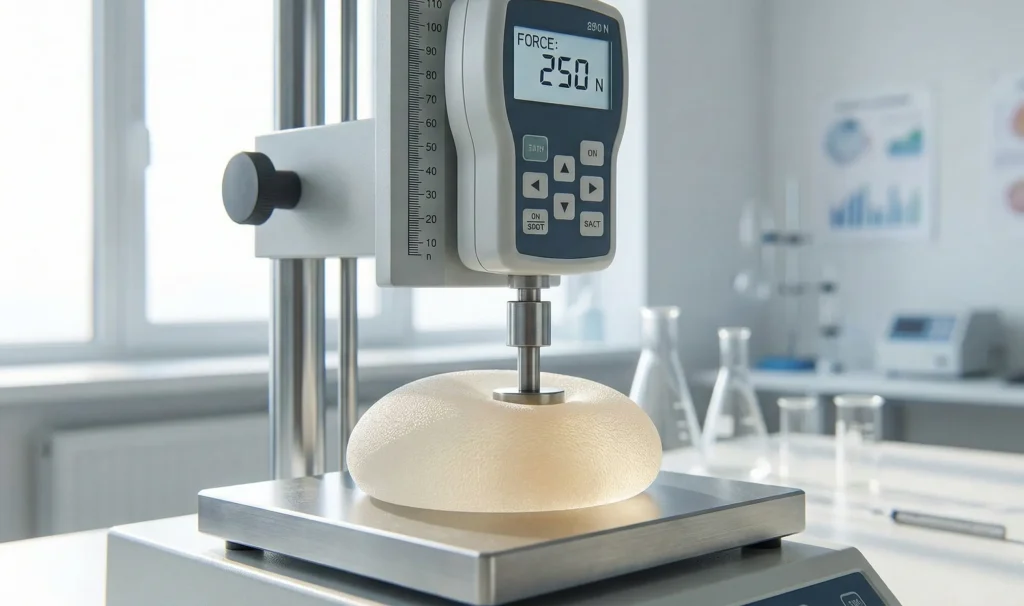
In order to appreciate how strong a silicone implant is, it is necessary to consider the extensive tests that they are subjected to before they are approved by the FDA or CE. Through laboratory “crush tests,” implants are pressed tightly between two metal plates.
The results here are truly amazing. Most modern and top-quality implants (from reputable brands such as Mentor or Motiva) are capable of handling anywhere from 175 to 250 pounds (80 to 115 kg) of very concentrated push without being ruptured. Furthermore, some research even suggests that this threshold has been exceeded to 400 pounds. To visualize this, you could pile up your heavy suitcases several times over on top of one implant, or even in some very exceptional situations, running a car slowly over one and still the implant shell would fend off any damage. The shell is made to be able to stretch and change shape under pressure so that it will not break when the energy is absorbed.
Sharp vs. Blunt Force: The Achilles’ Heel

Even though implants have a very high level of resistance to blunt force (such as a punch, a fall or a squeeze), they are also vulnerable to one of the weakest parts: sharp force.
Imagine a breast implant as a state of the art, very thickly coated gourd. You could try to squeeze it, step on it, or hurl it against a brick wall and it would most probably be able to spring back. However, if you touch it with a needle, it will be damaged in no time at all.
- The Danger Zone: The most frequent reason for rupture is not a car accident or a fall but operating room instruments during the initial surgery or a biopsy needle in the later stages of life. A pointy tool shatters the natural silicone skin of the implant, resulting in a weak spot that can soon also become torn. That is why we always instruct our patients to inform every doctor carrying out a breast biopsy or injection that they have implants.
Can a Seatbelt Rupture a Breast Implant?
There is no doubt that car accidents are one of the main concerns of patients. The seat belt however will be the first thing to save your life. It applies a huge amount of instantaneous, diagonal force to the chest in a collision. There is a natural tendency to think that this impact is like a guillotine for the implant.
Nevertheless, breaking an implant by the pressure of a seatbelt alone is almost unheard of. Most of the times when the trauma is so severe that the patient is admitted to the hospital, a rib fracture or a really bad bruise on the chest will usually be the reason even though the implant will be found to be intact. How come? The implant is very flexible. The moment the seat belt forces it against the chest wall, the implant changes its shape and moves sideways instead of bursting.
The fact that an implant is usually injured in a vehicle accident can hardly ever be attributed to the just belt pressure but is rather a consequence of the implant being punctured from the inside by a sharp edge of a broken rib. Trauma doctors have noted that implants may function as somewhat of a “mini airbag,” thus, potentially absorbing the shock and saving the ribcage from even greater injury.
The Mammogram Factor
One of the main causes of tension among those who have breasts with implants is the mammogram instrument. It is no secret that mammograms include squeezing the breast tissue firmly between two plates to get an X-ray picture.
Is it possible for a mammogram to cause an implant to rupture? In theory, they could however, it is very infrequent. Those conducting mammograms are highly trained to carry out “displacement techniques” (the Eklund views) in which the implant is pushed back while the breast tissue is pulled forward. Due to the fact that an implant can handle a force of a few hundred pounds, the pressure coming from the compression of the mammogram machine is far from being a threat to the device. The possibility of a cancer diagnosis being overlooked as a result of a woman avoiding mammograms is significantly greater than the risk of a machine damaging her implant.
Daily Life: Sleeping, Diving, and Flying

It is quite common that patients wonder whether or not they can lay on their stomachs to sleep and if high altitudes (such as during a flight) or deep underwater (during scuba diving) can affect the condition of their implants.
- Sleeping: Sleeping on your stomach is really no big deal. The mere force of your body is definitely not enough to cause a breakage in the device.
- Pressure Fluctuations: There is a rumor going around that implants may either expand or go off on an airplane due to the changes in cabin pressure. This is absolutely impossible when it comes to silicone implants (which are made of solid gel) and practically no change in size when it comes to saline ones. Regardless of whether it is from skydiving or scuba diving, the changes in the atmospheric pressure will simply never cause a rupture.
What Happens If It Does Break?
The fact that they are resistant up to a certain point does not mean that implants are their user’s lifetime lucky charm. They are susceptible to failure due to “shell fatigue” (wear and tear over 15-20 years). Usually when a “Gummy Bear” type silicone implant fails in the context of a rupture, it is a “silent rupture.” Since the cohesive property of the gel means it is more solid, it does not actually leak into the body. It stays either within the shell or in the scar capsule which thus allows the breast to keep its shape. Without an MRI you would probably be totally unaware that it had happened. It is because of this very reason that at Lin Europe Clinic, our preference is for silicone rather than saline since even the worst-case scenario failure is safe and contained.
Frequently Asked Questions About Implant Rupture
It usually requires more than 200 pounds of direct pressure to rupture a breast implant, so they are able to endure quite a strong blunt impact without failing.
Certainly, in extremely severe crashes when the impact is very high, a seatbelt could cause a breast implant to rupture. However, it is very uncommon that the seatbelt alone would be the reason for the rupture because the silicone shell is elastic and durable.
Sleeping on your stomach will not cause a rupture in your breast implants simply because the pressure exerted by the weight of your body is significantly less than the amount of pressure required to break the device.
It is very uncommon for a rupture to occur during a mammogram; this is because the technician employs a special method to push the implant aside and protect it while the natural breast tissue is compressed.
Sharp tools such as biopsy needles are probably the biggest danger for the implant’s integrity. You must always disclose to your doctor that you have implants before any needle procedure is carried out in the chest area.
Bondurant, S., Ernster, V., & Herdman, R. (Eds.). (1999). Safety of silicone breast implants. Institute of Medicine, National Academy Press.
Brandon, H. J., et al. (2006). Biodurability of retrieved silicone gel breast implants. Plastic and Reconstructive Surgery.
Handel, N., et al. (2006). Long-term safety and efficacy of polyurethane foam-covered breast implants. Aesthetic Surgery Journal.