
Nicotine reduces blood flow and delays healing.
Out of all the guidelines we provide to our patients at a pre-operative consultation, the one that involves “stopping smoking completely” is the one which is most commonly negotiated by the patients. After being told that they need to stop smoking, patients respond with alternatives such as: “Can I just cut down the number of cigarettes?”, “Can I use a low-nicotine vape instead?” or “Can I use a patch?”. We know nicotine addiction is very strong and the stress of an upcoming surgery can ironically increase the urge to smoke. Nevertheless, in the realm of plastic surgery, nicotine is not just a threat to health in the long run; it is an immediate surgical toxin.
Normally, smoking is discouraged in general health to prevent cancer after many years. However, in plastic surgery, there is an immediate danger, which is also evident. If elective surgery and nicotine consumption are combined, there is a huge risk for very serious complications. Such a situation turns a surgery that is supposed to enhance one’s looks into one that may cause them to be permanently disfigured. At Lin Europe Clinic, we don’t see the “no nicotine” rule only as a judgment on your lifestyle; rather, it is a strict safety rule that is aimed at ensuring that the skin we lift is actually able to survive the process.
How Nicotine Damages Your Skin
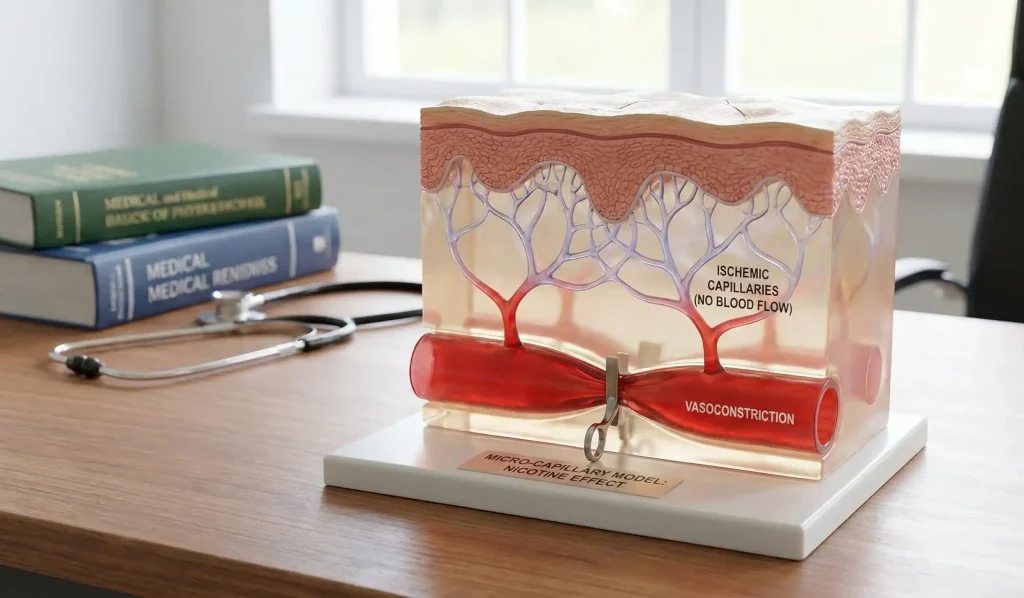
In order to get the gist of the danger, you need to get the gist of what nicotine does to your circulatory system. Nicotine is a very powerful vasoconstrictor drug. From the moment one inhales the cigarette smoke or the vapor, the chemical in question acts very quickly to constrict the blood vessels and hence significantly narrow their diameters. This is a generalized effect but the most detrimental effect is the constrictions of the blood vessels that are very small and that supply the skin micro-capillaries.
Let me illustrate the situation by using a gardening analogy. Your blood vessels are like your garden hoses watering the lawn (your skin). Nicotine is like a heavy boot that stomps on the hose. As a result, the water flow is reduced to a tiny trickle. In a healthy person, this situation can be handled. However, surgery is a situation where we purposely cut and re-arrange tissues. This is already a disruption of the blood supply to the tissues, only temporary at that. So, with the addition of nicotine’s “boot” (blood vessel constriction), the blood flow decreases so much that it cannot even keep the tissue alive. Oxygen that is carried by the blood is essential for the better functioning of the cells. When the cells are deprived of oxygen, it leads to their death in short order.
Tissue Death
Smoking in plastic surgery can cause various problems but the most dreaded one is Tissue Necrosis. This condition is basically the death of the body tissues. Necrosis is usually observed when the skin turns purple, then black as it dies, and the outer layer of the dead skin separates like a hard, dried scab (eschar).
The incidence of this complication is rather high in plastic surgeries such as Abdominoplasty, Breast Lifts and Facelifts that depend on “skin flaps.” In these procedures, the skin is lifted and a large area of it is pulled away from the underlying tissues. The stretched skin is nourished by the blood through tiny vessels at the periphery of the flap which are the only ones left intact after stretching. Smoking, causes these blood vessels to close, and the part of the flap that is the furthest from the blood supply (normally the incision line after abdominoplasty or the nipple in a breast lift) is at first deprived of oxygen and nutrients and, therefore, will die. The patient thereby obtains a large open sore that takes a long time to heal and results in a broad, disfiguring scar rather than a narrow white scar.
What About Vaping And Gums?
Modern patients, who are quite ignorant of the true facts, believe that the main responsibility for the problem is lying with smoke (tar, carbon monoxide) and, therefore, they recklessly conclude that “clean” nicotine delivery systems such as Vaping (E-cigarettes), nicotine gum, or patches are safe. This is totally inaccurate.
First of all, carbon monoxide and tar are the substances that cause your lung damage. On the other hand, nicotine is the one that causes blood vessels to constrict. No matter how nicotine enters your body—through the use of a vape pen, chewing a piece of gum, or smoking a cigarette—the effect on your blood vessels is the same. A nicotine patch after a tummy tuck is equivalent in level of blood flow reduction to smoking a pack of cigarettes. Hence, the only way to “quit” before surgery is to totally abstain from all forms of nicotine.
Nicotine And Anesthesia: Unhealthy Combo

Besides necrosis, nicotine is a major contributor in slowing the healing process. It is a fact that smokers are very prone to infections after surgery. The cellular response to infection in smokers is not as vigorous as in non-smokers which means that they develop infections quite often. Less oxygen as a result of a diminished blood flow to the site of injury means less collagen production. Thus, not only do the wounds of smokers heal approximately at half the speed, but their scars are also wider and more pigmented but also, there is a predominance of keloids which is explained by the abnormal collagen deposition.
More importantly, smoking is bad for your lungs which are less efficient at getting rid of mucus from the airways. This is a major concern during general anesthesia because it serves as a risk factor for pulmonary infection due to pneumonia or lung collapse (atelectasis). For the patients who are undergoing abdominoplasty, the smoke induced cough is a big problem. Since coughing causes the intra-abdominal pressure go up, it results in increased tension on the line of muscle repair and this can even cause the internal sutures to give way and this is something that will necessitate a second surgery to repair the disharmony of the muscles.
The Body Needs Time to Heal
This is because the human body requires sufficient time not only to get rid of the nicotine but, more significantly, to have the endothelial lining of the blood vessels fixed so that the normal blood flow can be re-established. At Lin Europe Clinic, we put a ban on smoking for 4 to 6 weeks before surgery and not less than 4 to 6 weeks after surgery.
Stopping two days before the operation is not going to work. It takes weeks for the blood vessels to go back to normal. This is a matter we take very seriously; thus, if need be, we can test a urine sample for cotinine of the patient on the day of the surgery. Our right to cancel the operation is with you not us if the result is positive for nicotine. It is always a wise decision to delay an operation than to go ahead with it having a great chance of suffering from gangrene. We are your safety net. We make sure that you never make a decision that you are going to regret for life.
Frequently Asked Questions About Nicotine and Surgery
Definitely. Vape juice with no nicotine at all (0mg) does not lead to vasoconstriction and generally, we are okay with it; however, we still encourage you to stay away from inhaling any kind of chemicals to keep your lungs healthy for anesthesia.
One cigarette only is enough to cause a great vasoconstriction that lasts for several hours. If you are not able to resist the temptation, be fully truthful with your anesthesiologist and surgeon because it changes your risk profile.
Certainly, if you live with a heavy smoker and are continuously exposed to second-hand smoke, you may increase your nicotine level in such a way that micro-circulation is affected. Make sure your recovery place is not contaminated with smoke.
Absolutely not. Nicotine gum contains a highly concentrated dose of that vasoconstrictor which gets directly into your bloodstream. Only non-nicotine methods (such as regular chewing gum or meditation) should be used to calm down during post-operative period.
At least 6 weeks after the operation is our recommendation. By then, the most critical healing has been done and the blood supply to the skin flaps is strong enough to be able to tolerate the influence of nicotine although we are always suggesting quitting smoking permanently.
Rohrich, R. J., & Coberly, D. M. (1995). The effects of nicotine on the cutaneous microcirculation. Plastic and Reconstructive Surgery.
Manassa, E. H., et al. (2003). The effects of smoking on flap survival. Plastic and Reconstructive Surgery.
Padubidri, A. N., et al. (2001). Effect of smoking on the healing of standardized wounds. Plastic and Reconstructive Surgery.