Sometimes, especially early on.
A major concern for women contemplating breast augmentation is the worry about “foreign body sensation.” Usually, you are scared that you will never stop noticing the silicone bags in your chest that would be moving every time you take a step. You can even feel your implants moving loosely like something rolling around in your pocket. Indeed, it is a legitimate worry, because a breast implant in the human body is a foreign object after all and one that occupies a very limited space.
The question “Do they move and can you feel it?” has a double meaning to it. If the surgery is done correctly and the pocket is not too big then you will not feel the implant that slides inside you, as if it were a daily habit. They should feel just like an extended part of your own body after they have healed completely. Nevertheless, physically, there are still specific phases, especially during the first week or two, when you may feel a strong implant-related sensation and later during very intense physical activity as well. At Lin Europe Clinic, we are all about arming you with knowledge so that you will recognize implant-related sensations and know that the implant settling is good, but the implant move means that there is a problem with your surgery.
The “Integration” Phase: When They Feel Foreign

Implants feeling like an alien body is something that you can hardly avoid when you are talking about the initial days after surgery. It is the period when your skin and muscles are very tight, and implants are still pressing the nerves that are not used to the pressure. Generally, patients in this period compare the feeling to that of an “Iron Bra.” It is not at all the implant moving which can be felt; the feeling of tightness has its source in the fact that the pectoral muscle is spasming around the new object.
Moreover, a bizarre auditory or tactile phenomenon that is quite unfamiliar even to the brain is “sloshing.” You may panic if a squishing noise arises each time you move, and this is simply air or fluid (seroma) that has been trapped in the pocket. It is completely harmless and will spontaneously disappear as your body gradually absorbs the fluid. When talking about the first few months after the surgery, you might be very conscious of your new weight, especially when walking or going over a speed bump. This is called proprioception, and it disappears in about three months when your brain treats the “new” weight as normal and stops sending the signal.
The “Animation Deformity”: The Muscle Flex
The scenario that will probably most trigger your implants to move physically and you see the same, is if your implants Sub-Muscular (Dual Plane) have been placed. That means the implant has been placed underneath the pectoralis major muscle, and every time you contract the muscle, it is acting like a compressor on the implant. Medically, this is referred to as Animation Deformity.
If you are doing some push-ups or trying to open a heavy door or reaching out for something on a tall shelf, the sensation that you might encounter would be a very peculiar “tugging” or tightening deep inside your chest. The breasts may visually pull apart a little or flatten momentarily as the muscle contracts over them. Though this can be a bit weird at the beginning, it is the usual exchange for the natural, well-hidden result of the under-muscle technique. In fact, quite a few ladies eventually get used to the sensation and within a year they no longer notice it at all.
When Movement is a Problem: Sliding and Displacement
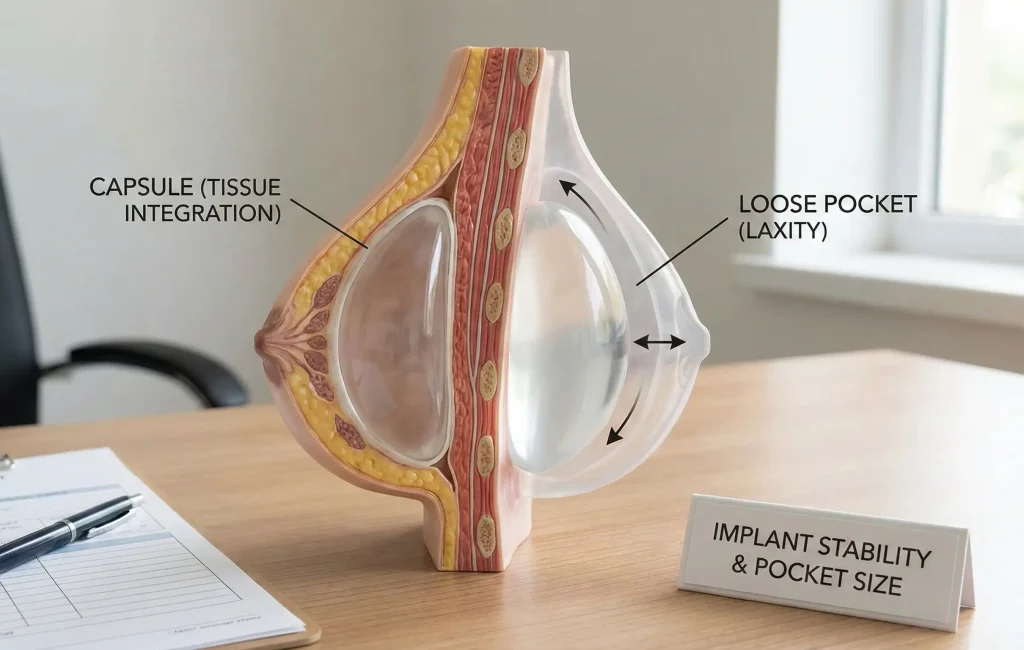
Besides muscle, the implant should not be sliding loosely inside the pocket. The pocket the surgeon creates must be a “snug fit”—the right fit, not so tight that the implant cannot move naturally, and at the same time, not so loose to allow the implant to slide. Suppose, when lying down on your back, you feel the implant physically sliding sideways (Lateral Displacement) to the point you can even feel the implant coming into your armpit or if the implant vertically drops to a substantial degree the pocket may be too large. This causes instability as a feeling, like the implant being “lost” inside your chest wall. The reason why this is considered a cosmetic problem is what makes it a possible case for revision surgery where your internal pocket would be tightened with the help of sutures.
Textured vs. Smooth: The “Velcro” Effect
The extent of movement of the implant with the capsule is greatly affected by the kind of implant surface. Textured implants feature an uneven surface to which the tissue attaches itself as Velcro. The tissue grows to the surface, thus locking the implant in place with just minimal movement.
On the other hand, smooth implants are expected to remain slippery within the scar capsule. The implant moving inside in this case is actually healthy for the establishment of a very natural look because when you walk, natural breasts will bounce and sway as well. Nonetheless, it means that if you happen to be lying on one of the sides, in that case the implant will move in the direction of gravity to that side. No discomfort or pain should come from this; it simply should be like the force of gravity acting on your breast.
The “Flipping” Sensation
Teardrop (Anatomical) implants display a special sensation which is not that common but it is quite clear indeed: rotation. In the event of a teardrop implant rotating, i.e. flipping upside down or sideways, it is improbable that you will get the chance to feel the moment it happens; however, you will definitely notice the difference afterwards. The breast can get firmer in the “wrong” area or deform visually. With Round implants, on the other hand, because of their perfect symmetry, they can rotate inside you 360 degrees, and you will never feel it or even know it. One reason, among others, why many sporty/women who are active in sports choose round implants is that they do not need to bother about their implants going out of alignment during intense activities.
Precision in Turkey
At Lin Europe Clinic in Turkey, sensory integration is when your most sensitive organ is too fooled to realize that you have implants. We accomplish this through Precise Pocket Dissection. We use cautery tools to open a stoma that is calculated to the millimeter based on the implant’s base width. We do not just cram an implant in; we make a custom glove for it. This gets rid of the feeling of the implant being “loose” and sliding around. We also give you guidance with regard to choosing between Round or Anatomical, depending on your level of activity. In the case that you are a CrossFit athlete or bodybuilder, we might suggest Sub-Glandular placement or a particular smooth implant so that you can avoid the Animation Deformity and the associated discomfort during your workouts.
Frequently Asked Questions About Breast Implant Sensation
It does. Your brain is highly plastic. In the same way, you do not always notice the weight of a watch on your wrist, your brain will “erase” the feeling of the implant’s weight after a few months, and it will simply feel like “you.”
Very thin women might be able to. You may be able to feel the edge of the implant (rippling) on the side of the breast with your fingers, but you shouldn’t feel it rubbing internally.
Certainly, just like natural breasts, implants will bounce during high-impact activity. That is why wearing a sports bra with high support is mandatory not only to prevent stretching the skin but also for comfort.
It may be a bit uncomfortable or tender in the initial couple of months after surgery but eventually, it should not hurt. If you experience sharp pain with movement after a few years, it can be a sign of Capsular Contracture.
By the time the capsule has formed (after 6 weeks), the chances of the implant flipping from being in different sleeping positions is quite remote. The risk of flipping mostly pertains to rigorous exercise or trauma during the early healing phases.
Spear, S. L., & Baker, J. L. (2012). Animation deformity in the subpectoral breast augmentation patient. Aesthetic Surgery Journal.
Maxwell, G. P., & Gabriel, A. (2014). Biofilms and breast implant contracture: Was the era of texture a mistake? Aesthetic Surgery Journal.