No, a well-done facelift looks natural.
It practically seems like a ritual patients go through when they come in to talk about facial rejuvenation, then run into the same dilemma of voice: “I want to look younger, but I’m afraid that people will see that I’ve done something.” I guess that the majority of us can remember those scares in magazines or movies—”windblown” celebrity with a mouth stretched too wide, a frozen forehead that shows no emotion, or the frightening shiny skin that looks as if it’s going to crack. Thus, for a long time, the fear of looking “plastic” or “pulled” has been the main reason why men and women decide against surgical facial rejuvenation. The fear, that is, certainly makes sense and can be traced back to the plastic surgery’s first limitations.
Nevertheless, modern facelift procedures are enormously different from the “tightening” operations of the 1990s. A good facelift nowadays should be secret. It shouldn’t be obvious that you have got surgery; it should simply look like you have come back from a month of relaxation. The “plastic” appearance is not an inevitable surgical side effect; it is a very specific consequence of using outdated methods that were dependent on skin tension instead of structural repositioning. Lin Europe Clinic team is convinced that differentiating “pulling skin” from “lifting muscle” is the most effective method of defeating the fear of an alienated look.
The Ghost of Facelifts Past: The Skin-Only Lift

The most likely offender in the “pulled” appearance is a procedure called the cutaneous or skin lift-only facelift. At the time when plastic surgery was in its infancy, surgeons assumed that wrinkles resulted only from too much skin. As such, the obvious answer appeared to be the removal of the excess skin and stretching the remaining skin tightly, just like when you pull on a bedsheet.
Although this method smoothed out wrinkles for a short time, it led to great disasters in terms of aesthetic impact. Skin is not a structural element; rather, it is elastic and flexible. If you depend on skin to support the deep and heavy facial muscles, the skin will stretch over time because of the tension. Such tension results in the “shiny” or “swept-back” look, enlarges the scars around the ears, and makes the facial natural contours disappear. More importantly, the fact that the muscles underneath had been left unsupported and loosening, while the skin was tightened on top, caused the first to remain sagging, which in turn made the face look as if the two layers simply did not match—skin was neat but the muscles were heavy. The “plastic” appearance is basically an extreme skin distress look.
The Deep Plane Revolution: Moving the Furniture, Not the Wallpaper
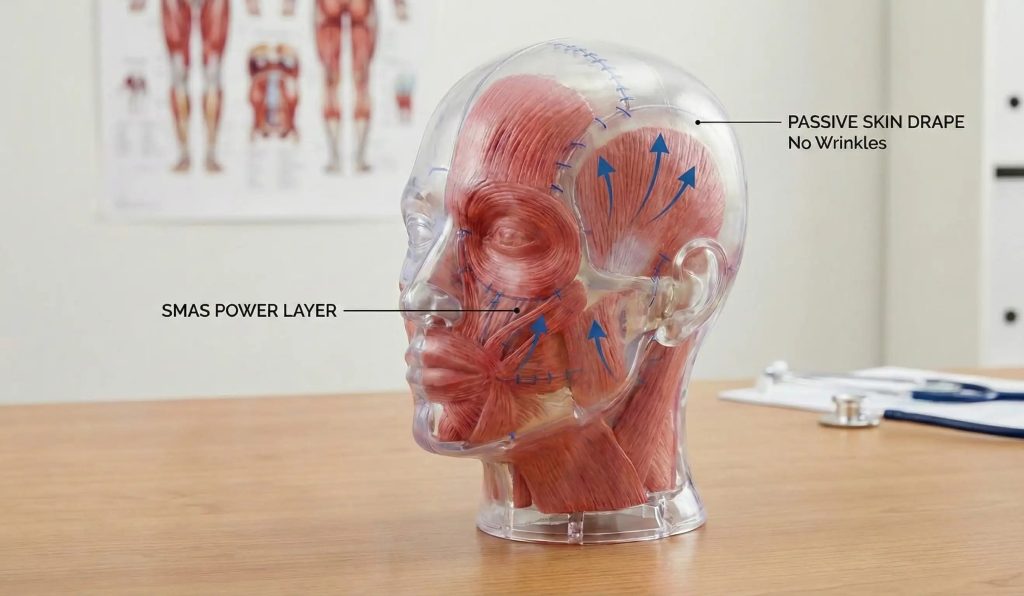
The Deep Plane (or SMAS) Facelift is the solution against the pulled look. We’ve recently discovered through advanced anatomy that aging of the face doesn’t appear on the surface but deep under the skin in the Superfacial Musculo-Aponeurotic System (SMAS). This is the fibrous net lying between your facial muscles and skin. With age, the SMAS layer gets loose and slides downwards taking the skin along with it as well.
A natural facelift is one that doesn’t basically depend on pulling the skin. Instead, the doctor in charge lifts the heavy SMAS layer and fixes it back to its youthful high position on the cheekbones with the help of sutures. The analogy goes like this: when making a bed, you shouldn’t just smooth the top sheet; first, you need to fluff the mattress and the pillows. When all the tension is taken by the deep muscle layer, the skin can be redraped on the face effortlessly without any stretching or pulling. The outcome is a face which feels soft when touched and behaves naturally when you smile or talk because the skin doesn’t act as a load-bearing wall.
Vectors of Youth: Vertical vs. Horizontal
Among other things, the main reason behind the “windblown” deformation is the direction in which the tissue is manipulated. Back in the day, plastic surgeons used to pull the tissues horizontally, which means straight back or towards the ears merely because it was more straightforward from a technical point of view.
Gravity pulls face vertically (downward) rather than forward. That’s why a natural rejuvenation will have to lift vertically (upward), going against gravity. A facial surgeon who pulls the face sideways is actually creating a “Joker” smile lateral sweep deformity. In such a case, the corners of the mouth are stretched and the sideburns get “lost” behind the ears. At Lin Europe Clinic, we are proud of our vertical vector approach. The cheek fat pads and the jawline are lifted almost vertically. This way, besides restoring the volume of the mid-face, the contour of the jawline is also defined without causing any distortions to the eyes or mouth. A vertical lift brings back the heart-shape of a youthful face, whereas the horizontal pull merely flattens it.
The Role of Volume: Deflation vs. Sagging

Simply tightening a face may result in looking so thin and bony that the face will appear unnatural and “surgical”. Aging is not only about gravity (the sagging) but also about deflation (loss of volume). Our temples, cheeks, and the area around the mouth are where the fat disappears as we grow older.
Using only a facelift to solve the problem of volume loss is like trying to repair a deflated balloon by stretching it—it just looks weird. To be able to walk the safe path concerning the “hollow” issue, facelifts nowadays are generally paired with facial fat grafting. We take fat from your body and carefully inject it into the hollows of the cheeks and the eyes. This is the effect of “putting back” the cushioning of youth. A full and elevated face indicates a biologically young one; a tight and hollowed-out face shows traces of surgery. Aging and volume loss are thus two problems that when treated together, limit the need for skin over-tightening.
Experience the Lin Europe Clinic: The “Un-Done” Look
At Lin Europe Clinic in Turkey, we see the best facelift as the one where nobody notices. We are experts in Deep Plane and High-SMAS procedures that put structural integrity ahead of superficial tightness. We are not willing to “skin-only” tweaks or “mini-lifts” that trade long-term naturalness and a higher price tag for a cheaper one.
Our surgeons take a humanistic approach to the face rather than viewing it as merely an instrument for engineering. We are aware that keeping a couple of wrinkles near the eyes may be necessary so as not to lose the sparkle and natural expression of the face. We do not want to give you a look of a different person or a 20-year-old version of yourself; we want to make you look like the best and most rested version of your present self. When you touch the mirror after healing, you won’t be looking at “work done” but a rejuvenated, energetic you instead of a tired stranger.
Frequently Asked Questions About Natural Facelifts
The deep plane facelift significantly extends the duration of your results because it not only repositions the heavy muscle layer but also securely anchors it. Deep plane facelift results typically last 10 to 15 years, which is much longer than skin-only lifts that can relapse within 3 to 5 years.
If done right, a facelift lifts the tissues vertically, so your mouth won’t look stretched. A horizontal pull causes the “Joker” smile or “fish mouth” deformity that is often seen after bad surgeries.
Facelift is a skin tightening procedure that mainly removes sagging skin and deep folds (jowls), however it leaves fine line wrinkles (like smile lines) which only intensify with age, and yet these are better treated with lasers or peels. Trying to remove each and every wrinkle can result in a mask-like look.
It is a hallmark of a botched facelift where the skin around the earlobe is overstretched and the lobe is hooked to the cheek. This is due to the great skin tension; hence, the expert surgeons eliminate this risk by making sure the ear incision is tension-free.
“Shiny” is the skin with no texture and looks unnatural. This condition is a result of excessive removal of the subcutaneous fat layer and pulling the skin too tight over the muscle, thereby thinning the dermis and obliterating the natural texture of the pores.
Hamra, S. T. (1990). The deep-plane rhytidectomy. Plastic and Reconstructive Surgery.
Mendelson, B. C. (2001). Surgery of the superficial musculoaponeurotic system: Principles of release, vectors, and fixation. Plastic and Reconstructive Surgery.
Jacono, A. A., & Parikh, S. S. (2008). The role of volume in aging and facelift surgery. Facial Plastic Surgery Clinics of North America.