
Usually after 4–6 weeks.
For most of our patients at Lin Europe Clinic, thigh liposuction is the finishing touch to a long fitness journey. It focuses on those stubborn fat areas like saddlebags or inner thighs, that even diet and exercise can’t get rid of. Many of these patients, therefore, are active and fitness-conscious individuals who eagerly anticipate their running routines after the treatment. The mental urge to “burn off” the surgery and hit the treadmill again is quite powerful.
Anyway, running is very different from walking or lifting weights. It is a high-impact, ballistic activity.
We do support walking straight after surgery to avoid blood clot formation, but running on top of that gives a totally different and dangerous stress to the healing tissues of the leg. Going back to the road or the track too soon not only causes pain but can even counteract the results of your surgery and result in complications with fluid and loose skin. Knowing the biomechanics of why your legs should rest from impact is the key to finding out whether you can get back to running safely on a firm, sculpted basis.
The Physics of Trauma: Understanding “Shearing Forces”
To see why running isn’t good for you at the beginning, you should try to follow the picture of what has been done to your skin below. Liposuction cuts through the fat layer thousand tiny times, thus internally separating the skin from the muscle fascia underneath. Your body’s response has been to “stick” the skin and the muscle back together. Such a re-attachment of the two parts is only possible through the fibrin clot and also the scar tissue that is formed at the first stage of healing.
Running causes what the physicists call shearing force. The impact with the ground when your foot touches it sends a shockwave up your leg. Because the skin is loose and the fat is gone, the skin “jiggles” or slides back and forth over the muscle.
- The Consequence: If you run before skin adhesion takes place, then this continuous sliding movement damages the fragile healing connections already torn. It hinders the skin from lying flat sticking down that way. That’s pretty much the first reason of Seroma occurrence (fluid pockets). The body reacts by releasing fluid to the area of friction for lubrication, thus a water balloon under the skin is formed, which can be later drained with a needle.
The Seroma Risk: Why Friction is the Enemy
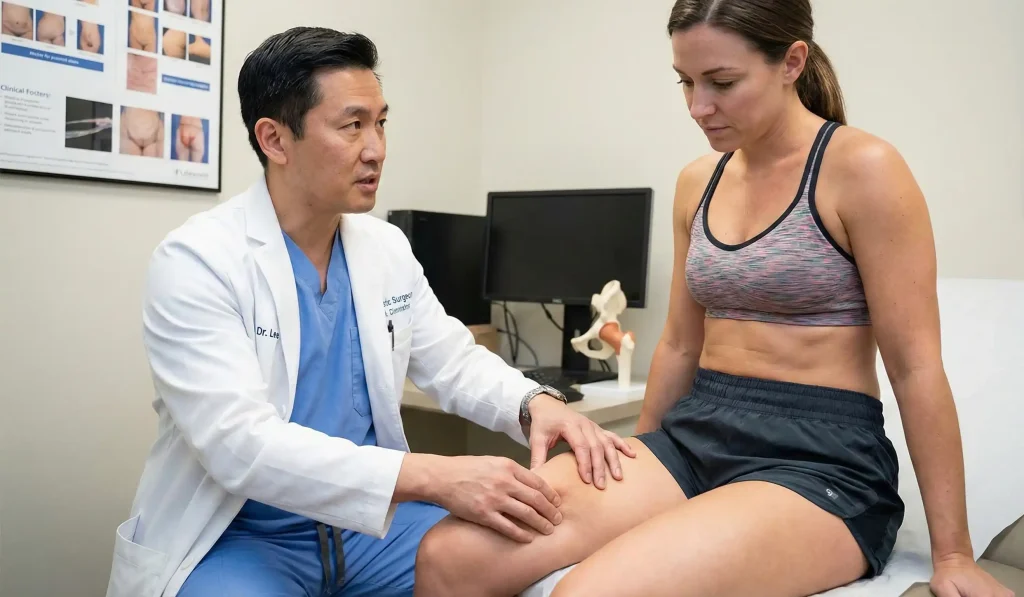
Friction has always been the archenemy of the seroma. With their constant movement, thighs are naturally one of the most common spots for seroma after body contouring procedures. So with the repetitive motion of your running—30 minutes means thousands of steps—you are making the perfect conditions for an accumulation of fluid. Having a seroma is not only a problem physically but also emotionally, it is your healing process. The fluid separates skin from muscle which prevents skin from tightening. Seroma in some cases when left untreated, can result in a formation of a capsule (shell) which surgically has to be removed. That is why we are very strict about keeping to the “no impact” rule. It is not that we want to deny you cardio gains, but it is total legs dry and tight maintenance that we want.
The Timeline: Walking to Sprinting
Running again is to be done step by step. You can’t go from being a couch potato to running 5 kilometers right away.
- Phase 1: Walking (Weeks 1–2): Walking must be your main mode of movement. Gentle, low-impact walking helps to get blood circulating and lowers swelling. But this is more of a shuffle than regular walking. You have to keep your heart rate very low.
- Phase 2: Static Cardio (Weeks 3–4): When your wounds are closed completely and the soreness has gone down, you are free to carry out low-impact cardio exercises. The stationary bike (best a reclined one) and the elliptical are the perfect choices. On these pieces of equipment, you can exercise your legs without the vertical ‘thud’ of landing. P.S. If you have had inner thigh liposuction, sitting on the bike could still feel uncomfortable.
- Phase 3: The Test Run (Week 6): Typically, this is the earliest point at which we allow our patients to run again. Start with a “walk/jog” interval on a soft surface (grass or treadmill, not concrete). If you experience a sloshing feeling, heat, or throbbing pain, stop immediately.
- Phase 4: Full Intensity (Week 8+): Sprints, HIIT, and long-distance runs should be postponed until 2 months after the operation so that the skin adheres firmly and the lymphatic system is prepared for the increased blood flow.
Skin Retraction and the “Gravity Effect”
Aside from the fluid threat, there is one more risk on the table—the aesthetic. Skin retraction is one of the objectives of thigh liposuction (we want the skin to wrap tightly around the thinner thigh).
Running causes gravity to pull the skin with every single step. And if the skin is swollen and healing and you keep exposing it to high-impact running, then the skin is basically being stretched out. You are working against yourself. It is similar to pulling at the wool sweater at the same time as you try to shrink it.
People who return to high-impact sports too early often observe that their skin does not tighten as much and the final result has more irregularities (waviness) compared with those who only performed low-impact activities like swimming or cycling during the period of contraction.
Inner Thighs: The Chafing Hazard

Inner thigh issues will be the main concern of a runner. Even with the present ‘thigh gap’, the postoperative swelling may temporarily make your legs touch more than before.
The numbness (dysesthesia) of this area also creates a risk level bump. You might not be able to detect the friction of your thighs rubbing each other or the shorts until you are fully undressed and then you may realize that the skin is raw and blistered.
- The Solution: When you restart running, you have to put on long compression shorts (biker shorts) that fit tightly and cover the entire surgical area. Not running in loose split shorts that allow the skin to come into contact with itself. Restoration of the healing scars with lubricants (for example, BodyGlide) is also a great thing to do to prevent friction burns.
The Role of Compression Gear
At Week 6 when you put on your running shoes, the surgical compression garment will most probably be too loose for you. On the other hand, running cannot be done unsupported. You are going to require a High-Impact Compression Legging.
You see it like your legs’ sports bra. Just like you would never consider running without breast support, similarly, you should not run without thigh support after lipo. Compression keeps the tissue ‘jiggle’ under control, thereby decreasing the shearing force on the skin and also reducing the rebound swelling which is at times experienced after exercise. There are many well-known sport brands that produce medical-grade compression tights for runners—get yourself a pair. If your legs are swollen significantly after your first run, it means either that you did too much or your compression was not tight enough.
The Lin Europe Clinic Difference: Athletic Recovery Protocols
At Lin Europe Clinic, we have a large number of athletes and fitness lovers among our patients, and so we know that for you “rest” is almost a swear word. We do not just hand you a blanket “no exercise” prohibition; rather, we create a pathway for you to re-achieve your performance.
Our post-op support team cautiously distinguishes for you the difference between “good pain” (muscle conditioning) and “bad pain” (tissue trauma). We give you precise instructions on lymphatic massage techniques especially highlighting those to be performed prior to and subsequent to your first couple of runs for the purpose of fluid management.
Furthermore, we perform skin quality evaluation at your follow-up appointments so that we can give you your personal ‘green light’ date. In case your skin is slowly retracting, we might tell you to do another couple of weeks of cycling before running so as to safeguard your beauty result. With the help of Lin Europe Clinic, your return to the track is safe, easy, and it also protects the investment you have made in your body.
Frequently Asked Questions About Running After Lipo
Yes, you may try slow walking on a treadmill at day 2 or 3 after surgery (flat incline) mainly to promote circulation. However, use such a low speed that you are not bouncing or sweating heavily.
When you exercise, blood flow to the muscles increases. Your lymphatic drainage system is still healing from the operation and it cannot quickly get rid of this extra fluid, thus there will be a temporary “rebound swelling” post-workout.
Yes, swimming is a great activity since water pressure serves as natural compression and there is no impact. However, you cannot go swimming until all your wounds are perfectly healed and waterproof (normally 4 weeks) so as not to get infected.
Yes, indeed you should. However, the moment you are done, you have to shower and change into a clean and dry garment. Being in a sweaty and dirty compression garment is definitely inviting a bacterial skin infection.
When you experience moving fluid under your skin, your first reaction should be to stop. This is an indication of seroma (fluid collection). By running you are only aggravating the condition. You need to get in touch with your doctor for a check-up.
Kenkel, J. M., et al. (2008). Hemodynamic physiology and thermoregulation in liposuction. Plastic and Reconstructive Surgery.
Rohrich, R. J., et al. (2004). The key to long-term success in liposuction of the legs. Plastic and Reconstructive Surgery.
Chow, I., et al. (2015). Postoperative management in body contouring. Clinics in Plastic Surgery.