Vaser lipo offers more precise fat sculpting.
The practice of Liposuction continues to be one of the most popular Medical Procedures globally; however, the associated technology has progressed massively over the past decade. The dilemma for many patients is whether to go for Regular Lipo (Traditional Suction-Assisted Liposuction) or VASER Lipo (Ultrasonic-Assisted Liposuction). They commonly wonder if the additional money spent on VASER can bring a better outcome or if it is just a marketing gimmick. Lin Health Europe Clinic considers these options as specialized Surgery procedures within our Cosmetic Surgery division, and we think that the decision should be based on the clinical facts instead of the hype.
Both methods do indeed extract subcutaneous fat, but they apply entirely different principles of physics. In order to decide which of the two methods will be the most “beneficial” in your case, one should not focus only on the amount of fat that can be taken away but also weigh factors such as tissue damage, skin tightening, and the degree of accuracy that would lead to an aesthetically pleasing transformation. Nowadays body contouring techniques aim not just for the reduction of size but for definition as well. According to nowadays research, patients 2026 want a “sculpted” look, thus the focus is shifting from weight loss to bony framework of the body.
Fat Extraction: The Underlying Physical Principles
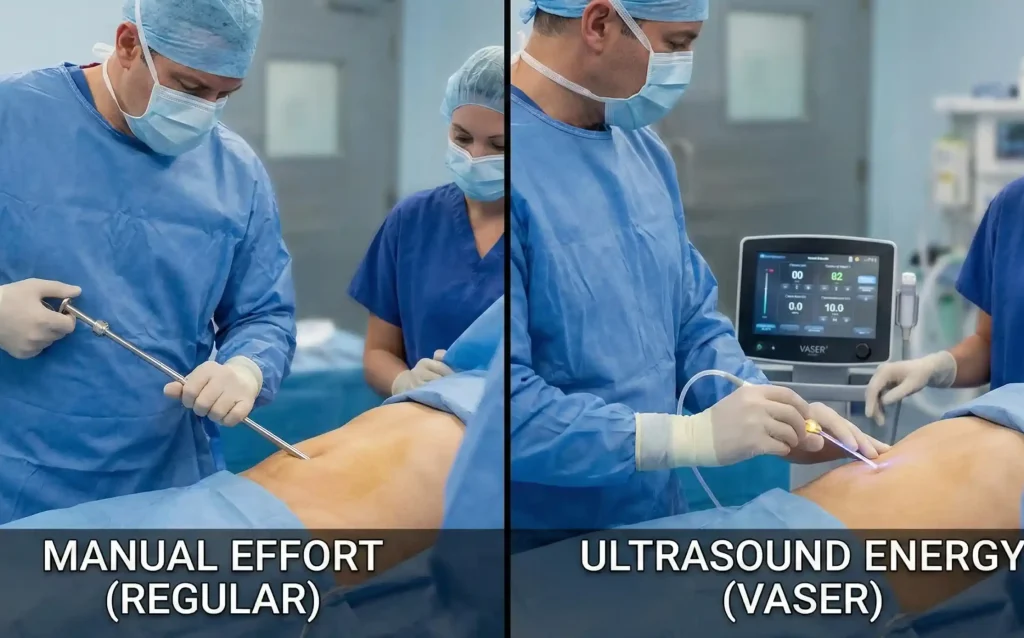
The fundamental difference between Regular Lipo and VASER Lipo is the method used for freeing fat cells from the surrounding tissue fiber network before removing them. Regular Lipo features a cannula which is essentially a hollow tube and the process mainly depends on the physical energy exerted. The plastic surgeon uses a cannula and physically moves it in a back-and-forth motion so as to break up and dislodge fat deposits. As this technique happens to be “non-selective,” it is capable of damaging accidentally other structures such as nerves, blood vessels, and connective tissues. That is probably why, according to existing data, conventional methods cause more bruising and take longer to heal the initial phase, among other things.
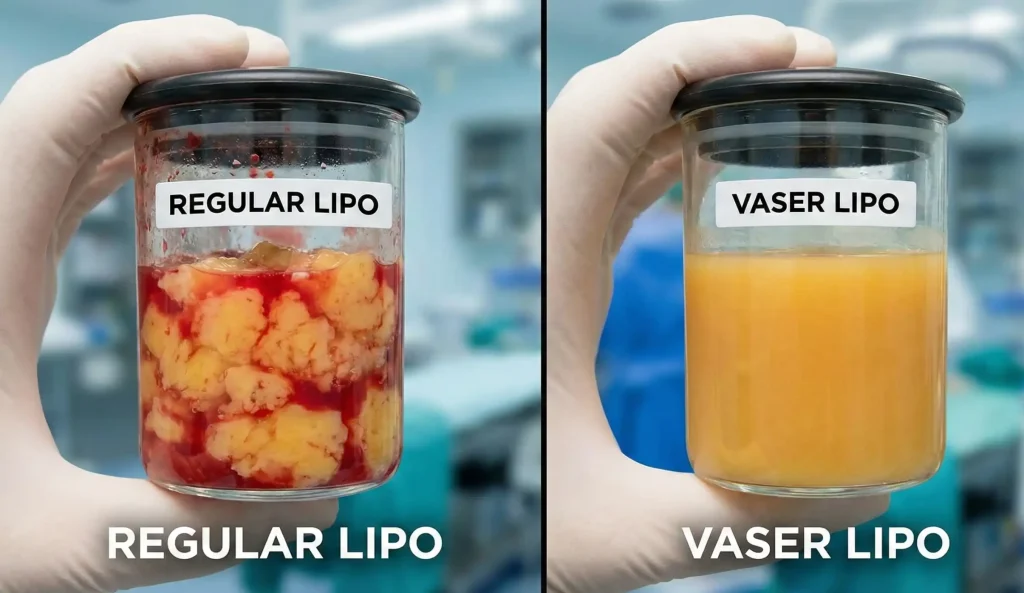
VASER Lipo, on the other hand, means Vibration Amplification of Sound Energy at Resonance. This system employs ultrasonic sound waves to break the fat cells in an extremely selective manner. The ultrasound energy initiates the cavitation process which involves multiple bubbles in the tumescent fluid that eventually burst and thus emulsify the fat, which is then drained in liquid form. The surgeon, therefore, can suction out the fat easily from the liquid state and the surrounding structures remain intact as the assisting blood vessels and nerves are scarcely touched. Hence VASER minimizes tissue damage during the procedure, leading to a better and finer result.
Collagen and Skin Tightening
A major clinical feature that distinguishes VASER Lipo from RegularLipo is the difference in skin surface. When liposuction is done, a space or a void is created. This void is located between the skin and the muscle underneath. If the skin does not shrink to fit this newly created space, the patient will have loose or “crepey” skin. Regular Lipo may impact on skin tightening to the level of that genetically inherited by the patient. In case one is in his/her older age, or has mild skin laxity, traditional suction could even make the skin look more wrinkled than before, once the volume is lost.
By carefully using heat VASER Lipo caters to the problem. The continuous movement of the ultrasonic probe causes the tissue to produce heat and in turn, collagen fibres are stimulated in the deep dermis. This “shrink-wrap” effect initiates a Skin Retraction that lasts for several months after the operation. In one research, it was stated that VASER can achieve much more skin tightening than traditional methods, therefore it is a better option for delicate parts of the body such as the neck, arms and inner thighs where the skin is naturally thinner and hence more easily lax.
High-Definition Sculpting: The Athletic Edge
A very important aspect of VASER Lipo in the performance of High-Definition (Hi-Def) Liposculpture is the precision level of the device. Because the fat is liquefied, surgeons can remove it from the very superficial layers directly under the skin without creating the “divots” or “dents” that are common risks with the mechanical scraping of Regular Lipo.
The surgeon then is able with the utmost precision to highlight the abdominal muscles or even to “define” the shoulder muscles for a most natural look. In the case of traditional mechanical liposuction, it is very risky to work so close to the skin surface. By using VASER, the surgeon has the liberty and the tools to create shadows and highlights of the anatomy as an artist would, so that the patient gets a “gym-fit” look even if he/she does not have regular and sufficient access to muscle definition through exercise. Therefore, it acts as a bridge between mere fat removal and real anatomical makeover.
Healing and Trauma: The Recovery Schedule
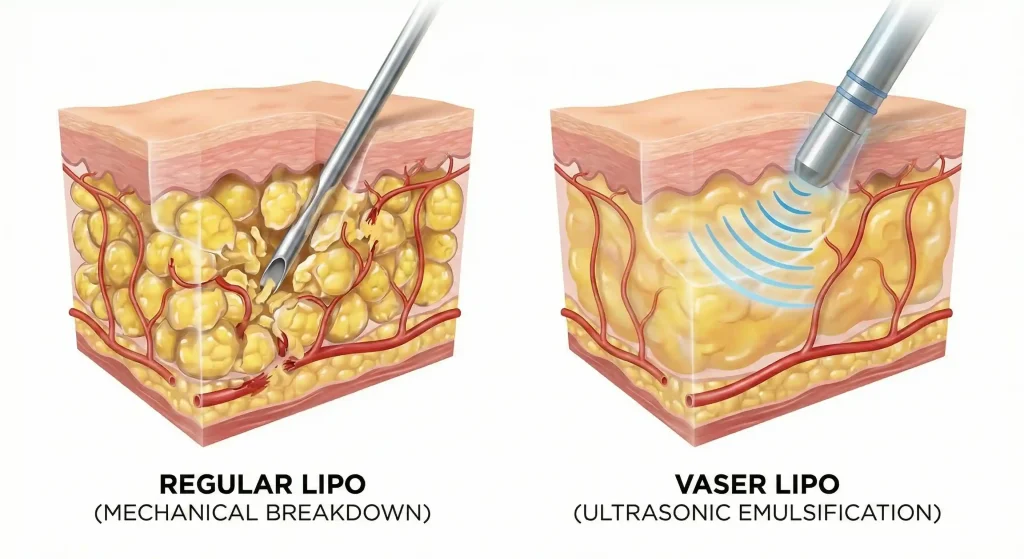
There are differences not only in the initial outcome but also in the total recovery time between the two methods. In the process of Regular Lipo, the physical and forcibly applied motion that a plastic surgeon needs to do in order to separate the fat, which is sometimes quite compact, might be the cause of extensive post-surgical swelling and bruising.
Since VASER Lipo is selective of the tissues to be treated, the internal skin “scaffolding” made up of collagen fibers, nerves, and lymphatic pathways remains mostly undisturbed. The fact that the natural structure of the body is preserved means that the patient can expect to experience less pain, less bleeding, and a quicker return to his/her regular activities. In both procedures, it is still necessary to wear a compression garment to control fluid build-up, but VASER patients often say that their healing process was more comfortable and that they had fewer problems such as fibrosis (hard lumps) or prolonged numbness.
Vaser Liposuction in Turkey: Why Choose Lin Health Europe Clinic?
Istanbul has established itself as the world center for body contouring, but the standard of care here is still all over the map. It is very important to pick a Medical Facility that focuses on patient safety and real technology rather than the number of people. Vaser Liposuction in Turkey features the latest generation VASER equipment and the experienced board-certified plastic surgeons who excel in high-definition body contouring are the ones who conduct all the procedures at Lin Health Europe Clinic. We recognize that it is a big step to undergo surgery abroad, which is why we have put together a medical tourism package including VIP airport transfer, 5-star hotel accommodation, and English-speaking patient coordinators who are always at your disposal. Choosing Lin Health Europe Clinic means that you will have the opportunity to access the top-notch VASER technology and expert surgical artistry from the comfort of your own home at prices which are just a fraction of that in the UK or US and, moreover, you will get uncompromising safety and results.
Frequently Asked Questions About Vaser vs. Regular Lipo
Yes. Vaser has the added cost of specialized ultrasonic equipment and the surgeon must have advanced surgical training, thus the procedure price is higher than the price of the traditional manual liposuction.
Of course. Even though the fat is liquefied, the cells remain alive and capable to be transferred to the breasts or buttocks. Moreover, surgeons are agreeing that the consistency of emulsified fat is actually smoother for reinjection results.
Vaser can cause the skin imprint and contraction through collagen significantly, however, it does not substitute a tummy tuck. If you have hanging skin with stretch marks, a surgical case will still be required to cut the scrap off.
Definitely. Regular suction-assisted liposuction is the basis of body contouring and has been done safely for decades. It is still a very good instrument for superficial fat layer reduction.
In most cases, yes. As there is less destruction of nerves and connective tissue, the post-operative pain and swelling with Vaser Lipo are generally less than with regular mechanical lipo.
Jewell, M. L., et al. (2002). Clinical application of VASER-assisted lipoplasty: A pilot study. Aesthetic Surgery Journal.
Garcia, O., & Nathan, N. (2008). Comparative analysis of VASER-assisted lipoplasty and suction-assisted lipoplasty. Plastic and Reconstructive Surgery.
Hoyos, A. E., & Millard, J. A. (2007). Vaser-assisted high-definition liposculpture. Aesthetic Surgery Journal.