Expect soreness and swelling for a few weeks.
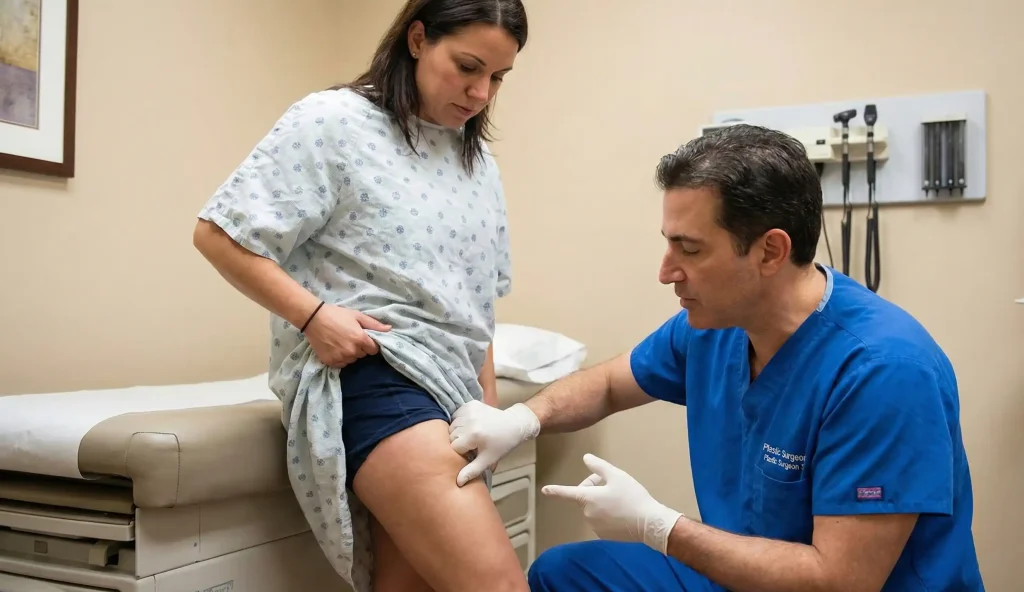
Thigh liposuction is an incredibly effective procedure to streamline one’s figure. However, it is also the locker body contouring surgery with the most underestimated downtime. If you think of abdominal liposuction, you’re mostly dealing with the core that you can rest and protect. But your legs are the main engines of your daily life and you simply cannot “turn them off.” Every time you get up, walk to the bathroom, or turn in bed, you are using tissues that have just been traumatized by surgery.
People tend to expect a bit of soreness only, but actually, the reality includes the swelling brought about by the pull of gravity, nerve hypersensitivity, and loss of mobility. Recognizing the physiological basis of these symptoms and realizing that the sensation of “heavy legs” is only for a short time, is very helpful for one’s inner calm. To assist you in the preparation for what lies ahead, this article has reworked recovery into five clearly defined phases
Where Is the Pain? It Can Range from Muscular Cramps to Surface Burning
Thigh liposuction really has an unusual pain profile owing to the fact that it changes. Just a few days after the operation, one can hardly feel anything but the muscular pain. Patients talk of the pain as if it was a deep-tissue bruise plus the muscle soreness resulting from having performed an extremely arduous and untrained leg workout, say 500 squats. Due to the fact the cannula is constantly moving between the skin and the muscular fascia, a “Charley Horse” type feeling is produced. The muscle is not cut, however, the sheath that covers it is irritated and this leads to an inflammatory reaction that is felt as a severe sporting injury. This pain coming from deep inside the body is usually constant and it also produces a sensation of “heaviness,” as if the legs were made out of lead.
When the internal bruising starts to fade, approximately after two weeks, the new feeling which is Neuropathic Dysesthesia starts to appear. The thighs’ skin, especially the inner part, is very rich in sensory nerves that are close to the surface. These nerves are momentarily “knocked out” by the trauma. They regenerate, but do that in an abnormal way and the result is that they send sudden, sharp electrical “zaps” or there is a continuous “sunburn” sensation of the skin which looks and feels hot and raw. This “burning” stage is a good indication that feeling is coming back, but it can be very inconvenient when the clothing rubs against the over-sensitive skin.
The Nextarenvironment and the Movement of Watery Swelling “Cankles”
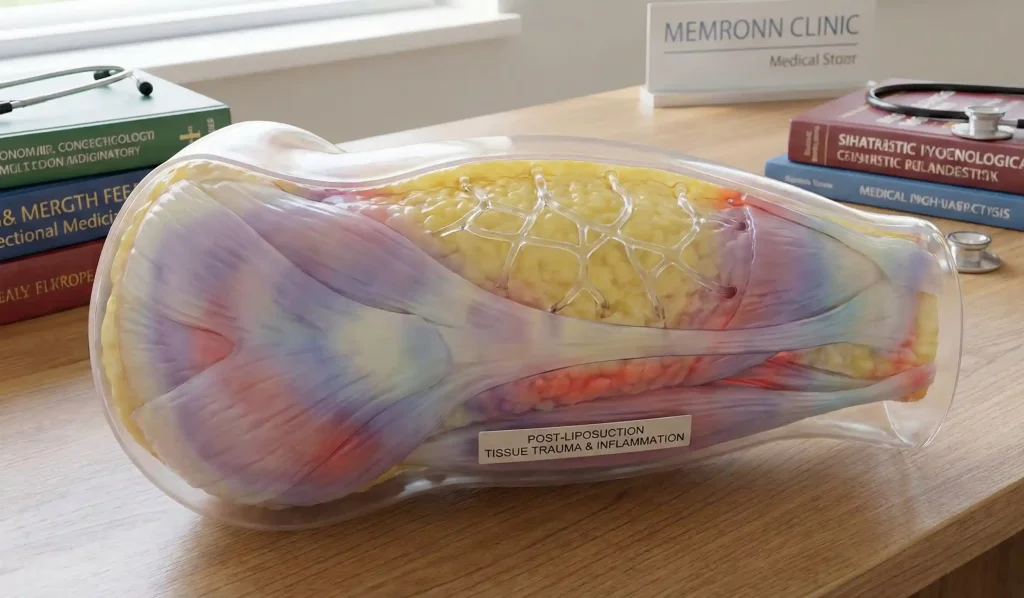
The migration of swelling is the most disturbing thing from the visual point of view during the recovery. It is unlike even breast surgery where the swelling remains local because the leg swelling is under the influence of gravity.The lymphatic system in the upper part of the legs is only temporarily functioning properly, thus the fluid that drains toward the torso is caught in a traffic jam scenario since the pathways are blocked. As the fluid cannot flow upward, it flows downward instead.
You will probably see around Day 3 or 4 that your knees, calves, and ankles are all swollen. You might discover that your ankles have disappeared or that there is tense, glossy skin by your shins. This is the so-called dependent oedema. Elevating the legs is going to be your full-time job if you want to beat it. Your legs must be raised above the hip level whenever you are not moving around. We recommend putting a couple of pillows under your calves (not your heels) so that the fluid goes back to your body core naturally with the help of gravity. If you do not make elevation a habit, then the swelling will linger for a long time.
Functional Recovery: Walking, Sitting, and Hygiene
The most challenging and frustrating ones are usually the logistical problems. Even small things require good planning and careful execution. The first obstacle to overcome is “Start-Up Pain“. You get stiff muscles and fluid accumulates when you stay still. Once you stand up, blood rushes to the legs because of gravity and the accumulating pressure causes sharp throbbing pain. The initial steps will be slow and rigid and you will most probably be forced to walk with bent knees to prevent them from touching. As soon as you power through the initial few steps, the muscles heat up and the discomfort subsides.
The bathroom is another place where the patients come across difficulties. Squatting is especially difficult when the quadriceps are sore. Obviously, hard toilet seats put pressure exactly where the thighs are most sensitive. Some patients, in fact, will have to install a raised toilet seat or do an arm-supported “hover” technique for the first week in order to “hover” as they do the “hovering” they also keep their muscles active. Also, getting into a car requires a “swivel” technique: sitting on the seat first with both legs outside, then swinging them in together, rather than stepping in one leg at a time.
Importance of Compression and the Risk of Stiffness
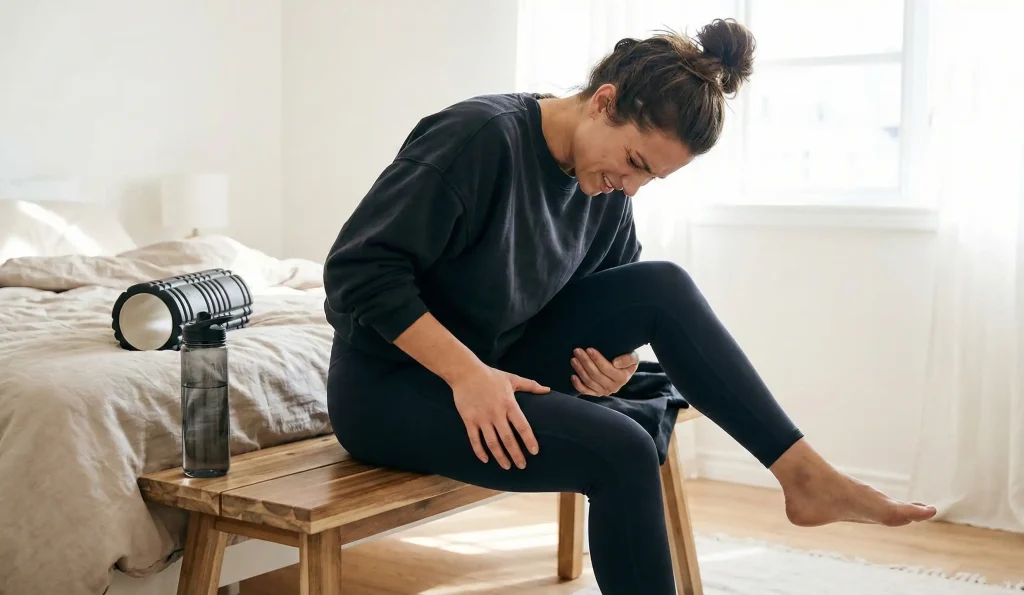
The compression garment is an absolute must in the case of liposuction thighs. Legs are vertical structures, therefore the hydrostatic pressure of blood is high. If there was no compression, legs would become very swollen and painful which later one would also have the risk of seromas and uneven skin. The piece of clothing resembles a second skin and it keeps the tissues pressed together thus the “jiggle” during movement that causes pain is not there.
On the other hand, between rest and movement, you have to find some point of equilibrium. Even though moving is painful, not moving is putting your life at risk. Other than that, the risk of Deep Vein Thrombosis (DVT) at the leg surgery sites is higher than elsewhere because the trauma has been done in the vicinity of great veins. So you have to walk. We recommend walking shortly but very often (5 min. every hour) to get the calf pump mechanism going which is the one responsible for the blood returning to the heart. This will prevent both stiffness and blood clots. As a matter of fact, you probably would like to lie down but in properly planned bedridden recoveries, the formation of tighter scars is avoided. Thus, the saying is ‘Walk a little, rest a lot.’
Experience the Lin Europe Difference: Your Safety Net
When mobility is affected, one can feel very lonely on the way to recovery from thrombolysis. At Lin Europe Clinic, we offer a comprehensive system of assistance going especially to body contouring patients to help them get back to normal life after surgery without any problems. You simply can’t ‘dash off to the pharmacy’ when your walking is difficult. We take care of the whole situation for you.
Inspecting the skin in the leg area is one of the skills the medical staff is trained for. We watch the swelling migration very closely to ensure that it stays at the normal level of ‘dependent oedema’ and that there is no clot formation. We support you throughout the whole pain progression process, from acute pain to the ‘itchy/burning’ nerve regeneration phase, and we reassure you that the sensations you feel are the signs of success. Also, on the occasion of compression garment fitting, we make sure the device fits the thigh perfectly and does not compromise blood circulation. Having surgery with Lin Europe Clinic means you don’t have only the operation to look forward to. You get a trooper by your side who takes (very careful) steps with you all the way through your transformation.
Frequently Asked Questions About Thigh Lipo Recovery
The deep, intense, bruise-like muscle soreness usually reaches its highest level at around day 3 and by day 10 the pain is noticeably less, however, a mild discomfort may stay for approximately a month.
These sudden shocks or “zaps” happen because the sensory nerve ends on the skin are going through a process of regeneration as they were temporarily stunned during liposuction procedure; hence, it’s a normal healing sign.
Indeed, the force of gravity causes lymph fluid to drain from the thighs to the calves and feet, leading to temporary swelling, which, if the feet are properly elevated, generally disappears around 3 to 4 weeks.
It is recommended not to cross your legs for the first few weeks post-surgery since it limits the blood flow and may cause uneven pressure on the healing fat tissues, thus, potentially altering the contour.
Generally, you may start light walking straight away but be careful to avoid any high-impact leg exercises such as squats, lunges, or running for at least 6 weeks so that the tissues can properly bind.
Illouz, Y. G. (1983). Body contouring by lipolysis: a 5-year experience with over 3000 cases. Plastic and Reconstructive Surgery.
Dixit, V. V., & Wagh, M. S. (2013). Unfavourable outcomes of liposuction and their management. Indian Journal of Plastic Surgery.
Pitman, G. H., & Teimourian, B. (1985). Suction lipectomy: complications and results by survey. Plastic and Reconstructive Surgery.