Severe pain, excessive swelling, or difficulty breathing are red flags.
Rhinoplasty entails a lot of patience and it’s often likened to a roller coaster ride with the different stages of swelling, stuffy nose, and weird sensations. Most patients who undergo this surgery usually have a safe and predictable healing process even though at times it might hurt. However, the risk of complications exists because the nose is the main vascular and central feature of the face. If such complications are neglected, they can quickly become serious. Not knowing what is happening makes one anxious, and this results in excessive mirror-gazing to check out every detail and sensation.
Differentiating between the “normal, ugly” side effects after surgery and genuine medical emergencies is a common struggle among patients. How can one tell if the throbbing pain indicates only post-operative recovery or an infection? Is that small nosebleed really normal or does it represent a hemorrhage? The ability to distinguish between the two will most definitely mean that you will be safe and at the same time get the best result. From our perspective at Lin Health Europe Clinic, we think that when a patient is knowledgeable, then they are safe. We want you to be comfortable with identifying the warning signs and if you do not feel very well or if something is not right, then it should be easy for you to act fast and get help.
The Bleeding: Drip vs. Gush
Following a nose surgery, bleeding that is minor is perfectly normal. For the first one to two days, you might need to wear a drip pad (i.e., a piece of gauze taped under the nose) because a combination of mucus and blood will come down the nose. This is a totally natural thing and should go away pretty quickly as you are resting with the head raised.
What’s the Problem: The abrupt, continuous flow of bright red blood that doesn’t seem to slow down. A Hemorrhage is when you are bleeding so heavily that every 10 to 15 minutes you find yourself soaking a gauze pad through or the blood is running to the back of your throat and you choke. This is one of the ways a spike in blood pressure—due to such activities as bending over, carrying heavy things, or straining on the toilet—can cause the rupture of a vessel that is coagulated. you should immediately seek medical help so that the nostril can be packed or the vessel can be cauterized. Don’t just keep changing the gauze; be sure to call your surgeon or go to the emergency room without delay.
The Pain: Manageable vs. Escalating
In general, post-operative discomfort after rhinoplasty is surprisingly small for most of the people. Instead of a feeling of sharp surgical pain, it is commonly compared to a really bad head cold or sinus pressure. By Day 3, most of the patients gradually wean themselves off of the more potent prescription painkillers and take only Tylenol.
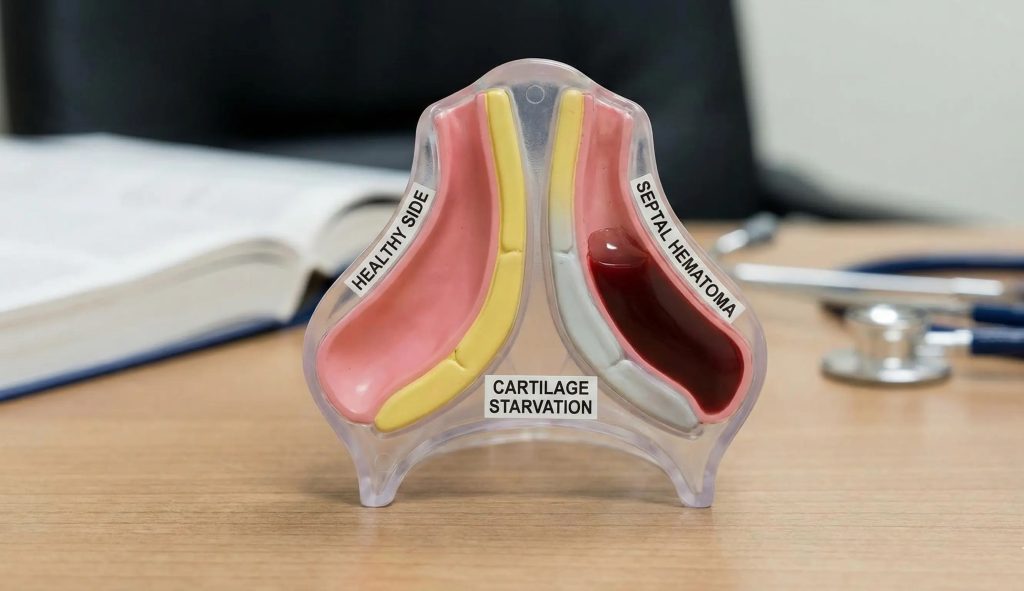
What’s the Problem: The pain is so unbearable, throbbing and it keeps increasing even after Day 3. If the pain is not alleviated by taking medication or there is a presence of intense heat and pressure inside the nose then it might be a Septal Hematoma. A Septal Hematoma is a blood clot trapped in the thin layer of tissue that lies on the septum cartilage. If the hematoma is not drained on time, the increased pressure can cause the death of the cartilage which results in a saddle nose deformity or even a perforation (a hole) in the septum. This pain that keeps increasing is never something to “be brave”; it is a desperate call from your body for assistance.
The Skin and Cast: Bruised vs. Burning
Your nose and eyes will definitely be the main targets of assault. Changing colors from purple to yellow and green is your body’s way of telling you that you are on the right track in terms of healing. Your nose tip may also be shiny and swollen. Nonetheless, you need to be very careful in how you perceive the whole cast thing.
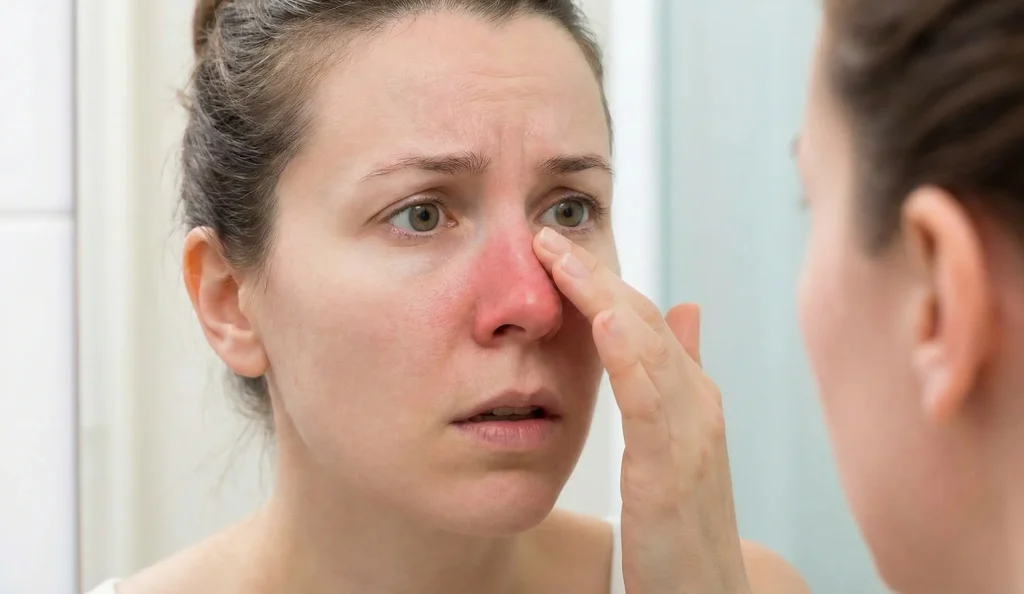
What’s the Problem: When the skin becomes discolored in various shades like dusky, grey, pale white, and even black the implication is Skin Necrosis or vascular compromise. However, Cast Pressure is equally important. The cast ought to be a perfect fit to the nose but it shouldn’t be so tight that it feels like it’s gouging your skin. If a sharp, localized burning pain appears under the plastic splint which lasts for hours and you don’t know what to do about it then possibly you are already at the stage of a pressure sore formation. Neglecting this kind of sensation will give you a scar or an indentation on the bridge that is permanent. Likewise, if your cast is excessively loose and starts moving around dramatically before it is due for removal then this should not be overlooked either. When a cast is loose it can rub on the skin and cause irritation; in this case, you should get in touch with a clinic where they can fix the issue.
The Fever: Low Grade vs. Spike
For the first couple of days, it is perfectly normal to have a temperature that is a bit on the high side (roughly 37.5°C or 99.5°F). What happens here is that your body is reacting metabolically to trauma and anesthesia which is also termed as “resorption fever”. More often than not, this temperature is not a sign of a serious problem.
The Red Flag: Severe fever that rises up and goes above 38.5°C (101.3°F), especially if it is in the 3-5 day post-operative period. At this point one is susceptible to a bacterial infection. If the symptoms that come with the fever are shaking chills, vomiting and the smell of the discharge from the nose is really bad (pus), then bacteria is the culprit. The use of antibiotics that are taken by mouth is usually the immediate treatment to heal infection before the sinuses get involved or the cartilage grafts get damaged due to infection. Do not make a mistake of thinking that your condition is flu because, in the context of recent surgery, fever should be considered as a symptom until proven otherwise.
Experience the Lin Europe Difference: 24/7 Monitoring
At Lin Europe Clinic in Turkey, we do not leave you to wonder constantly about how you have progressed. Each patient who visits us is given an elaborate “Traffic Light” system to recovery where Green (Normal), Yellow (Caution), and Red (Emergency) represent different stages of healing. Besides, we continue to check the patient’s condition especially for septal hematomas and skin perfusion even before the patients are discharged after the first week.
Since we understand that anxiety cannot be regulated by working hours, our aftercare response team is at your disposal at any time of the day. Patients are free to send in pictures when they are not sure. Rather than missing one sign of a hematoma or a cast pressure sore, we would prefer to receive ten photos of a normal, messy nose. We guarantee you a safe, not only successful, journey to a new profile through mutual vigilance and partnership.
Frequently Asked Questions About Red Flags After Rhinoplasty
Light dripping is normal for 2 days. On the other hand, if you are wetting a gauze pad with bright red blood every 15 minutes, this is a red flag showing bleeding in the nose. Get help right away.
Septal hematoma is essentially the pooling of blood inside the nose, which is very dangerous. The main red flag here is the severity of the pain and difficulty of breathing through both nostrils that lasts for a while. This is usually accompanied by the soft and spongy feeling inside the nose.
Mostly, it is just mucus. Nevertheless, if you are experiencing a drip of clear and watery fluid all the time coming out of your nose, and it also tastes salty or metallic (CSF leak), and gets worse when you bend over, this is a very red flag although it is a rare occurrence after rhinoplasty.
You can expect the mild smell due to the crusts forming, but a strong and disgusting (rotten) smell along with the yellow or green discharge is a clear sign that the inside of your nose might be infected.
Definitely , a fever higher than 38.5°C(101.3°F) is a redflag that plays an infection. If it happens a few days after your rhinoplasty, particularly 3-5 days, then you are advised to seek help from your surgeon for prescription of antibiotics.
Rohrich, R. J., & Muzaffar, A. R. (2002). Rhinoplasty in the African-American patient. Plastic and Reconstructive Surgery.
Rettinger, G. (2007). Risks and complications in rhinoplasty. GMS Current Topics in Otorhinolaryngology.
Cochran, C. S., & Landecker, A. (2008). Prevention and management of rhinoplasty complications. Plastic and Reconstructive Surgery.