Temporary swelling or nerve irritation may cause it.
The Course of Marginal Mandibular Nerve
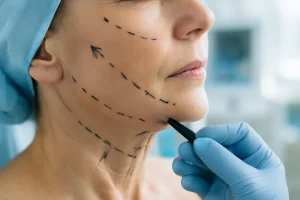
Within the niche area of submental contouring and intimate lower-third facial restoration, a patient may manifest temporary facial asymmetry or a “crooked smile” post-chin liposuction, which is actually one of the characteristic clinical manifestations. The root of this particular motor incongruity lies in the temporary disruption of the marginal mandibular nerve, which is a fine neurological offshoot of the facial nerve that extends along the lower jawline.
This distinct nerve branch is the one that actually governs the motor signals going to the muscles responsible for lowering the lip, particularly the depressor anguli oris. While performing submental liposuction, the repeated movements of the surgical cannula under the skin surface can cause traction, compression, or even localized friction in the area of the nerve pathway. This simple physical movement causes a nerve to temporarily come under a condition, which the medical community calls neuropraxia or very simply, nerve stunning. The nerve is only stunned or affected on one side; consequently, the muscle signal transmission will be slowed down. As a result, the lower lip appears uneven, flat, or slightly crooked during speech, smile, or laugh.
Post-Surgical Edema and Tissue Compression Asymmetrically
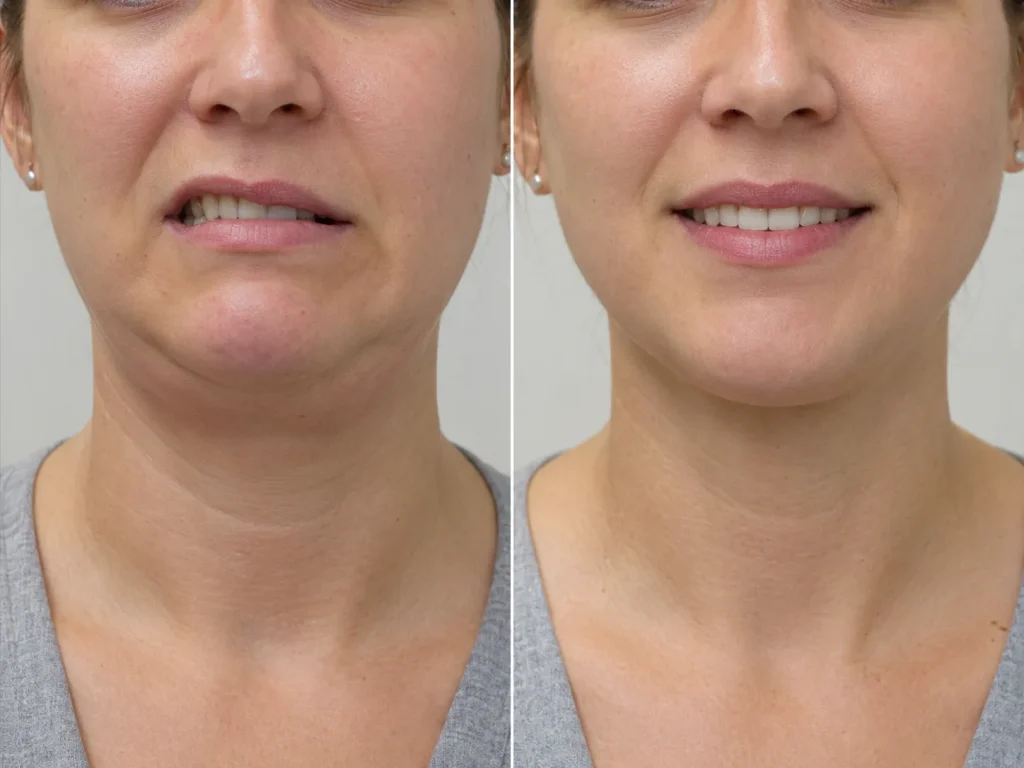
Although the major biological cause of a crooked smile is nerve stunning, severe and uneven post-surgical fluid retention (edema) can enhance this temporary facial imbalance even more. Chin liposuction results in a very intense localized inflammatory response within the submental tissue layers, bringing about an asymmetrical collection of fluid over the jawline.
When swollen parts trap delicate nerve fibers or the local muscle matrix is compressed only on one side of the face, it resists natural facial expressions. This localized fluid pressure can give a false impression of nerve stunning or can aggravate it, making the lower lip appear to be very stiff on the side that is more swollen. As this acute tissue fluid is naturally drained by local lymphatic pathways in the first weeks post-operation, muscle pressure is reduced, and the smile progressively comes back to its normal balance.
To Promote Safe Nerve Regeneration Lower Jaw Kinetics
Strict behavioral compliance is a must during this delicate nerve repair phase, especially for those who live a disciplined lifestyle and seek facial symmetry perfection. Face kinetics support is essential to your structural progress if you are a dedicated person who keeps a sharp, high-definition facial matrix to complement an elite, highly conditioned athletic body. Doing strong, larger facial movements or getting the physical friction on the jawline will biologically penalize you very seriously: besides increasing localized tissue inflammation, it will also delay neural recovery.
If you want to give the marginal mandibular nerve a chance to heal without internal friction, you must refrain from opening your mouth wide and consume only soft, easy-to-chew foods for the first two weeks after the surgery. Besides, giving up nicotine and tobacco products altogether is a must for the whole period. Nicotine is a powerful systemic vasoconstrictor that restricts the facial capillaries, and as a result, the healing nerve fibers and soft tissues get deprived of the most essential oxygenated blood supply necessary for completing neural repair. Letting your jawline recuperate without chemical or physical stress is what you need to restore your facial symmetry at its best biological level.
Healing and Symmetry Stability: The Biological Clock
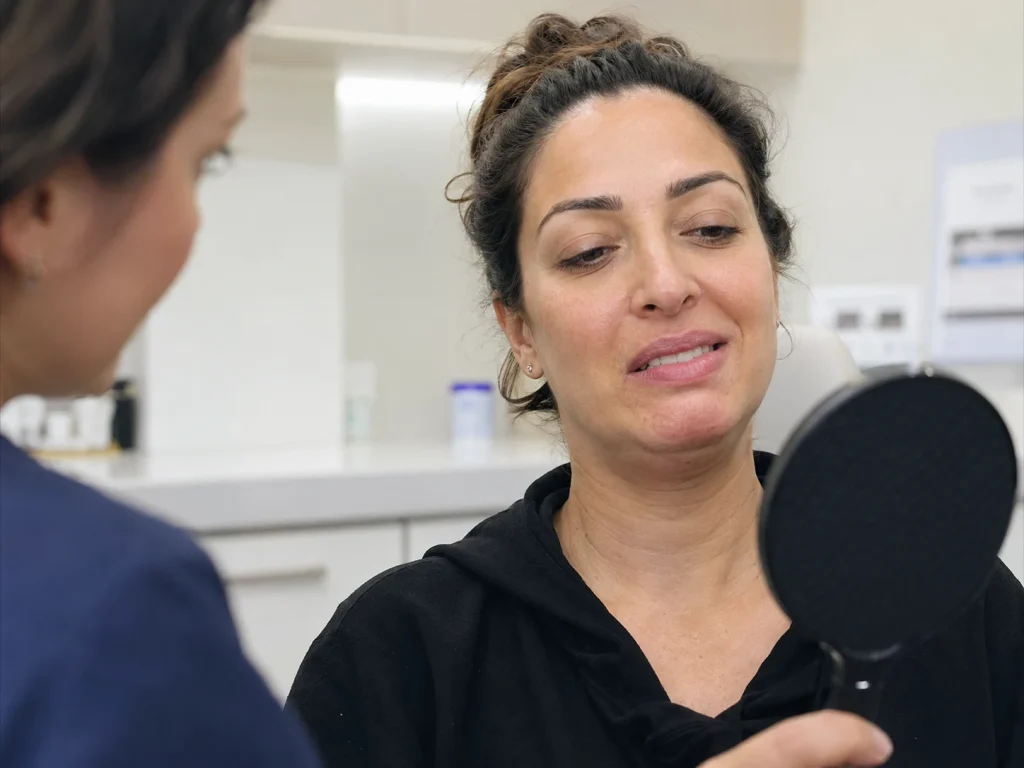
Being aware of the long-term biological clock of nerve regeneration can be very reassuring and give you a clue about when your symmetric smile will be fully restored. Note that neuropraxia is not a type of nerve damage that is permanent; the nerve’s underlying architecture is preserved, which means that, in time, a full recovery is expected.
| Recovery Phase | Timeline | Biological Progress |
| Acute Swelling Phase | Weeks 1–2 | Intense fluid pooling; peak asymmetry and muscle stiffness. |
| Early Neural Repair | Weeks 3–6 | Initial nerve firing returns; lip mobility begins to look more balanced. |
| Final Stabilization | Months 2–6 | Complete clearing of micro-swelling; smile symmetry is 100% restored. |
In a matter of weeks or months, the effect wears off, and nerve fibers finish their repair path. Once this structural fixing is done, the lower lip muscles get the full neurological ability back, that is, they can perfectly deliver from all angles, a nicely balanced, sharp, and natural smile line.
Turkey as a Destination for Chin Liposuction
Selecting LIN Europe Clinic means stepping into a top-tier global medical haven where your facial aesthetics, advanced structural contouring, and surgical pathways are offered with clinical excellence without compromise and profound empathetic care. Besides, the domination of evidence-based medicine is our core principle. LIN Europe Clinic in Turkey offers the top element in the international arena of advanced facial remodeling and submental care, while also providing a tranquil place where your health plan is strictly overseen by the highest global patient safety standards.
Trusting our committed staff of specialists at LIN Europe Clinic in Istanbul means getting your recovery parameters checked with the utmost diagnostic accuracy. Furthermore, we offer complete, tailored post-operative instructions; nerve-recovery monitoring and customized healing protocols to escort you thoroughly through each step of your tissue maturation and lifestyle integration. Our top medical team will be guarding your beauty investment and overall health balance while you enjoy settling into your perfect silhouette with full peace of mind. Discover the exquisite, all-inclusive care of LIN Europe Clinic, and accomplish a perfectly balanced canvas, safely and skillfully done right in the center of Turkey.
FAQ:
Your smile is crooked because the marginal mandibular nerve running along the jawline was knocked out or compressed by swelling and cannula movement during the operation, resulting in temporary weakness of the lower lip muscles.
For the most part, such temporary crookedness is naturally corrected within 2 to 6 weeks when the swelling disappears. However, complete nerve regeneration may at times take 3 to 6 months.
No, there is hardly ever any permanent nerve damage; a crooked smile is almost always attributable to a temporary condition, neuropraxia (nerve stunning), which resolves entirely on its own.
Definitely continue using your jaw compression garment as advised by your surgeon, since decreasing fluid accumulation directly takes the pressure off the stunned nerve.
In fact, you should stay away from forcefully moving or working your facial muscles at this stage; the best approach is to let the nerve rest and get better on its own without any undue physical exertion.
Aston, S. J. (1980). The marginal mandibular nerve in submental liposuction: Anatomical risk zones, cannula friction, and neurological adaptation. Plastic and Reconstructive Surgery, 65(3), 304-312.
Rohrich, R. J., et al. (2004). Advanced incisional care, fluid management, and nerve protection standards in submental sculpting. Plastic and Reconstructive Surgery, 113(5), 1473-1485.
Ahmad, J., et al. (2011). Evaluation of temporary motor nerve neuropraxia and long-term facial symmetry stabilization timelines following chin liposuction. Aesthetic Surgery Journal, 31(7), 815-824.