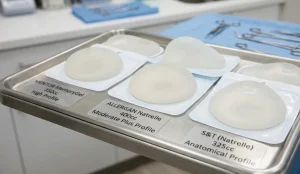
Inserted through a small chin incision.
Pre-Surgical Vector Analysis and Mentoplasty Structural Planning
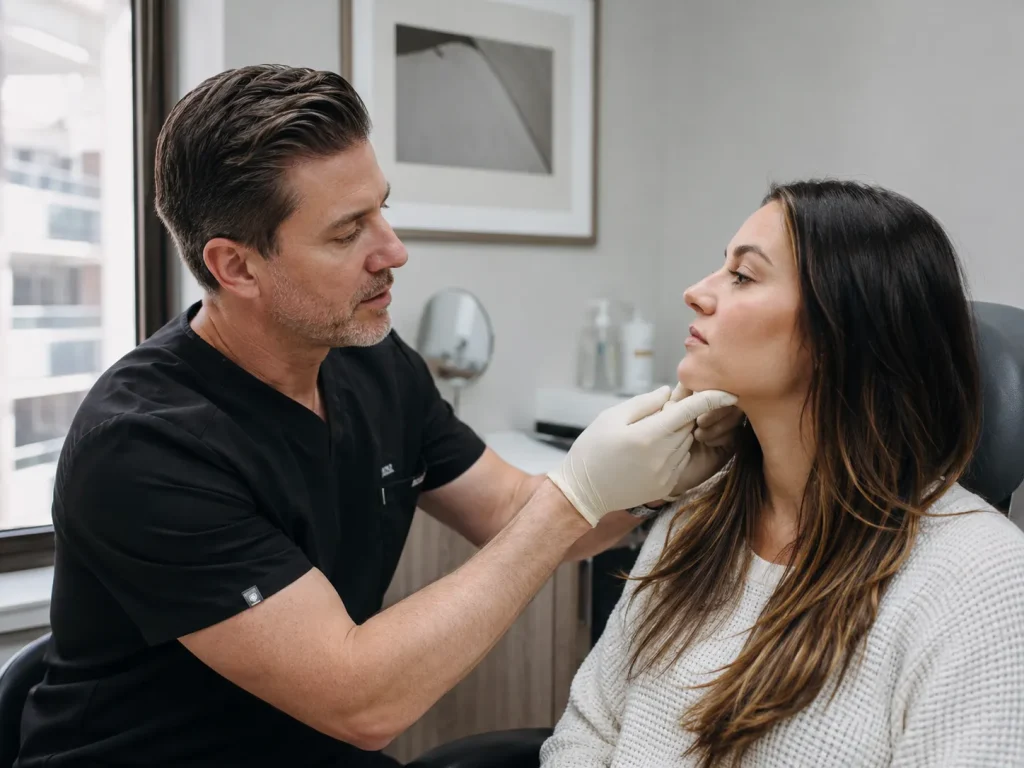
In the very complex field of facial plastic surgery and specifically lower-third facial rejuvenation, the decision to insert a chin implant (glabelo-mental augmentation) is a very serious structural planning step. The surgeon, before starting the surgical procedure, analyzes in detail the patient’s profile through a vector analysis to determine the severity of microgenia (receding chin) and mandibular deficiency. The doctor measures the relationship between the lips, nose, and chin in order to decide which implant size, shape, and material is the most suitable, for example, solid silicone that is biocompatible or porous polyethylene.
The planning step is very important for figuring out how the artificial piece will be positioned in relation to the mandible’s skeleton. The implant must accomplish not only pushing the chin forward but also fitting so well into the pre-jowl sulcus that it doesn’t look like a fake, alien object. Through the consideration of the patient’s specific bone structure and the thickness of the overlying soft tissues, the surgical team plots out the exact placement guidelines. This way, the implant will adhere to the bone, and the balance of the structure will be maintained over time.
Choosing the Incisional Pathway: Intraoral vs. Submental Exposure
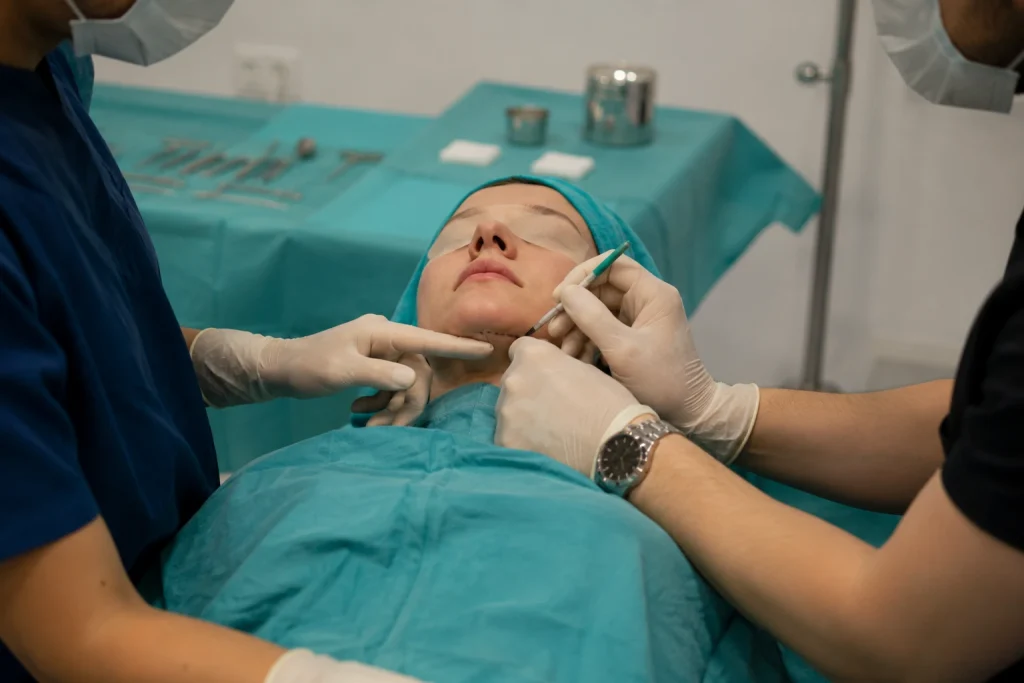
Performing a chin implant is a very precise outpatient procedure, and the operation usually lasts for 30 to 60 minutes, under local anesthesia with sedation or general anesthesia. One of the most important decisions during the planning phase is to choose the incisional pathway, which can be done either by an intraoral approach or a submental approach.
- The Intraoral Approach: The incision is done inside the mouth along the lower labial mucosa near the base of the gums and is therefore totally invisible from the outside. This way, the patient can have absolutely no external scarring, but this method requires a careful oral hygiene regimen after the operation so as to prevent bacterial contamination from the oral cavity.
- The Submental Approach: The surgeon makes a small incision externally under the chin so that it is almost invisible in a natural skin crease. This method is safer in terms of infection and allows a direct view of the mandibular bone. The scar that remains is very small, well hidden, and after some time, it becomes practically invisible.
Dissection of the Periosteal Pocket and Prosthetic Placement
After the incision is made, the surgeon goes through the subcutaneous tissues and the mentalis muscle to reach the bone of the mandible. Through a subperiosteal dissection, the surgeon detaches the periosteum—which is the dense fibrous membrane that covers the bone—in order to construct a tight and tailored pocket.
The size of the pocket has to perfectly correspond to the dimensions of the chosen chin implant. A pocket that is excessively large may give rise to the implant shifting or rotating out of place, whereas a pocket that is too small may precipitate tissue distortion or mental nerve compression. Centrally positioning the sterile implant along the midline of the jawbone, the surgeon gently inserts it into the deep subperiosteal space. Often, the implant is directly fastened to the mandibular bone through the use of micro-screws or permanent structural sutures so as to guarantee complete immobilization and to prevent displacement over time.
Layered Muscle Closure and Compression Stabilization
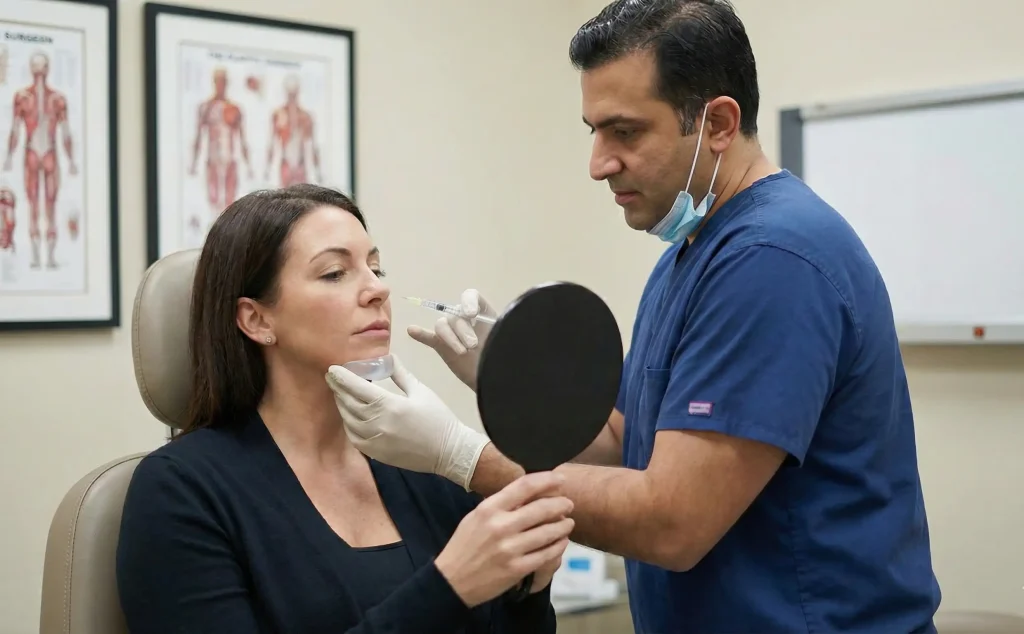
The final mechanical stage of fixing the new jawline structure in place is the securing of the internal layers and the controlling of post-operative tissue memory. The surgeon needs to perform a very careful and thorough closure, going layer by layer, first re-approximating the muscle fibers of the mentalis over the implant and then closing the skin or mucosal layer, which might be either with dissolvable or with removable sutures.
Once the closure is done, the lower face is directly subjected to external compression therapy. The area is covered by a surgical tape or a chin compression strap, both of which are firm and properly shaped. This physical pressure is indispensable for accomplishing the healing goals: to close any dead space within the wound, to minimize the formation of localized fluids (seromas or hematomas), and to prevent the mentalis muscle from pulling the implant upward during early facial expressions. This support wrap should not be removed for the first few days.
Chin Implant in Turkey
By coming to us at LIN Europe Clinic, you are choosing a world-class medical destination where your facial aesthetics, structural contouring, and surgical procedures are done at the highest level of clinical excellence with a deep understanding and kindness. We understand that precisely preparing and recovering from advanced facial augmentation is a complex, difficult task that requires a first-class, transparent, and very supportive environment that puts evidence-based medicine first at all times. LIN Europe Clinic in Turkey is a real global leader in facial remodeling and mentoplasty aftercare and offers a very comfortable space where your health roadmap is strictly regulated by top worldwide patient safety standards.
Trusting with your deep confidence, our knowledgeable and devoted group of experts at LIN Europe Clinic in Istanbul, your post-operative parameters are under strict diagnostic evaluation. We offer very thorough, personalized recovery schedules, tissue maps, and healing instructions that take you step-by-step through structural maturation and lifestyle integration. Our high-level medical staff makes sure that your beauty investment and systemic health protection go hand in hand, thus enabling you to delight in your ultimate shape with a full sense of security. Feel the exceptional, comprehensive care of LIN Europe Clinic and get a beautifully harmonious face, safely and very skillfully delivered in the heart of Turkey.
FAQ:
A chin implant is placed through a small incision, either inside the mouth or under the chin. A pocket is then made over the jawbone, and the implant is positioned and fixed there.
The cuts for the chin implants can be in the lower lip from the inside (intraoral) or directly under the chin in a natural fold that can be easily hidden (submental).
Chin implants are made of strong, biocompatible materials and are intended to be permanent, though they can be taken out or changed with surgery if needed.
Many times the answer is yes; it is common for the surgeon to use small titanium micro-screws or permanent sutures for securing the implant to bone so that it doesn’t move.
The surgery itself is a brief one, generally taking 30-60 minutes depending on the incision type and the implant anchoring technique.
Flowers, R. S. (1991). Alloplastic augmentation of the anterior mandible: Precision pocket dissection and implant selection. Clinics in Plastic Surgery, 18(1), 107-117.
Terino, E. O. (1995). Alloplastic facial contouring: Clinical anatomy and implant anchoring mechanics. Aesthetic Plastic Surgery, 19(1), 33-41.
Brennan, H. G., et al. (2008). Mentoplasty: Evaluation, surgical approaches, and long-term structural stability. Facial Plastic Surgery Clinics, 16(1), 113-122.