
Silicone implants tend to last longer.
Deciding between saline and silicone implants in breast augmentation and rebuilding breasts after surgery, is a major step that decides not only the looking and feeling outcome but also the possibility of long-term resorting to surgery. Patients who inquire about which type of breast implant lasts longer, clinicians base that answer on the very constitution of the different fillers. Though the shells of the two types of implants are both of a high-grade surgical silicone, the modern silicone gel that keeps its shape (“gummy bear” implants) is generally considered to hold its volume better than saline. A saline implant is basically a silicone shell filled with a saline (salt water) solution, which can suffer from small leaks or from the shell getting old and weakened, resulting in deflation of the implant.
Our philosophy at Lin Health Europe Clinic lies in implant selection being the right trade-off between strength and tissue friendliness. Being with our patients from abroad who come to Turkey for breast implants, we point out that “long-lasting” is not only the character of the filler but also of how the implant fits in your tissue pocket. Our clinic is the top breast augmentation center in the country that allows medical excellence in the form of high-resolution imaging to check the implant’s consistency, so that your path to a beautiful bust with utmost confidence is under safety and permanence of structure standards of highest level.
Reasons for Saline Deflation

Saline implants have an empty silicone shell that is filled with sterile saline at the time of the operation. Since the filler is a liquid, it constantly exerts hydraulic pressure on the shell and the filling valve. Mechanical stress may also be the major cause, so that after 10 to 15 years of use, those implants start to deflate due to damage to the valve or the appearance of a pinhole-type leak in the shell. The loss of volume resulting from the deflation is very visible and will be very evident within a few days physically.
At Lin Health Europe Clinic in Turkey, we inform our international patients that although saline has a slightly greater chance of “catastrophic failure” than silicone, it is of no harm to the body, as this solution is perfectly absorbed. Some might consider this feature of “early warning system” on the part of the body as an advantage from a clinical point of view, though it does imply that after some time, a surgery to replace the saline implant might have to be done earlier than that for the silicone implant in Istanbul.
The Properties of Cohesive Silicone Gel or “Gummy Bear” Implants
Current silicone implants contain a cross-linked, cohesive gel that has a solid-like behavior rather than a liquid. This “form-stable” feature is the main reason why silicone is deemed one of those materials that can last structurally for a longer time, apart from the fact that if the shell of a silicone implant suffers a tiny tear, the gel inside, being cohesive, will stay within the shell or the fibrous capsule outside, without leaking. This condition is referred to as a “silent rupture.” Since this gel remains stable and the shape and volume of the breast are preserved quite well over the years, even in such cases, that is why the physical indicators for the time to change them are much less evident.
The staff at Lin Health Europe Clinic works with the best quality FDA-approved, 5th-generation silicone that is designed to resist even extreme tensile stress. In Turkey, we believe that these highly developed substances lead to a desirable outcome performance-wise for a longer period, as physically they are less exposed to the factors that cause discontinuities such as “rippling” or “folding” in saline implants.
The “10-Year Rule” and the Actual Clinical Scenario
Whether saline or silicone, the medical panel’s level of agreement is that breast implants should be checked for replacement/removal after 10 to 15 years. Implants do not “expire,” as it is said, yet the risk of rupture increases by about 1% each year after the first 10 years.
At Lin Health Europe Clinic, we keep a close eye on your implants to make sure that the changes occurring with age do not go unnoticed. Gel bleed and the subsequent shell thinning are some of the consequences of aging that the silicone shell experiences, making it more vulnerable to damage and failure even without any trauma. The patients of Istanbul benefit from our referrals to the screenings, such as ultrasound or MRI, that are used for the detection of any deviations in the integrity of the shell. It is by adopting this preventive medical approach in Turkey that you can be sure of exchanging your implants prior to their rupture, thus maintaining the safety and attractiveness of your augmentation indefinitely.
Capsular Contracture: The Biologic Factor Determining Longevity
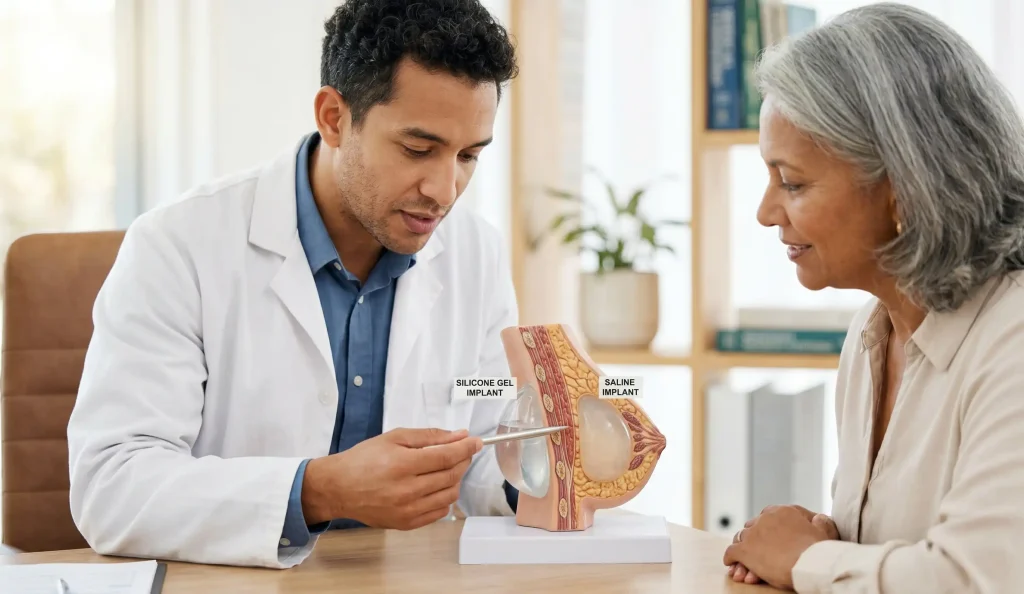
More often than not, the “longevity” of a breast implant is actually determined by the response of the organism towards the device rather than the implant per se. After placement of a breast implant, a “capsule” of scar tissue forms around it; however, in some cases, this tissue can be excessively thick, hard, and tight, a condition referred to as capsular contracture that results in implant being rigid, appearance being altered, and the possibility of an early rupture occurring increased. Capsular contracture is a common feature with implants made of both materials, though on some level, the incidence has been reported slightly less with certain textured silicone surfaces.
At Lin Health Europe Clinic in Istanbul, we adopt submuscular placement accompanied by strict “no-touch” surgical protocols to keep the risk of contracture at an absolute minimum. For us, continuation of a healthy biological milieu around the implant is as significant as the choice between saline and silicone in Turkey for longevity, if not even more so.
Maintenance and Revision: A Long-Term Promise
To choose breast implants means undertaking long-term medical maintenance. You may pick saline for its “fail-safeness” or silicone for its naturalness, but anyhow, you are bound to be submitted even once to a revision surgery.
The Lin Health Europe Clinic medical team has extended a comprehensive care plan over the years to every patient who comes to us from abroad. We think it is wise to consider the possibility of revision mastopexy (lift) at the time of changing the implants, since the breast tissue continues to age and relax going forward as well. Recognition of your breast augmentation as a multi-decade dynamic journey allows you to get acquainted with the s
Breast Implants in Turkey
Lin Health Europe Clinic is convinced that true surgical perfection can only be achieved by giving results that are safe and long-lasting at the same time. Our center in Turkey is a medical pearl of advanced services and par excellence standards of international patient care. We operate in the most modern, JCI-accredited clinic, which is a testimony to our status as the global leader in medical tourism and a provider of top-notch breast rejuvenation.
Going to Lin Health Europe Clinic means you are entrusting the hands in Istanbul that have, without a doubt, the highest level of trust and skills in terms of your safety. Our experts with worldwide reputations will put first absolute structural integrity and natural aesthetic harmony in their treatments for each patient, no matter the country of origin. You will be lucky to have the professional thoroughness and top hospitality that made us the leader in aesthetic medicine, from biometric breast analysis to an elevated silhouette that is both beautiful and natural.
FAQ:
Usually, both types of implants are up for a check-up between 10 to 15 years. However, today’s cohesive silicone gel implants tend to fare better in terms of structural integrity and getting less damage through ‘shell fatigue’ compared to saline. Besides that, because silicone is ‘form-stable,’ it doesn’t get deflated and collapses like a saline implant valve leak does in Turkey.
If cohesive silicone implants rupture, the gel inside, being sticky like gummy bear, mostly remains within the implant shell and the scar tissue, so the person doesn’t even notice that the rupture took place and this is what silent rupture means. While saline causes an implant to deflate straight away, a silicone rupture in Istanbul, for instance, can only be detected through a professional ultrasound or MRI scan.
Although breast implants don’t have a literal ‘expiry date,’ it’s advisable to get them professionally inspected by our experts at the Turkey clinic once they turn 10 years old. We employ biometric imaging to identify any signs of shell thinning or the formation of capsular contracture so that your health and aesthetics are well maintained.
Yes, that is possible! In fact, a number of our patients in Istanbul have this cosmetic procedure of changing from saline to silicone brought about by desire for more natural feel and better durability during their 10-year replacement surgery. Our experienced team here will check your tissue pocket to make sure that the two materials can be interchanged perfectly in Turkey.
It usually takes less time and effort to recuperate from an implant replacement surgery than from undergoing the initial breast augmentation as the tissue pocket was made already. Most patients in our Turkey facility start with simple exercises within a couple of days though they have to wait several weeks before heavy workouts.
Rohrich, R. J., et al. (2014). The safety and efficacy of silicone gel breast implants. Plastic and Reconstructive Surgery.
Spear, S. L., et al. (2007). Saline-filled breast implants: a review of the literature and current outcomes. Plastic and Reconstructive Surgery.
Maxwell, G. P., et al. (2003). The evolution of breast implants: from 1st to 5th generation. Aesthetic Surgery Journal.
Brown, S. L., et al. (2000). Silicone gel breast implant rupture: a review of the literature. Journal of Long-Term Effects of Medical Implants.
Tebbetts, J. B. (2002). A system for breast augmentation. Clinics in Plastic Surgery.
Handel, N., et al. (2006). A long-term study of outcomes, complications, and patient satisfaction with breast implants. Plastic and Reconstructive Surgery.