
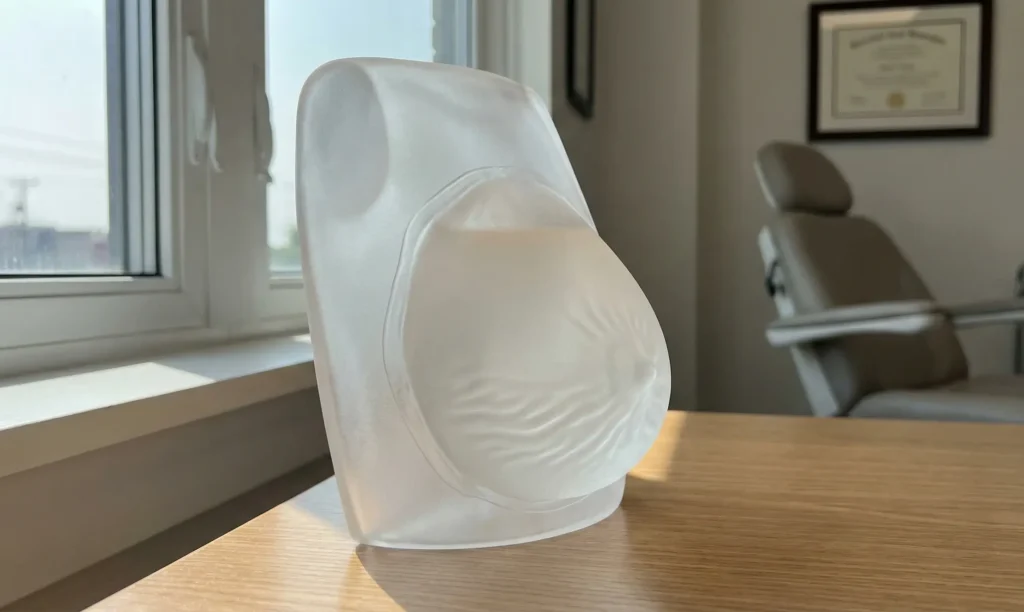
Choose the proper implant size and placement.
Most breast augmentation patients dread the “telltale sign” more than anything else. After all, they desire their augmented breasts to be so natural in appearance and touch that nobody can tell that they are actually implants. Visible rippling, which is the presence of small waves, wrinkles, or folds either on the side of the breast or in the cleavage, is the quickest way to shatter this illusion. Patients frequently say that it looks like “wrinkled plastic bag” beneath the skin. At Lin Europe Clinic, we are aware that prevention of this complication depends on many factors going right before the surgery stage is even reached, namely planning.
Answering “How to prevent rippling?” goes back to the basic concept of tissue coverage.
Rippling happens when the implant edge folds (which all implants do somewhat) and there is not enough natural tissue over it to hide that fold. If you are extremely skinny or have hardly any natural breast tissue, the risk is higher for you. Nevertheless, by selecting the appropriate implant material, the right placement plane, and making use of adjunctive techniques such as fat grafting, we can effectively cover these edges, thus making sure that the results are smooth and flawless at all times.
The Basics: What Causes Implants to Ripple?
Please be aware that breast implants are not hard stones; they are elastic shells filled with gel or saline. Similar to any elastic item, when held vertically, the filling is pulled down by gravity, resulting in the top and sides losing volume and folding inward. This is simply the law of physics.
Rippling becomes a visual problem only when the implant “blanket” is very thin. Picture putting a wrinkled sheet under a thick winter blanket; the wrinkles will not be visible. On the other hand, if you put it under a thin silk sheet, all the folds will show. Thick breast tissue or body fat gives women the natural “duvet” while thin skin or very low body fat women have the “silk sheet.” Our main objective is to make the cover thicker artificially or to select an implant that does not fold easily.
Solution 1: Submuscular (Dual Plane) Placement

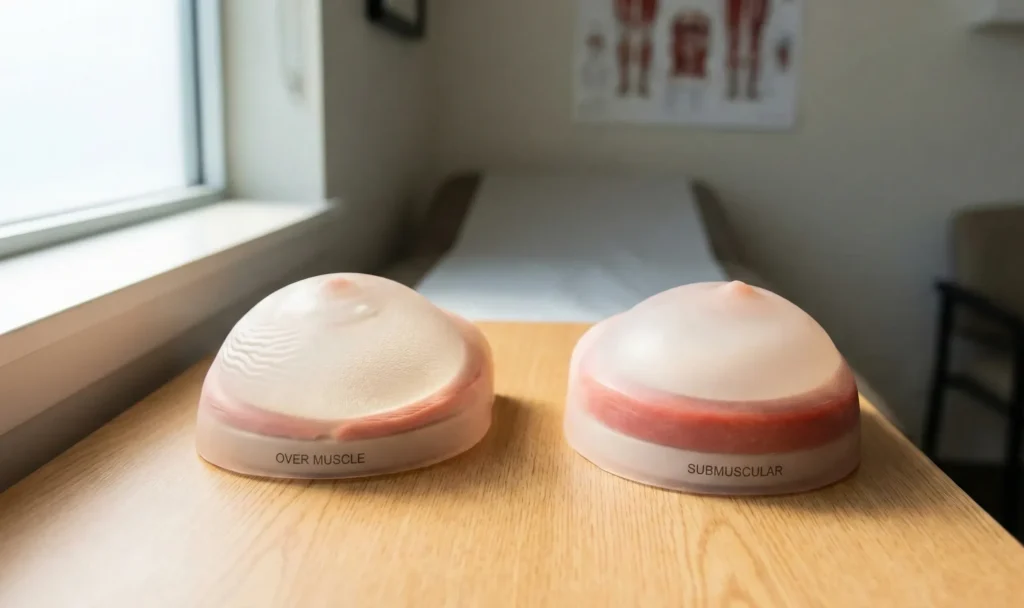
The surest method of concealing ripples is to position the implant beneath the muscle. In the “Dual Plane” technique, the upper portion of the implant is covered by the pectoralis major muscle. This muscle band serves not only as a thick and vascular cushion but it also completely hides the upper edges of the implant, which is the most frequent location where ripples become visible.
If a subglandular implant (i.e., implant placed over the muscle) is used in a thin patient, only skin and a very small amount of gland will separate the device. This means rippling is almost certain after some time already. We add a significant extra layer to the insulation by placing the device behind the muscle wall, which helps to smooth the contouring from the chest wall to the breast.
Solution 2: Highly Cohesive “Gummy Bear” Gel
What the implant is made of is very important. Earlier generation silicone and saline implants had the consistency of water (low cohesivity). The liquid would move to the bottom when the implant is in the upright position, leaving the top edge empty and thus highly susceptible to folding. This is very typical of saline implants which has the characteristic of the “empty bag” look.
To fix this issue, our suggestion is that you go for High Cohesivity (Form-Stable) implants, commonly referred to as “Gummy Bear” implants. The gel used in these implants is thicker and more cross-linked. It maintains its shape against gravity and does not fall downwards. Since the gel stays evenly distributed all over the shell, the edges stay full and rounded instead of folding over. For a thin patient, going for a gel with high cohesivity is a must-have step for getting a result free from ripples.
Solution 3: Fat Grafting (Composite Augmentation)
In some situations, even the best implants and muscle coverages cannot sufficiently address certain spots such as the inner cleavage or the lower outer breast because the muscle does not extend this area. Here, we accomplish fat grafting (Composite Augmentation), which involves liposuction of fat from your abdomen or thigh and thereafter injecting it all around the edges of the implant.
Imagine this as “airbrushing” but using your own tissue rather than paint. We deposit fat between the skin and the implant, thus thickening up the “blanket.” This kind of concealment is extremely potent for hiding ripples that would normally become visible in the cleavage area. What it yields is a soft, natural coverage at the very spot where you require it most.
Preventing Rippling Caused by Oversized Implants
One of the reasons why implants ripple is due to the choice of an implant that is too wide as compared to your natural breast footprint. If the implant extends beyond your breast tissue, the edges will be protruding either towards the armpit or the center of the chest where the skin is the thinnest.
This problem can be prevented by adopting strict sizing rules. You ought to rely on your surgeon’s judgment when they measure your Breast Base Width (BWD). Should you decide to cram a 13 cm implant into an 11 cm chest, then the edges will start buckling and rippling as a result of getting “squeezed” by the tight pocket. By using your anatomical dimensions as a guide, you limit the chance of the shell folding under duress.
Breast Augmentation in Turkey
One of the reasons you pick Lin Europe Clinic in Turkey for your breast augmentation is because we do not compromise long-term aesthetics to gain short-term volume. The Dual Plane technique and Composite Augmentation are the specialties of our surgeons in Istanbul. Only the thinnest patients are given implants and fat transfer at the same time here, which is a procedure demanding special skills and equipment.
The entire experience you get in Istanbul is top-notch. We employ 3D simulation so you can see for yourself how various implant sizes will relate to your particular body frame thus getting your overfilled look absolutely perfect. When you combine high-grade implants by Mentor or Motiva with a recovery plan that supports healing to the maximum, then Lin Europe Clinic is the place to get your result(s) that look flawless from every angle.
Frequently Asked Questions About Rippling
They do, actually, all implants have folds when the person is standing. However, visible rippling is definitely not something typical. It only shows up when the person’s tissue layer is so thin that it can’t hide the folds.
Absolutely, saline implants have a much higher tendency to ripple than silicone does. The reason is that saline behaves like water, so the shell folds very easily when the water moves. On the other hand, silicone gel is denser and more stable in shape.
It depends, sometimes a treatment for the loss of volume in the skin can be enough such as fat grafting. This is a technique whereby we take your own fat and inject it locally to thicken the skin thus hiding the wrinkles without altering the implant.
A bit, it greatly lowers the chance in the upper chest, I would say. Though, it is not covering the lower or outer parts of the breast, so the rippling can still happen in those areas if the patient is very thin.
No implant is 100% free from ripples, however, Gummy Bear (form-stable) implants have the greatest resistance to rippling because the stiff gel keeps the shell’s shape and, therefore, the deep folding is prevented.
Maxwell, G. P., & Gabriel, A. (2014). Biofilms and breast implants: How the science of biofilms affects the practice of breast surgery. Aesthetic Surgery Journal. (Note: Discusses implant pocket science).
Spear, S. L., & Jespersen, M. R. (2010). Breast implants: Saline or silicone? Aesthetic Surgery Journal.
Auclair, E. (2009). Composite breast augmentation: Soft-tissue planning using implants and fat. Plastic and Reconstructive Surgery.