Light lifting usually starts after 4–6 weeks.
Fitness-oriented patients often find the most challenging part of breast augmentation recovery to be not the pain but the forced inactivity. You have been building up your strength and working out regularly for a long time, and the thought of being inactive for several weeks is a major source of anxiety. It’s natural to wonder, “Can I do just leg day?” or “What if I use very light weights?” We at Lin Europe Clinic share your enthusiasm to hit the gym again; still, we’re also very familiar with the biomechanics of a healing chest.
There is no straightforward answer to the question “When can I lift weights?” Instead, it is a phased timeline. You may go for a walk right away, but heavy lifting and upper body resistance training are a no-no for at least six weeks. This point is emphasized if you have submuscular (Dual Plane) implants. To make room for the implant, your pectoralis major muscle has been incised, lifted, and stretched. If you engage this muscle too early, i.e., before it has formed a firm scar, it can pull your implant pockets and cause implant displacement to the side or downward motion, also known as “bottoming out.” We support your safe fitness journey to ensure that your progress doesn’t cost you your results.
Phase 1: The “Active Rest” Period (Weeks 0–2)
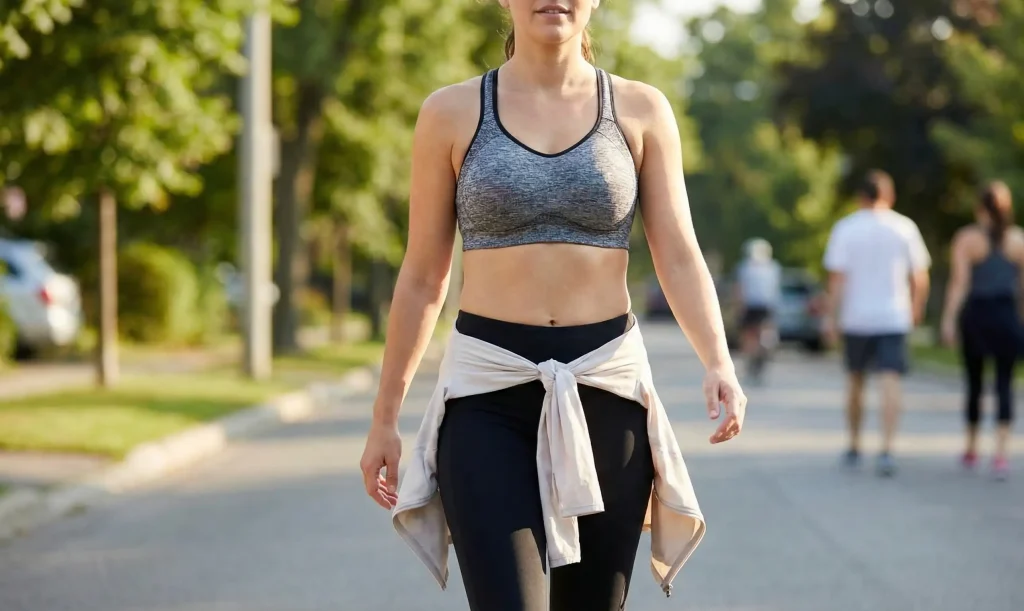
The intention of the first two weeks is healing, and you shouldn’t think of these days as training. Elevation of your heart rate and blood pressure during these first days might lead to bleeding and swelling (hematoma). It is important to realize that the first two weeks don’t mean absolute bed rest. Walking is good for you after the surgery, and you can start walking the day after breast augmentation. It is an excellent way to avoid blood clots in the legs because walking increases blood circulation.
In this phase, it is important to refrain from activities that can cause your body to “bounce,” thus significantly raising your blood pressure. A light jogging session, spin classes, or workouts with weights are some of the things to avoid. Even if you only plan to lift your dumbbell for one rep, it won’t be safe. Your priorities should be mobility and flexibility – just a little leg stretching and back work without straining the chest or arms.
Phase 2: Cardio and Legs (Weeks 3–4)
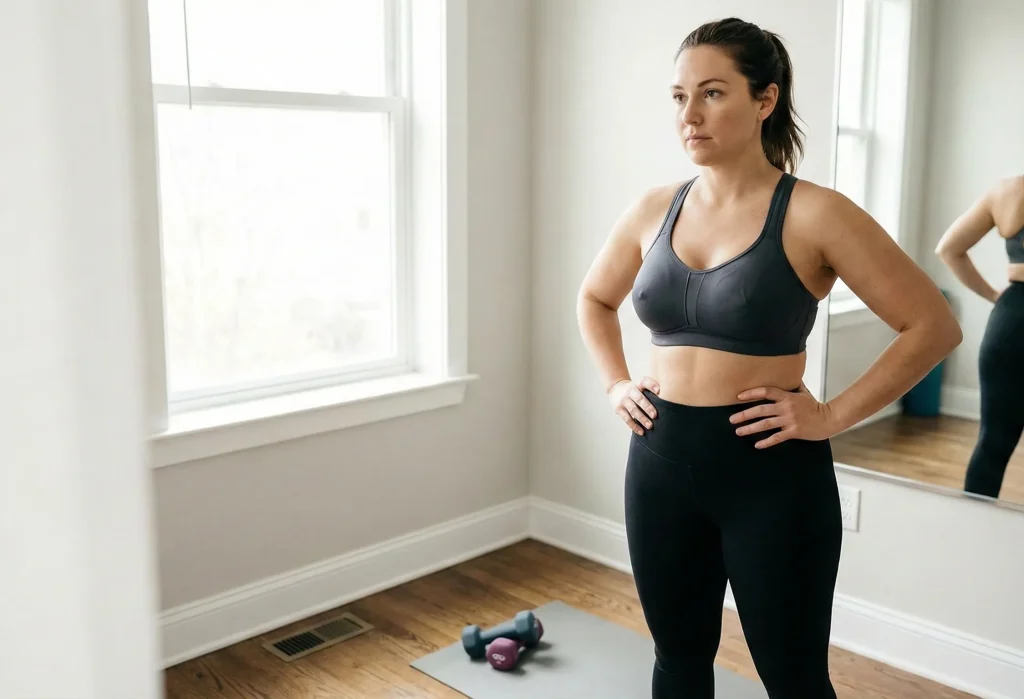
Generally, after your wounds have healed and the acute bleeding danger has passed (it is typically around week 3), you are allowed to reintroduce low-impact cardio very gradually. The stationary bike (recumbent is the best) and elliptical (without using the arm handles) methods of exercising are great choices. It is fine to raise your heart rate, but you have to keep your upper body steady.
The isolated lower body exercises should also be considered. In the absence of any weights in your hands, air squats, lunges, or leg press machines should be safe. Holding dumbbells will put strain on the shoulders and chest stabilizers and that’s why it is not allowed. The right thing to do here is to clang your hands by your sides. If you want resistance, go for ankle weights or gym machines that don’t count on upper body bracing.
Phase 3: The Danger Zone – Chest Exercises (Weeks 6–8+)
At six weeks, patients are often given a green light for “general” exercise, but the situation looks quite different when it’s about the chest. If you have had subpectoral breast augmentation, then your pec muscles are basically covering a foreign object. By doing a push-up, bench press, or plank, you are squeezing the implant which is less than ideal.
At least for 8 to 12 weeks, we suggest not doing direct chest isolation work like chest flys or heavy bench press, and some surgeons even advise the permanent cessation of heavy chest training so as to avoid “Animation Deformity” (implant distortion upon muscle contraction). At week 6, when you get back to doing upper body exercises, it’s best to start with back and shoulder (rows, lateral raises) workouts using 20% of your usual weight. Work on the range of motion without stress by doing high reps and low weight.
The “Bounce” Factor and Sports Bras
You can’t just jump or run straight away; you have to be properly equipped first. Your newly enhanced breasts weigh more and have more momentum than your natural ones. The skin gets stretched and eventually gets loose (ptosis) when the gravitational tug is strong during high-impact exercises (running, CrossFit, HIIT), and the breasts do not have adequate support.
A sports bra of high-impact and encapsulation type is an absolute necessity. Compression bras that push the breasts flat are out, whereas the encapsulation bras that support each breast individually are in. You should refrain from running or jumping until at least 6 weeks after the surgery, and then only with the best support available. If you experience pain and/or your breasts move too much, stop immediately. Internally, your ligaments are still healing as they form scar tissue to support the weight, so don’t overstretch them by turning the loads loose too soon.
Feeling Your Body’s “Zaps”
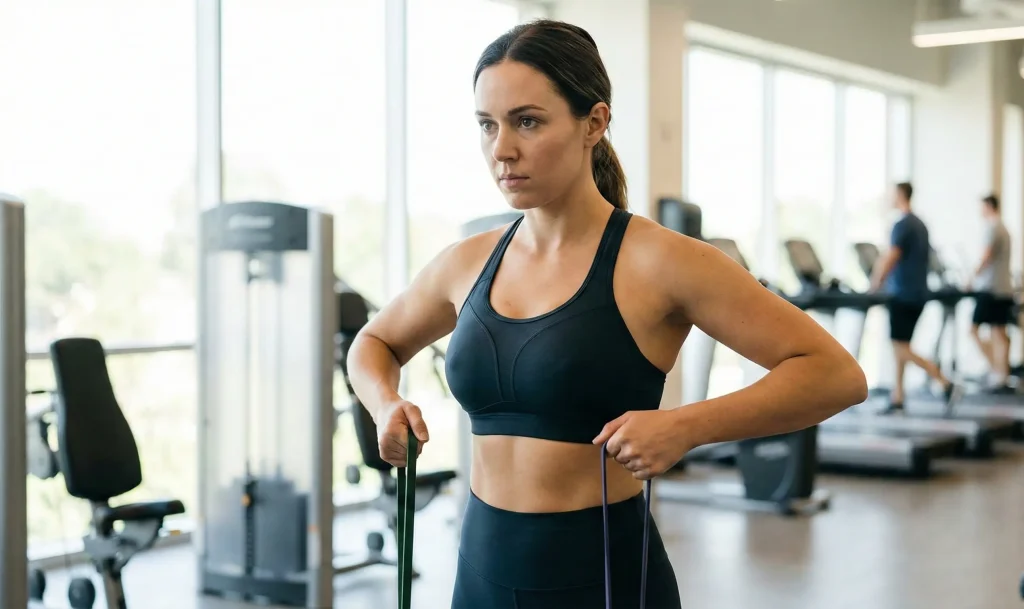
As you gradually increase your lifting, especially after breast augmentation, you might notice sharp, shooting pains aka “zaps” in the breast area. This is a pretty normal phenomenon, especially as nerves regenerate and scar tissue is stretching. If you switch to an overhead press or a lat pulldown and find yourself wincing, then the message to you from your body is: the pocket is being excessively stretched.
Always honor such signals. If one movement is hurting you, change it or omit it altogether. Many patients find wide-grip pull-ups very uncomfortable for a few months, whereas close-grip rows usually don’t cause them any trouble. You might have to make permanent adjustments to your grip or angle to accommodate your new anatomy. Keep in mind that pressing through the pain might cause fluid to accumulate (seroma) around your implant, which can ultimately mean taking it easy again or even having revision surgery.
Breast Augmentation in Turkey
You sort out your breast augmentation in Turkey at Lin Europe Clinic because we make the surgical plan meet your lifestyle. For instance, if you are a CrossFit athlete or a bodybuilder, the conversation might revolve around whether the implants are best placed subfascially instead of submuscular so that your muscle function is preserved and the heavy lifting can be resumed sooner.
The experience in Istanbul also includes a very detailed postoperative coaching. We don’t only offer you a vague “take it easy” phrase, but also give you a precise schedule. Our follow-up crew stays connected with you once you return to the gym, ready to answer your queries about particular moves or sensations. Essentially, at Lin Europe Clinic, we want you to be strong in your new body, and for that to happen, you first need to protect it when you get stronger.
Frequently Asked Questions About Working Out
Bodyweight squats are usually allowed after 3 weeks. Do not add heavy weights until 6 weeks since heavy squats requiring core bracing also engages the chest and there is more pressure on the abdomen.
If your implants are under the muscle, performing push-ups will be tough and may cause the implant to be distorted. Majority of surgeons suggest that the patient refrain from doing push-ups for at least 3 months, and some even suggest that the patient should avoid push-ups entirely as a long-term measure to prevent displacement.
Intense chest workouts can cause the implants to slowly move towards your armpits (known as “lateral displacement”) by pushing the implants. Furthermore, it can also lead to the worsening of “animation deformity” where the implants move visibly when you flex.
You have to completely avoid running, which is a high-impact exercise, for at least 6 weeks in order to prevent skin stretching and bruising. Make sure to always wear a high-support sports bra once you start running again.
The implants themselves do not make you weaker but the initial post-surgery muscle cutting during submuscular placement can lead to the temporary loss of chest press strength. In most cases, women have full recovery of their functional strength within a few months.
Chun, Y. S., et al. (2010). Implant displacement and its correction. Plastic and Reconstructive Surgery.
Spear, S. L., & Baker, J. L. (2012). Safety of breast augmentation in athletes. Aesthetic Surgery Journal.
Tebbetts, J. B. (2002). Dual plane breast augmentation: optimizing implant-soft-tissue relationships. Plastic and Reconstructive Surgery.