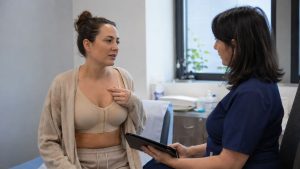
Yes, if your surgeon approves travel.
The Medical Clearance at Day 14
In the complex world of advanced rhinoplasty and structural facial sculpting, making travel arrangements after surgery must be strictly based on your healing process. International travel is a major factor in deciding whether you want surgery outside your home country which in turn becomes another factor to consider during the recovery timeline. From the point of view of medical safety, there is a certain yes. Most patients can return to traveling or even fly 2 weeks after rhinoplasty. By then, the acute surgical phase has ended; your external cast and interior plastic splints have been removed, the risk of sudden epistaxis has declined a lot, the nasal bones have started forming an initial fibrous union. Although medically safe for travel, the act of traveling is an event that can lead to some uncomfortable aesthetic experiences because of environmental stress factors that your body will be exposed to during a flight.
Impact of Atmosphere: Cabin Air Pressure and Micro- Edema
It is perfectly acceptable to fly at 14 days post-operatively, yet the inside atmosphere conditions of a commercial aircraft may temporarily influence your tissue healing:
- The Swelling Rebound: Onboard cabins of a commercial plane are pressurized at a level between 6,000 to 8,000 feet, so that the drop in surrounding air pressure causes the human body to naturally enlarge gaseous and liquid volumes. For this reason, a nose that is only 14 days post-operation, that very shift causes a sudden swelling of micro-edema (fluid trapped) and so, your nose may look significantly more swollen at landing.
- The Dry Air Affects Mucous: The aircraft cabin air is famous for dryness, and it can get down to below 10% RH. This very dry condition takes away the moisture from your healing internal nasal mucous at a fast rate, and it may dry up so much that the mucous is just a powder, which may be painful, and it may also cause a very unpleasant and uncomfortable sensation inside your nostrils.
- Risks of Barotrauma: Since internal nasal passages are still constricted after surgery by a post-surgical swelling, the body may have a very hard time equalizing pressure between your sinuses and the varying cabin pressure during boarding or landing, leading to temporary sinus headaches or ears popping.
Maintain Structural Integrity During Transits
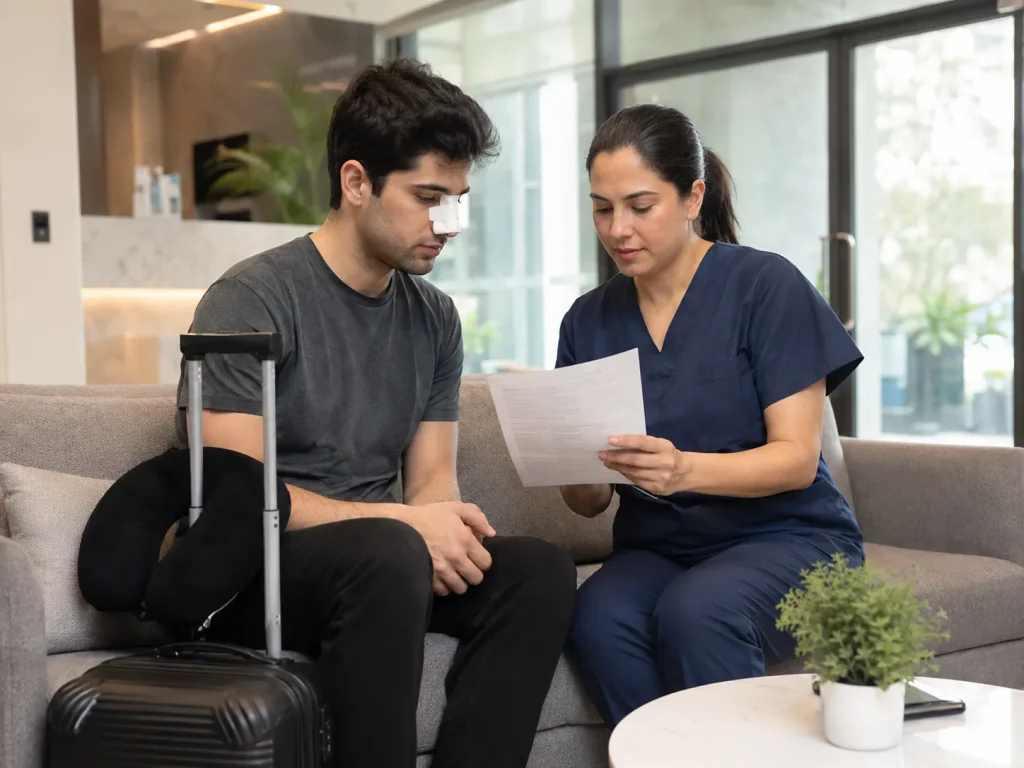
One has to be fully equipped with protective strategies and behavioral restrictions that one is willing to observe while moving from one international airport to another or a transfer point. Traveling itself is hectic which subjects the fragile nasal structure to an infinite number of physical risks. It is essential to safeguard this healing framework for one’s structural security. So, to make sure that your newly contoured nose is set with the greatest care and that your travel is not marred in any way by the discomfort, you need to carry a travel recovery pack with your hand luggage. It includes a saline nebulizing system with a fine mist nozzle to be freely used every 1-2 hourly flight, and your swelling management supplies according to prescription. Along with it, you must refrain from all kinds of nicotine, like cigarettes, pipes, and chewing tobacco, as nicotine is extremely vasoconstrictive, constricting micro-vessels all over the human body, resulting in oxygen-deprived blood flow starvation to tissue under healing nasal structure, which can be even worse if the air inside the passenger cabin is stationary. As a matter of fact, it’s a major no-no to raise a heavy large size bag by yourself since such exertion can easily result in dangerously spiking blood pressure and a nosebleed after some time.
Checklists for International Travel Safety
Your surgeon and/or care team will most probably discuss with you the boundaries of travel that are safe or dangerous after surgery so that you’ll be clear on your travel plans when you want to return to home. If you want a safe and smooth transition from the 2rd week recovery post-op time period, then it’s advised to add the following medical guidelines to your travel plan:
| Travel Element | Potential Risk Vector | Preventative Action Checklist |
| Cabin Air Pressure | Sudden swelling & fluid pooling | Wear your nasal compression tape during the flight; stay upright. |
| Arid Environment | Severe mucosal crusting & scabbing | Apply sterile saline spray frequently; use a water-based nasal gel. |
| Luggage Handling | Spiking blood pressure & bleeding | Utilize airport luggage carts; request assistance from airline staff. |
| Deep Vein Thrombosis | Stagnant blood circulation on long flights | Walk down the aircraft aisle every hour; wear compression socks. |
Rhinoplasty in Turkey
Finding the right partner for your surgery and aftercare journey means that you have to get very close with one of the medical team members you choose and the way your case will be handled. At LIN Europe Clinic, which is one of the top international medical facilities, your nasal beauty and advanced remodeling surgery are conducted with clinical excellence and total empathy. We believe that coordinating post-operative travel with early rhinoplasty recovery is a major challenge but we are prepared to offer a very advanced, clear, and highly supportive environment where scientific facts are our first priority. With a view to providing a luxurious and high-standard facility in Turkey, our clinic has also gained an international reputation as an authority in advanced facial contouring and plastic postoperative care, by doing so and offering such a quiet and calm healing space.
You can be assured that in LIN Europe Clinic, the team in Istanbul will take good care of your recovery and travel planning with an accuracy that even a physician would be proud of. Not only will our surgeons give you the full medical clearance needed to travel by airplane, but they will provide you with a thorough pre-travel flight safety review and high-precision tissue-motion monitoring. You can also expect to receive customized patient documentation that will make your way through customs without any problem. In summary, we are committed to making your cosmetic enhancement not only look beautiful but also make sure that your health is fully protected at all times, whether traveling or otherwise. If you want to get in shape with a balanced and well-contoured body, come and experience the top-rate, total care of LIN Europe Clinic and you know that a masterpiece result can safely be delivered at the heart of Turkey.
FAQ:
If you can bear to do so, yes, you will be able to physically and clinically fly 2 weeks after your procedure as your surgeon’s cast will have been taken off, and the high incidence of bleeding and other major problems, especially bleeding, has significantly gone down if at all.
Yes. The inside cabin pressure during the flight in which the air pressure is much lower is likely to cause some more fluid retention, therefore your nose will look or feel more puffy during or just after the flight. In the very short term, it may even give you that “tight” feeling.
The way out is a good amount of moisturizing – you can use a nasal spray filled with purified salt water (called the sterilized saline or the sterile saline nasal solution in medical terms) at intervals of 1 or maximum 2 hours. This ensures good hydration and keeps the moist lining of the nose inside, thus, preventing severe dryness, cracking, or itching.
Definitely no. The act of carrying large suitcases could raise blood pressure very significantly, and this puts the healing vessels in jeopardy, possibly leading to a nose bleeding at the later stage which may be quite sudden.
It is not mandatory to have the medical certificate to be carried along if your travel to be done, but if your doctor gives you the clearance letter after the surgery it is better to travel with that letter especially if you are going to go through security where you may be questioned about why your face is very much swollen or changed at that time of the travel and you will then be able to show that you are in the recovery process.
Rohrich, R. J., et al. (2011). The rhinoplasty recovery matrix: Analyzing operational parameters, external splint compression, and travel safety standards. Plastic and Reconstructive Surgery, 127(4), 1651-1663.
Toriumi, D. M. (2007). Structure rhinoplasty: Managing the external skin envelope, cabin pressure mechanics, and long-term osteotomy stabilization. Clinics in Plastic Surgery, 34(1), 119-126.
Gunter, J. P., et al. (2014). Advanced postoperative care, managing international transit risks, and structural stability in secondary facial contouring. Aesthetic Surgery Journal, 34(5), 587-595.