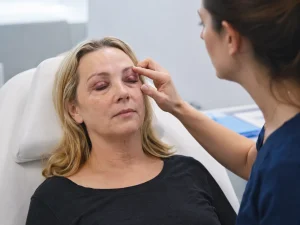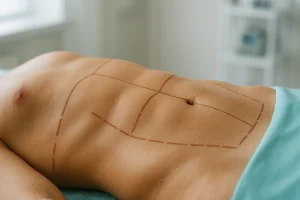

There’s no ideal age; skin elasticity matters most.
One of the most frequently asked questions at Lin Health Europe Clinic is, “Am I too old for this?” or conversely, “Is my daughter too young?” There is a myth that liposuction is a preserve of 25-year-old Instagram models. Actually, body contouring is a medical procedure that patients of all ages may request.
Besides, from a physiological point of view, age does have an impact—not because of the number on your passport, but because of your tissue quality. Liposuction success is actually determined by two main factors: fat is being taken away (which is easy at any age) and skin is retracting (which gets tougher as we get older). Although there is no formal cut-off age, figuring out how your “biological age” can influence your results is very helpful for setting realistic expectations. Here is the clinical rationale behind the changes in liposuction results with different age groups.
The Golden Window: The 20s and 30s
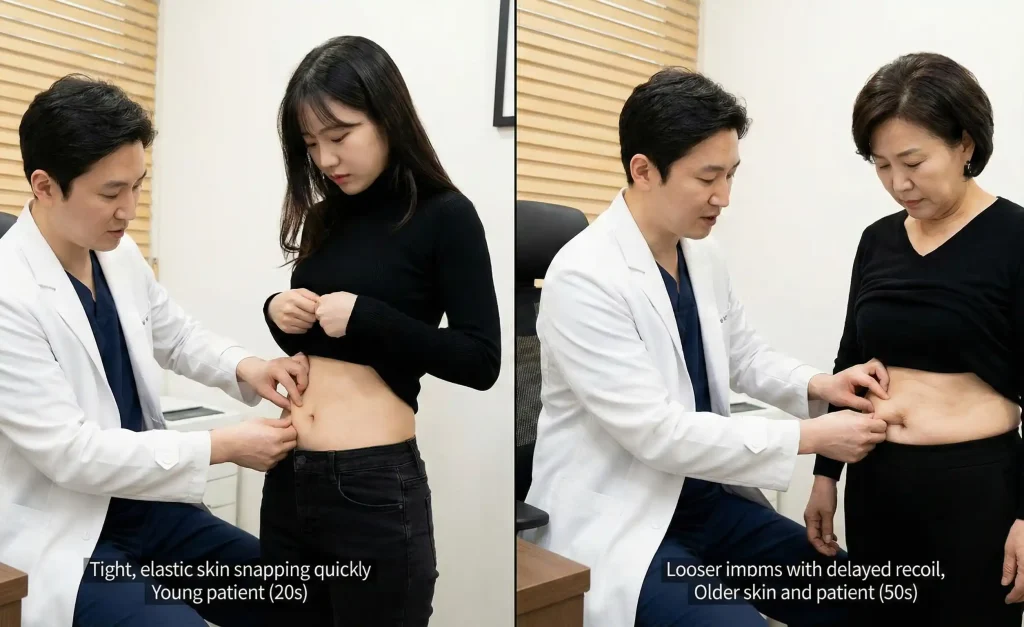
Physiologically, the “best” age for liposuction is usually thought of as anywhere between the late 20s and late 30s. Within this span, the human body reaches the prime stage where the skin’s ability to stretch is at its natural maximum. When we get rid of the fat layer, the collagen and elastin fibers in the skin give it the capacity to tightly “snap back” over the new, slim figure, quite similar to a brand-new rubber band. This inherent shrinkage property explains why patients belonging to this age range seldom need a supplementary skin-tightening operation and quite often enjoy the smoothest and clearest effects with a very low chance of irregularities.
Besides, young patients happen to have a high metabolic flexibility, which normally means quicker healing from the surgical inflammation. Eliminating fat cells at this age has another advantage in that it is a preventative measure. Since fat cells do not regenerate once removed, body sculpting at this time would render a permanent template. It would thus become a lot easier to maintain the figure through future lifestyle changes or even after such events as pregnancy, for the treated parts will stay in proportion to the rest of the body.
The Hormonal Shift: The 40s and 50s
In fact, this age group forms the major part of our clientele. People aged 40 to 50 usually decide to have a liposuction not because of the overall weight increase, but since their body shape changes as a result of hormonal shifts like perimenopause or andropause. At this point, the metabolism naturally slows down, and fat stubbornly redistributes to the belly and sides (love handles), where it becomes highly resistant to diet and exercise regardless of the patient’s effort.
The main issue for this age category is the handling of skin looseness. As the skin loses some of its youthful bounce, doing regular mechanical liposuction may leave you with saggy or “deflated” skin. Hence, for patients in the 40s and 50s, we mainly prefer using Energy-Assisted Devices likeVASER Liposuction or J-Plasma. These ingenious devices heat the skin to cause an artificial collagen production which the skin, on its own, is no longer able to produce efficiently. Thus, when the fat is gone, the skin will shrink tightly and securely.
The Safety Zone: Liposuction Over 60
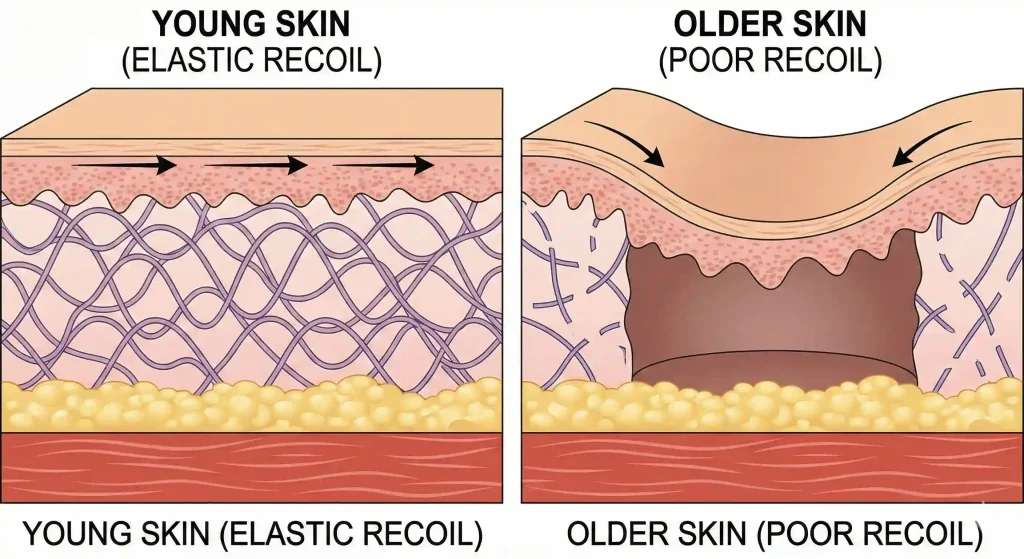
Liposuction for people over 60 years old is feasible and increasingly becoming common as long as the person is generally healthy. We often see elderly patients who still lead an active life and only want their clothes to fit better or reduce the physical discomfort resulting from dense breasts or heavy thighs. Yet, the talk in this age range moves away from “sculpting” into “improvement.” It is only fair to acknowledge that due to lower skin elasticity, the skin will not retract entirely smoothly.
Those over 60 need to face the consequence of a trade-off: they can expect to become much slimmer and better proportioned in their clothes; however, when they are naked, they might be somewhat “wrinkly” or have some sagging skin. For the elderly, the very first thing is a Medical Clearance. We carry out very thorough heart and blood tests to be certain that the patient can safely be given anesthesia and can endure the fluid shifts that happen during surgery. In this population, safety invariably comes first, and we move forward only if we are certain that the medical risk is minimal.
The Teen Exception: Under 18
Generally, reputable board-certified surgeons do not perform cosmetic liposuction on minors. The body keeps on growing, and hormonal changes can bring about alterations in fat distribution naturally, so to change it permanently may be premature. Nevertheless, there are two great medical exceptions when we step in early to spare the kid from getting a psychological or physical handicap.
The first exception is Gynecomastia, or a situation where boys’ chests become mysteriously enlarged, which can be psychologically very tormenting. If the problem persists after puberty, liposuction along with the removal of the gland is the standard, life-altering procedure. The other exception is Lipedema, a fat disorder that mainly starts in the legs and is progressive. Mild early treatment via Water-Jet Liposuction may prevent the condition from reaching a very disabling stage. In these very cases, the surgery is more of a functional and preventive nature rather than just cosmetic.
Biological vs. Chronological Age
At Lin Health Europe Clinic in Turkey, your birth date is not what we measure, but your tissues. It so happens that we get 50-year-old patients with skin elasticity as if they were 30 years old and on the other hand, there are 20-year-old smokers with poor, non-elastic skin. Hence, your age is not as significant as it is your body’s condition.
When you come for a consultation, one clinical test that is a part of the evaluation is the “Snap Test.” We take a little fold of skin between our fingers and look at how fast it comes back to its initial position. This is a far better way, in fact, by which we determine your suitability for the procedure than simply by your age. Whether you are 25 or 65, we match the technology with your biological requirements – if the tissues are fragile, we choose Body-Jet for the gentle removal, while for severely stretched skin, we bring in the J-Plasma for the maximum tightening – thus we guarantee the best result for your individual body.
Frequently Asked Questions About Age and Liposuction
From a physiological point of view, people between their late 20s and late 30s usually have the most pleasing results since their skin is naturally very elastic and it retracts easily over the newly shaped body.
Not at all. Surgery is still an option if you are generally healthy and can get a medical clearance. Nevertheless, you should be aware that the results of skin tightening may be limited.
Normally no. We wait till the patient turns 18 for most cases. Only special circumstances like severe gynecomastia in boys or extremely painful lipedema in girls may warrant exceptions.
People over 50 have increased chances of skin sagging. Our clinic combined with the use of technologies such as Vaser or J-Plasma promotes collagen production and thereby skin tightening to reduce the risk.
Sure, but safety is related to the person’s health condition. Therefore, elderly people have to undergo more detailed medical check-ups before the procedure to confirm their physical state is suitable for general anesthesia.
Chia, C. T., et al. (2015). Evidence-Based Medicine: Liposuction. Plastic and Reconstructive Surgery.
Heymans, O., et al. (2006). Liposuction in the elderly: safety and efficacy. Aesthetic Plastic Surgery.
Illouz, Y. G. (1983). Body contouring by lipolysis: a 5-year experience with over 3000 cases. Plastic and Reconstructive Surgery.