Possible numbness, swelling, or contour irregularities.
Five Years After the Surgery: Bio Metrics of Adipose Tissue Homeostasis
For the ultra-specialized and involved profession in body architecture and high definition lipo-sculpturing, gauging a client’s results at the 5-year point is the only way to get real insight into tissue behavior over a long period. In fact, one question that creates a lot of discussion between patients and surgeons is, “Does liposuction have any permanent or late side effects?” If you look at it from a strictly biometric perspective, 5 years after liposuction is considered a time of complete cell stabilization and metabolic homeostasis. The fat cells under your skin that were removed during your surgery are gone for good, and there is no adult fat cell formation within the treated areas.
At LIN Europe Clinic, we state that the long-term shape of your figure depends on how your remaining fat cells (adipocytes) accumulate lipids over time. If you do not experience much fluctuation in your weight, the sculpted figure created by surgical finesse five years earlier will be preserved completely. On the other hand, if a drastic metabolic disturbance or weight gain happens years later, the body has to find a way to store the surplus energy. Since the areas that you had treated contain a greatly reduced number of fat cells, the body will naturally store new fat in the nontreated parts of the body, thus changing your overall structural proportions. This is a phenomenon that requires clear clinical understanding.
Tracking Visceral Fat and the Mechanism of Fat Redistribution

In the event of weight gain 5 years after a body reshaping operation, the physical expression of the accumulated fat will change because of altered subcutaneous biometrics. Normally, fat tissue in the body is distributed evenly over the subcutaneous layers of the abdomen, hips, and limbs. However, after a targeted extraction, these subcutaneous fat storage depots are going to be limited structurally.
Should the patient become a significant caloric surplus a few years later, the body will react in two ways:
- Subcutaneous Accumulation in Untreated Areas: Fat is redirected to the natural parts of the body that were not operated on, for instance, the upper back, arms, or neck, which can sometimes result in visually mismatched body symmetry.
- Visceral Fat Storage: In case of notable weight gain, excess lipids can also be stored internally within the abdominal cavity in the form of visceral fat around the internal organs.
From a health perspective, visceral fat is metabolically very active and therefore linked to heart problems. At LIN Europe Clinic, we stress that though the aesthetic changes brought about by your procedure are permanent, liposuction is not a protective measure against future fat gain. Maintaining a biological balance and preserving your body contours over the long term will entail continuous physical activity and a healthy lifestyle to avoid the internal storage of visceral fat.
Five-Year Dermal Compliance and Fibrous Matrix Maturation
One more major factor considered at the 5-year time point is how the dermal matrix and the underlying scar tissue finally behave. In the early recovery phase, the subcutaneous space experiences a heavy post-inflammatory fibrosis that leads to the formation of temporary hardness or lumps under the skin. At 5 years, this internal scar tissue would have undergone a final maturation and is now a soft, flexible, and completely integrated fascial layer that works in unison with your musculoskeletal framework.
On the contrary, natural aging-driven collagen and elastin depletion, as opposed to the surgery itself, can cause your long-term outcomes to be affected. In a patient who had only marginal skin elasticity at the time of the operation, the loss of the underlying fat support can become very apparent over a 5-year period. Due to the absence of the volumizing effect of the subcutaneous fat, the skin envelope may show very subtle wrinkling, slight loss of texture, or minor variations in contour with wave-like undulations.
Nerve Stability and Long-Term Sensory Recovery
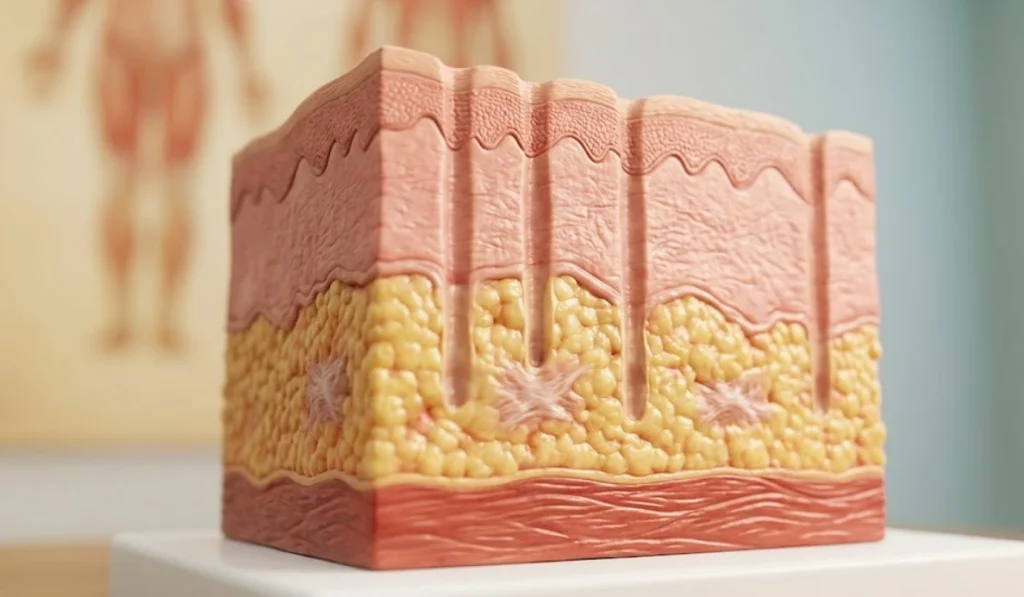
The extraction of fat using surgical micro-cannulas leads to trauma of the microscopic sensory nerve fiber network that runs through the layers of fat before reaching the skin surface. This will induce localized numbness, paresthesia (pins and needles), or hypersensitivity, which will last for about the first six to twelve months of the healing period.
At 5 years, the peripheral nervous system has normally driven a complete long-term regenerative plan. The majority of small nerve endings will be neurovascularly reconnected and able to fully restore the 100% native tactile sensation of the skin surface in almost all cases. Only on rare occasions, the internal scar matrix that is exceptionally dense might restrict the microscopic nerve path, resulting in minor patches of changed sensation or deep tactile awareness remaining. This is a completely benign condition, has no effect on muscle function or overall systemic vitality, and is actually a stable feature of your mature tissue architecture.
Comparison Table: Immediate Recovery vs. the 5-Year Permanent Outcome
| Biometric Marker | Acute Recovery Phase (1–3 Months) | Matured Permanent Profile (5 Years +) |
| Adipose Cell Count | Volatized; active fluid fluctuation. | Permanently locked at a lower baseline level. |
| Subcutaneous Texture | Firm, irregular, indurated scar matrix. | Soft, pliable, fully integrated tissue layer. |
| Dermal Adaptation | Active swelling and early skin retraction. | Permanent contraction over the muscle framework. |
| Nerve Conductivity | Widespread localized numbness or tingling. | Full sensory restoration across almost all zones. |
| Weight Gain Response | Edema masks true volume allocation. | Fat shifts to untreated or visceral compartments. |
Liposuction Turkey
Choosing LIN Europe Clinic means stepping into a world medical hub where your physical makeover is designed to last with the help of top-class clinical expertise. We are not fans of quick fixes that do not take into account the normal aging and metabolism of the body. Our luxury, state-of-the-art facility in Turkey is a leader in body sculpting on the highest level of definition. It also offers a very pleasant place where issues of your long-term health, safety, and confidence are given the highest level of attention and priority.
When you choose LIN Europe Clinic for your surgery, you are joining a top medical team that not only works while you are in the surgery room but also extends its professional care long after your operation. By using the most advanced and tissue-sparing technologies, we protect the dermal structures and help you formulate a lifestyle that will enable you to keep a chiseled profile throughout your life.
FAQ:
No, the fat cells that were physically removed by suction during your operation are permanently gone and will not return. However, if you get a lot heavier many years later, the few fat cells left in that area can increase their size.
In case you get significantly heavier at a later time, your body will put the new fat in different areas that were not treated like your arms, chest, or upper back. If you get extremely heavy, it can also be stored inside the body around the organs as visceral fat.
No, it is very rare as practically all patients get back complete sensation of the skin within the first year. Any small areas of numbness leftover after 5 years are no longer changing but totally safe.
In itself, liposuction does not bring about sagging, but the natural aging process together with the loss of skin elasticity over a period of five years may become more noticeable. Using advanced skin-tightening methods at the time of your initial procedure will help you to avoid this late-stage skin softness.
Absolutely not, there are no toxic or chemical effects of liposuction that would surface years after. If you keep a healthy lifestyle, your body’s internal systems would be functioning at optimal biological balance.
Tebbetts, J. B. (2002). Systemic Vitality and Surgical Precision in Circumferential Body Contouring. Saunders Elsevier.
Klein, J. A. (2000). The Tumescent Technique: Long-Term Adipose Behavior and Patient Safety. Mosby.
Janis, J. E., et al. (2005). Abdominal Anatomy and Biometrics: Five-Year Retrospective on Liposuction. Plastic and Reconstructive Surgery.
Nahai, F. (2011). The Art of Aesthetic Surgery: Principles and Professional Rigor in Long-Term Follow-up Care. Quality Medical Publishing.
Rohrich, R. J., et al. (2025). Long-Term Metabolic and Visceral Fat Changes Following Large-Volume Liposuction. Journal of Plastic and Reconstructive Surgery.