It can create a slimmer thigh contour.
Achieving the perfect thigh gap— the well-known space between the inner thighs when you stand with feet together — is oftentimes the ultimate beauty goal for a lot of patients. Yet, besides the social media trend, there is a practical side of it. Too much fat in the inner thighs can lead to unbearable friction between the legs, skin irritation (“chub rub”), and problems with finding jeans that fit both the waist and the legs. Thigh liposuction at Lin Health Europe Clinic is done from the perspective of a dual-purpose medical procedure: it is aimed at making your silhouette slender, elegant and feminine and simultaneously it relieves the discomfort of chafing.
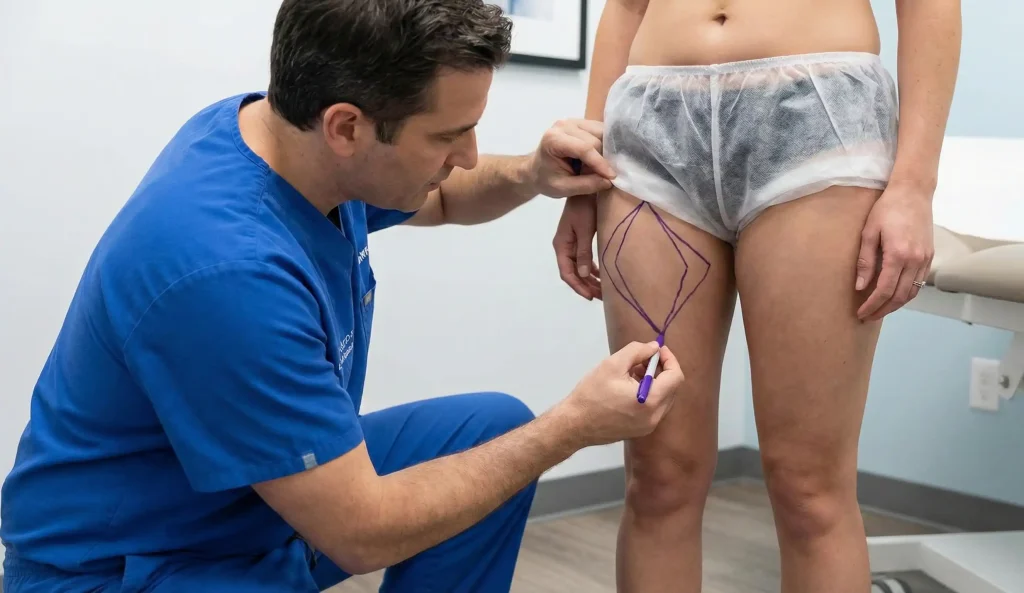
Going for a thigh gap is not just a radical fat removal operation. The inner thigh is a complicated anatomical area characterized by thin skin, important lymphatic vessels, and soft tissue, which does not easily tolerate surgical trauma. To make a natural-looking and beautiful gap without any irregularities or sagging, the surgeon has to find a way in which volume reduction and skin preservation are at a correct ratio. This is a fine cosmetic surgery that requires a thorough knowledge of leg architecture and a certain degree of artistry, not just the use of brute force.
Inner Thigh Fat from a Biochemical Perspective

The inner thigh is one of the storage sites of fat in the female body that is most strongly dependent on genes. This “sex-specific” fat is highly responsive to estrogen, which is why it usually makes its appearance at puberty and then remains stubborn even when a person is physically well conditioned. In contrast to belly fat, which can go up or down depending on your diet, inner thigh fat is different from a metabolic point of view and is intended to be a reserve of energy for a long period of time. That is why doing tons of lunges and squats usually isn’t effective in creating a gap; you can develop the muscle underneath all you want, but you can’t “target reduce” the fat layer that covers it.
Talking about the surgery, the fat in the inner thigh is soft and less fibrous than back fat, so it is very easy to take it out. Nevertheless, the main problem is the skin. Inner thigh skin is well-known for being extremely thin and having less elasticity than outer thigh skin. If a surgeon takes out too much fat too fast, the skin can give in and become “crepey” or wrinkled. So, the idea is to never remove all the fat, but rather to cut a concave curve that looks like the natural shadow of the sartorius muscle and to leave a thin layer of fat to act as a cushion for the skin and to keep it smooth.
Skeletal Structure vs. Amount of Fat
You should understand that a “thigh gap” isn’t only about the fat on your legs; your bone structure also plays a significant role. The size of your pelvis determines the distance between your thigh bones. Those with wider hips tend to have wider thighs, thus making it easier to achieve a thigh gap. Those with narrow hips have femurs that are closer together.
For patients with narrow hips, liposuction can certainly decrease contact and make the legs appear longer and leaner, but a large “supermodel” gap may be anatomically impossible without the side effect of an ugly, scooped-out area. We evaluate your skeletal structure during the appointment so that we can agree on a realistic target. We want to create a “functional gap”—what that means is that the thighs no longer rub against each other violently, rather than a huge space that looks like it has been made surgically.
Why Your Technology in Use is Crucial Regarding the Risk of Sagging
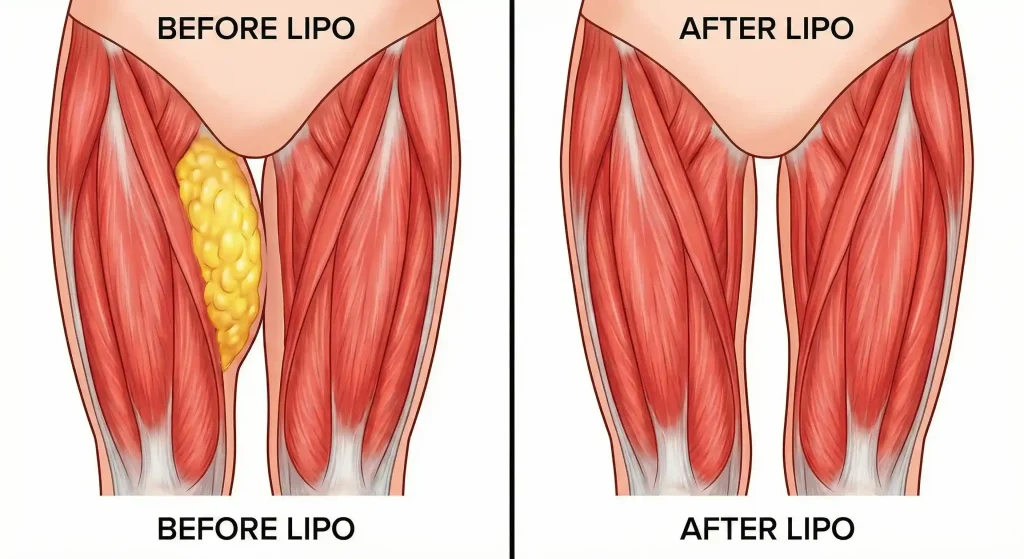
Since the skin on the inner thigh is very thin, depending only on traditional mechanical liposuction is often a gamble, especially for patients who are 30 years old or older or have had a big weight loss previously. When the fat is taken out, but the skin does not bounce back, there will be saggy skin that can even be worse than the original fat, thus, one of the phenomena from the “empty bag”. So here comes the era for advanced energy devices and technologies which are no longer optional but absolute must.
Practically for the inner thighs, we employ only VASER Liposuction and J-Plasma (Renuvion). The ultrasound energy used by VASER breaks down the fat and stimulates the collagen fibers in the skin, which thus contract. J-Plasma is one step ahead in that it uses the energy of helium plasma to “shrink-wrap” the loose skin tightly against the muscle. By using these technologies, we can take more fat out for you to have the gap you desire, and at the same time, we make sure the skin won’t become too loose.
How to Keep the Lymphatic System Intact
The inner thigh is referred to as a high-risk area in terms of lymphatic drainage. The largest lymphatic vessels that take the lymph from the lower legs pass through the groin. Surgical treatment thereof, an intensive and uncontrolled kind may cause lymphedema of the calves or ankles because of the damage to the lymphatic vessels.
That is why the surgical approach is what matters most. To avoid damaging the lymphatic vessels, we usually use a “longitudinal” method which means that the cannula is moved in the same direction as the lymphatic vessels rather than crossing them. When someone has heavy legs or the signs of lipedema, we can decide to perform Water-Jet Liposuction (Body-Jet). This is a water-assisted technique that very gently removes the fat without the use of heat or mechanical tearing which could traumatize the lymphatic vessels, thus ensuring that the legs of the patient will be light and healthy long after the operation.
Liposuction of Thighs in Turkey
Lin Health Europe Clinic‘s signature expertise is leg contouring. We are aware that legs should be seen as a unit in 360 degrees. Purely targeting the inner thigh may sometimes result in an unharmonious appearance; hence, we routinely add knee liposuction and outer thigh contouring to the procedure to produce beautifully slim legs from the hips down to the ankles.
Our surgeons have mastered the “360 Leg Makeover“. We harness the power of VASER to achieve high-definition sculpting and J-Plasma for ultimate skin tightening. Our all-inclusive package comes with special compression garments (fajas) for post-surgery to prevent fluid build-up in the knees. When you choose our Medical Facility, you choose a team that cares for the health of your legs just as much as the aesthetics of the gap, so you will be walking out feeling both comfortable and confident.
Frequently Asked Questions About Thigh Liposuction
Not at all. Liposuction eliminates the layer of fat responsible for the sides of your legs touching. However, the length of the gap after the procedure will largely be determined by your pelvic bone structure. Thus, the size of the gap may be limited in case of narrow hips.
Probably, the procedure removes the fat underneath the skin which is pressurizing the skin, thus, it stops the skins from rubbing together, hence, the problem of chafing or chub rub is resolved.
We cannot say for sure, but there is a risk of your skin sagging after the procedure since the skin of the inner thigh is very thin. Besides this, we also utilize skin tightening technologies such as Vaser or J-Plasma to assist the skin in retracting and thus, prevent skin laxity.
Yes, you might even walk immediately; however, from the compression garment and swelling, you will be waddling for the first few days. We recommend walking as it is one of the factors that prevent blood clots.
You will definitely be uncomfortable during the healing process, but your inner thighs will be very sensitive. For the first week, you might be feeling some burning or stinging. These feelings are quite normal and can be controlled with medication.
Kenkel, J. M., et al. (2012). Ultrasound-Assisted Liposuction: A Review of the Literature. Plastic and Reconstructive Surgery.
Lockwood, T. E. (1991). Fascial anchoring technique in medial thigh lifts. Plastic and Reconstructive Surgery.
Hoyos, A. E. (2011). High Definition Body Sculpting: Art and Advanced Lipoplasty. Springer.