They improve glow and hydration, not volume.
The terminology of aesthetic medicine can be quite confusing. For a long time, patients believed that if you were injecting a needle into the face, you were either freezing a muscle (Botox) or filling a hole (Filler). Nevertheless, a third category which doesn’t fit either description has emerged and is probably the most requested treatment of modern dermatology: Skin Boosters.
Originally, consumer-oriented marketing has associated skin boosters with a variety of trendy titles such as the “5-Point Lift“, “Glass Skin Injection,” or “Salmon DNA” thereby attracting a huge crowd of fans who blindly believed that it was a sure way to achieve the skin that looks expensive, hydrated, and filtered. However, the question that many people still have in mind is, “Will this make my face fat?” In brief, the answer is no. At Lin Health Europe Clinic, we classify these treatments as injectable skincare. We would like you to get familiar with the chemistry of Hyaluronic Acid—especially the idea of cross-linking—so that you can opt for the treatment that gives you a polished look without changing the shape of your canvas.
The Chemistry: Cross-Linked vs. Non-Cross-Linked
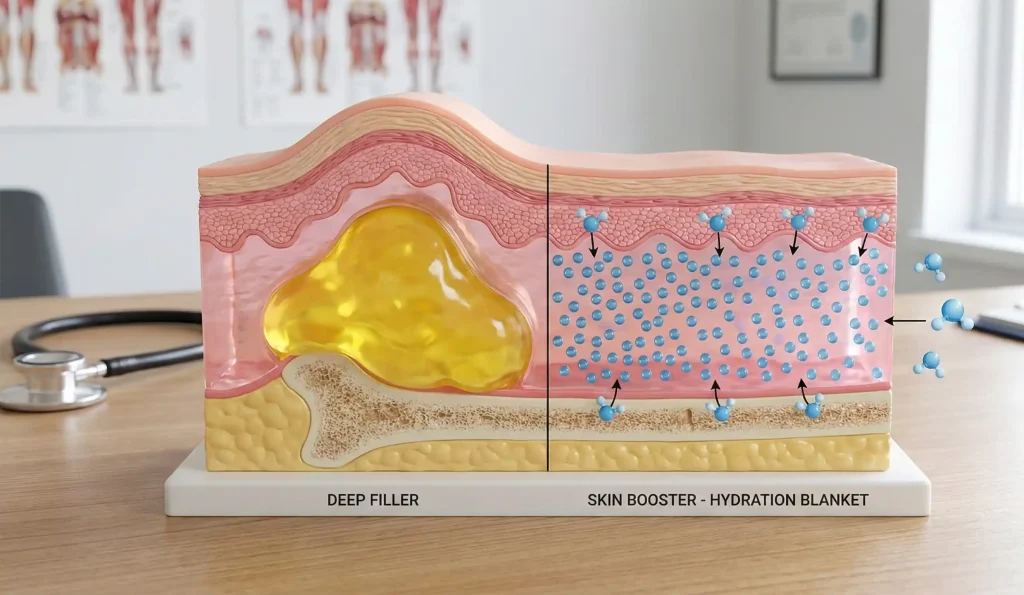
To grasp the reason why Skin Boosters don’t contribute to volume addition, one has to examine the molecule itself. Traditional dermal fillers as well as skin boosters are essentially constructed of the same component, which is hyaluronic acid (HA). The key difference is how the molecules are bonded to each other.
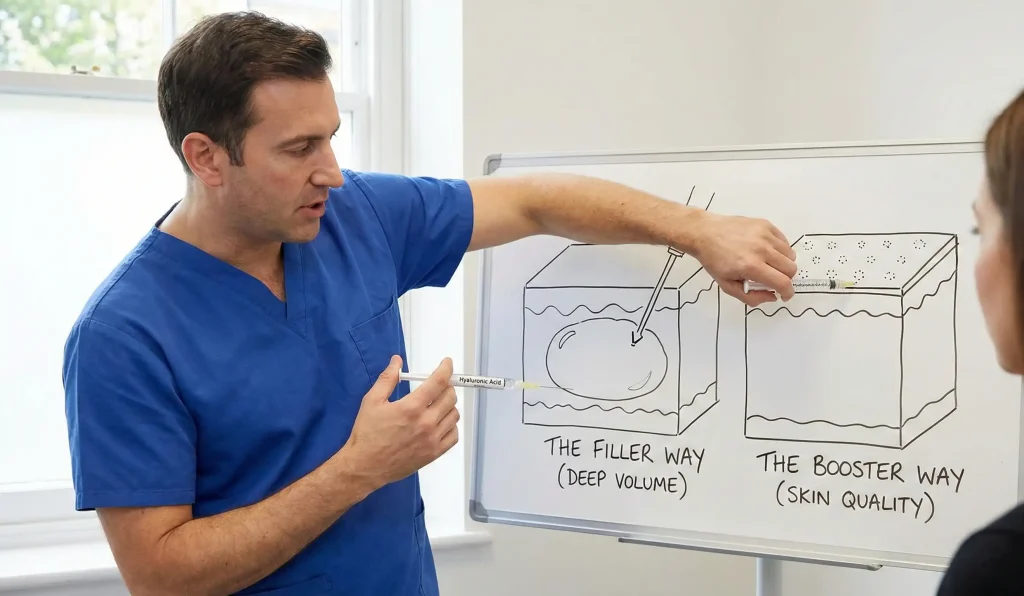
- Dermal Fillers (Volume): These would contain a chemical agent called BDDE that “cross-links” the HA chains together. One can picture a ball of yarn tightly knotted in different places. Such an arrangement results in a gel that is thick and stable. At the same time, when injected, it remains exactly at the spot where it was placed (e.g., on the cheekbone), thus the skin is pushed up forming lift and volume.
- Skin Boosters (Glow): They represent a class of beauty products that use Non-Cross-Linked or thermally stabilized HA. One may imagine strands of silk that flow freely in the water. Such material is very thin and runny, practically like honey. Once injected, it does not become a lump. Instead, it spreads evenly underneath the skin surface, thus it attracts water molecules and forms a blanket of deep hydration. The substance becomes a part of the skin instead of being a layer on top of it, physically, it is not capable of creating “cheekbone” or “chin.”
The Mechanism: Bio-Remodeling, Not Filling
Skin Boosters have many more benefits than just making the skin fresh and moisturized. At a cellular level, they provide your skin with good communication which is known as Bio-Remodeling. It is amazing that such a small component as pure HA when present at high concentrations and injected into the dermis (the second layer of skin), can trigger the skin to initiate a biological response.
The presence of this HA will signal your Fibroblasts—the very cells responsible for the formation of collagen and elastin—to come back from their inactive state. Thus, the fibroblasts will start synthesizing new Type 1 Collagen as well as Elastin. This is actually the reason why skin boosters are dubbed “biostimulators”. In essence, your skin will not merely be able to hold more water after the treatment; instead, it will be physically becoming denser and more elastic. What you get is a changed texture instead of altered contours. For instance, the superficial wrinkles (fine lines) become less visible; also, small pores are reduced due to the improvement in skin elasticity; and, finally, the skin becomes more radiant, giving that “glow” everyone desires.
The “Glass Skin” Effect: Treating the Surface
A perfect candidate for a skin booster is not someone who wishes to alter their face, but someone who desires to enhance their canvas. We usually recommend these treatments for those who describe their skin as “tired,” “dull,” or “gray.”
Just think about it for a second: a skin booster hydrates the skin from within, thus it will become a solution to problems that topical creams can’t reach. Indeed, a moisturizer lies on the outside layer of the skin, which is dead (stratum corneum). However, a skin booster introduces moisture directly into the living dermis.
This deep hydration is what leads to the “Glass Skin” effect—that is, a luminous, translucent, and healthy glow which, if you confer with anyone who has had a facial, they will tell you that it looks just like that, yet its effect lasts for 6 to 9 months. Most importantly, it is very effective for accordion lines on the cheeks (the wrinkles that come out when you smile) and for the delicate, thin skin of the neck and hands which are known to be difficult areas for heavy fillers.
The Menu: Profhilo, Salmon DNA, and More
Not all boosters are created equal. Lin Health Europe Clinic differentiates them based on their main activity:
- Profhilo: It is a class apart in terms of hydration. It incorporates one of the highest concentrations of HA available in the market. It requires just 5 injection points on each side of the face (the BAP technique) for it to spread and immediately tighten sagging, crepey skin. Its main indication is overall anti-aging and loosening of the skin.
- Salmon DNA (Polynucleotides): This line is heavily focused on repairs and is a great choice for patients with acne scars, rosacea, or very delicate skin. These molecules possess very strong anti-inflammatory properties and are obtained from trout or salmon sperm DNA. While hydrating the skin, they also provide healing.
- Light HA Boosters (e.g., Restylane Skinboosters, Juvederm Volite): These are frequently micro-injected all over the face to promote “hydro-balance.” They are a perfect choice for young individuals who want to have a filter-like finish or for smoothing lip lines that don’t necessarily lead to bigger lips.
Lin Health Europe Clinic: The “Mesotox” Cocktail
At Lin Health Europe Clinic in Turkey, we usually mix the treatments when we are looking for the ultimate glow. One of the signature treatments in our clinic is the “Mesotox” or “Glass Facial.”
The idea behind this protocol is to combine a skin booster (hydration) with a little bit of Botox and a vitamin complex. A microneedling device or specialized gun is then used to inject the cocktail superficially into the skin. The dilute Botox reduces pore size and oil/sweat secretion, thus making the skin matte and smooth, while the HA booster smoothes fine lines. Of course, since the application of the Botox is dilute and superficial, you do not lose your ability to make facial expressions. You can still move your face as normal, but your skin looks flawless. This mixed approach gives the advantages of both treatments: the texture of Botox together with the radiant skin of a Booster.
Frequently Asked Questions About Skin Boosters
Skin boosters are not structurally strong gels and thus cannot lift tissue or add volume. They only hydrate and improve the overall quality of your skin without changing your natural contours.
Generally, the effects of treatment can be seen for 6 to 9 months. Because the gel is made of non-cross-linked hyaluronic acid, your body metabolizes it faster than the thick fillers. It is best to come for a maintenance treatment every 6 months.
They can be used together. Actually, they benefit each other. Botox keeps muscles from wrinkling by relaxing them, while boosters make the skin look and feel better right on the surface of the muscle. You can have both treatments in one appointment.
Skin boosters are advanced mesotherapy treatments. Standard mesotherapy involves the use of very dilute vitamins and minerals. Skin boosters contain stabilized hyaluronic acid, which lasts much longer and provides a more profound hydration effect than a typical vitamin cocktail.
The injected material itself gives an instant “plumpness” effect but the actual “radiance” comes out after about 2 to 4 weeks. The duration of the bio-remodeling process is the time it takes for your body to create new collagen and elastin.
Iannitti, T., et al. (2014). Experimental and clinical efficacy of a new hyaluronic acid-based bio-revitalizing product. Journal of Cosmetic Dermatology.
Sparavigna, A., & Tenconi, B. (2016). Efficacy and tolerance of an injectable medical device containing stable hybrid cooperative complexes of high- and low-molecular-weight hyaluronic acid: a novel approach to facial ageing. Clinical, Cosmetic and Investigational Dermatology.
Landau, M., & Fagien, S. (2015). Science of Hyaluronic Acid Beyond Filling: Fibroblasts and Their Response to the Extracellular Matrix. Plastic and Reconstructive Surgery.