
Diastasis Recti: Does Tummy Tuck Fix Diastasis Recti?
Medically reviewed by Op. Dr. EmrePlastic and Aesthetic Surgeon
Yes, a tummy tuck repairs diastasis recti.
You've reached your target weight, performed thousands of crunches, and followed every core workout on YouTube, yet your stomach still protrudes. For many women, especially after pregnancy, it's not a matter of fat - it's a matter of the body's structure failing. The condition is called Diastasis Recti . It is a separation of the abdominal muscles that causes a permanent "pooch" or dome-like bulge in the middle of the belly.
It is very hard for you when you are told to "just exercise more" but your anatomy has failed. The reality is that once the connective tissue between your muscles has been stretched to the limit, no amount of planking will bring it back. Although a tummy tuck is well known for removing loose skin, its most remarkable effect is in the repair of the muscle gap. At Lin Health Europe Clinic, we consider the tummy tuck not only a cosmetic skin removal but also a functional reconstruction of the abdominal muscles.
The Anatomy of the Gap: Why It Happens
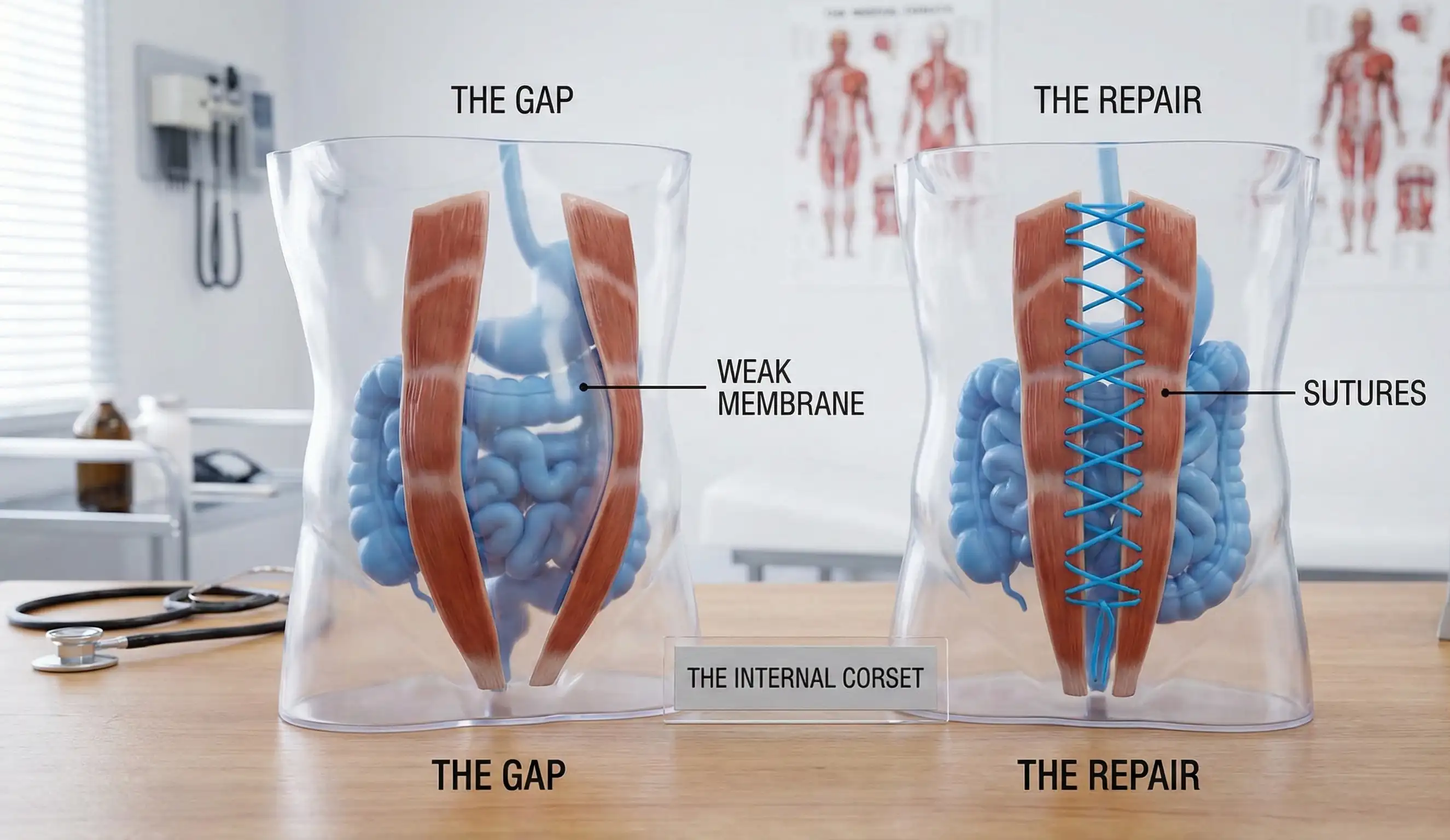
It is hard to understand a solution without understanding a problem. Your "six-pack" muscles (rectus abdominis) are two parallel vertical strips kept together by a central band of connective tissue called the Linea Alba. You can think of the Linea Alba as a rubber band. During pregnancy or weight gain, the internal pressure of the body causes these muscles to get separated, the Linea Alba goes very thin to let the baby or the fat inside the belly come in.
Usually, the tissue returns to its normal state after birth. However, for 60% of women, something similar happens to a rubber band that has been stretched too much and has lost its elasticity. The muscles stay apart, and the gap size ranges from 2 to over 10 centimeters. Due to the fact that the muscles no longer connect in the middle, they are not able to hold your internal organs tightly. Thus, the abdominal contents are allowed to protrude, which is the round, pregnant belly look that is typical even when there is very little body fat.
Why Exercise Fails: The "Rubber Band" Reality
One of the most widely spread myths states that Diastasis Recti can be solved at home by just exercising. It is true that with the help of physical therapy one is able to develop their muscles, but a stretched Linea Alba cannot be tightened. Imagine as if you were holding a very tightly stretched piece of saran wrap - you won’t be able to make it unstretched.
The fact of the matter is that by doing regular crunches and sit-ups you could actually be making your condition worse, especially if you are experiencing a great extent of their separation. By doing these movements, the pressure inside your abdomen increases, therefore, your organs get pushed out through the weakest spot and the gap gets bigger (it is known as the "doming" or "coning" phenomenon). In spite of the fact that it is very important for your health to have a strong core, a surgical method is the only available choice to physically re-establish tension along the middle line.
The Surgical Solution: Plication (The Internal Corset)
So, does a tummy tuck fix it? That is exactly what it does and it is considered to be the most effective method. The plastic surgeon exposes the abdominal wall by raising the skin during a full abdominoplasty. We perform a step called Muscle Plication at that time. From the pubic bone to the rib cage, we sew the separated muscle bellies together using high-strength permanent sutures.
This step is considered an "internal corset". It makes the abdominal wall physically tighter. As you waistin goes in and your stomach flattens the overall look changes immediately. It is the body that being structurally re-engineered. After the gap is closed, the tension necessary for a flat belly is brought back, and a square, wide torso is turned into a narrower, hourglass-shaped one.
More Than Looks: The Functional Relief

At first glance, the repair of Diastasis Recti might appear to be just a cosmetic procedure, but the functional advantages are really great. The abdominal muscles support your spine from the front. If they are separated, they no longer support your back and this is why you may suffer from chronic lower back pain, poor posture, and pelvic floor dysfunction (e.g., urinary incontinence).
After a tummy tuck, patients often say that their back pain is gone, their posture has improved without their noticing it, and they have more strength at a gym. This is the first time that they are able to engage their core completely because the parts are laid out correctly. It is as much a pleasure of the eyes as a lift of the spirit.
Lin Health Europe Clinic: Wall-to-Wall Repair
At Lin Europe Clinic, the perfection muscle repair is the top priority. There are some methods which only have the effect of tightening the lower part of the abdomen, and hence the protrusion of the upper part is not fixed. We do a High-Tension Lipoabdominoplasty which is a method that uses aggressive liposuction to highlight the waist combined with a full muscle repair.
We make sure that the plication is done in such a way that it is firm enough to get the wall to be flat but at the same time, it is not so tight that it would interfere with comfortable breathing. Since it is quite common for people with diastasis also to present with an umbilical hernia, we look for it and mend it at the same time. We consider the abdomen as a single functional unit so that when you wake up, you just not only look better, but you are physically stronger and more comfortable as well.
Frequently Asked Questions About Diastasis Recti and Tummy Tucks
References
Nahas, F. X. (2001). An aesthetic classification of the abdomen based on the myoaponeurotic layer. Plastic and Reconstructive Surgery.
Hickey, F., et al. (2011). The functional indications for abdominoplasty. Irish Journal of Medical Science.
Brauman, D. (2008). Diastasis recti: clinical anatomy. Plastic and Reconstructive Surgery.
Frequently asked questions
Can Diastasis Recti be fixed without a tummy tuck?
If there is a wide gap (over 2-3 cm), the answer is usually no. While physical therapy that focuses on specific exercises can make the function better, it won't be able to physically close the space that has been stretched. A tummy tuck is the only surgical method of physically sewing the Diastasis Recti together.
Is the muscle repair painful?
Yes. The strongest source of soreness after a tummy tuck is the muscle tightening (plication). It is like you have done 1,000 sit-ups. This soreness usually lasts for 2-3 weeks post-Diastasis Recti repair.
Can Diastasis Recti come back after surgery?
It is unusual but possible. If you put on a lot of weight or get pregnant again after the operation, the internal stitches might be stretched or broken, thus the Diastasis Recti may come back.
Does a mini tummy tuck fix muscle separation?
Generally, no. A mini tummy tuck normally just deals with the skin below the belly button. Most Diastasis Recti runs up to the ribs, so a full abdominoplasty is needed to fix the entire muscle length.
How long after giving birth can I fix my Diastasis Recti?
It would be best if you waited at least 6 months, preferably 1 year, after you have stopped breastfeeding. This will give your hormones time to get back to normal and the tissues time to settle before we do a surgical repair of the Diastasis Recti.
This article is general information, not medical advice, and does not replace a consultation. Every procedure carries risk and outcomes vary from person to person.
Last reviewed 9 February 2026