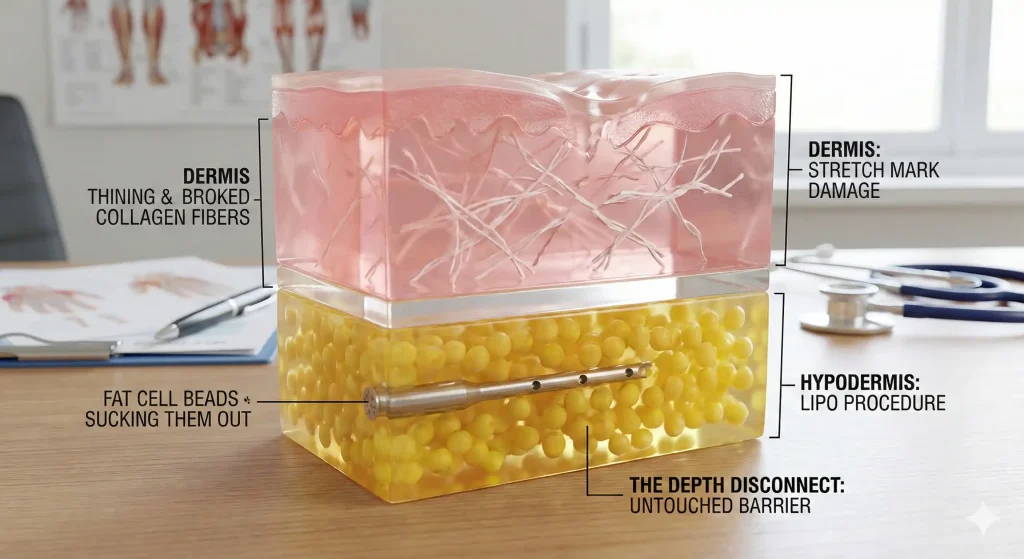
No, liposuction does not remove stretch marks.
Stretch marks (Striae Distensae) are essentially the scars left behind by our skin’s stretching over time. Whether it’s through puberty, gaining weight rapidly, or pregnancy, these lines in a variety of colors from shiny white to deep red are the story of our body’s growth. The skin’s inner layer or dermis gets torn due to the skin being stretched beyond its natural growing capacity.
A lot of people who visit Lin Health Europe Clinic hope that Liposuction is the answer to all their skin problems. This idea seems quite rational: “If I just remove the fat underneath, the skin will naturally contract and I won’t see any marks.” Unfortunately, this is a very common misunderstanding in body contouring. Actually, quite often what people who have undergone liposuction say to us is that the marks on their bodies became more noticeable after the operation. It’s like the skin has lost its support and hence the striae have been highlighted. Basically, Liposuction does not help stretch marks. If the treatment is done improperly, it might even make the marks stand out more. We think it’s important to always give a realistic view of the situation based on medical facts. Here’s why taking fat away isn’t going to fix your skin and what your options really are.
The Balloon Effect: Why Lipo Can Make Things Look Worse
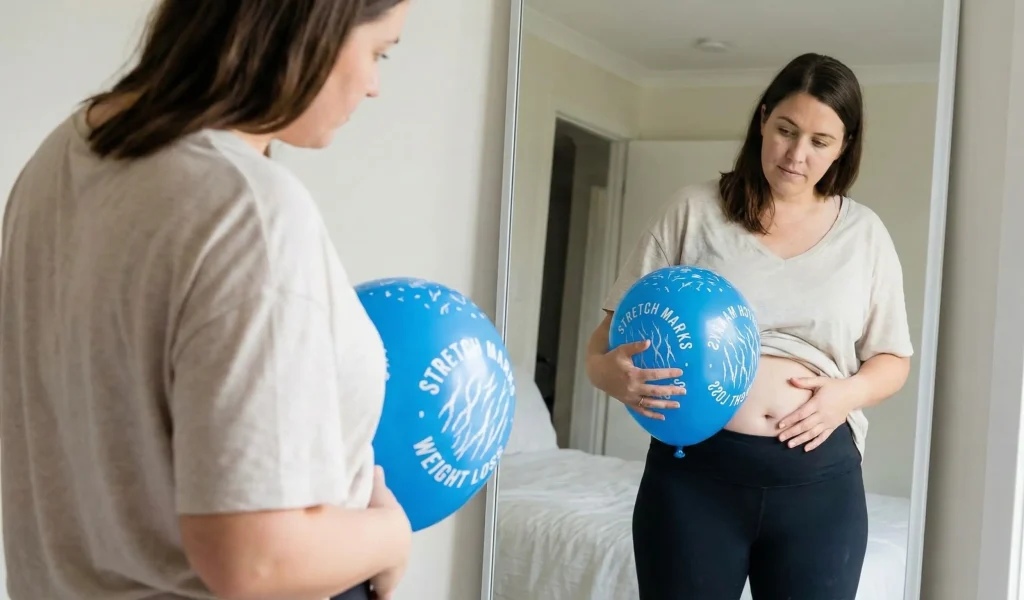
Imagine a balloon that has been fully blown up and left for a long time. The latex is so stretched and thin. Now, if you let the air (fat) out of the balloon, it won’t go back to its perfect original shape; it will get wrinkly and deflated.
Your skin is subject to the same laws of physics. Liposuction takes away the volume (fat) that is currently holding the skin to the limit of its stretchiness. At the moment the volume disappears, the skin is stripped of its tension. In the best case scenario, skin elasticity will allow the skin to retract flawlessly. Unfortunately, skin with stretch marks is essentially compromised skin with low elasticity. The elastic fibers are destroyed. So, when we take away the fat, the skin does not retract but hangs loosely thus the stretch marks get “bunched up”. This “concertina effect” can cause the marks to look deeper, closer to each other and more noticeable than they appeared when the skin was stretched.
The Exception: Excision Surgery (Tummy Tuck)
The only surgical method to completely remove stretch marks is excision. Therefore, Tummy Tuck (Abdominoplasty) is a very effective surgical procedure for lower abdominal stretch marks.
The surgery we perform in a full abdominoplasty is the removal of extra skin from the area of the belly button down to the pubic bone. If your stretch marks happen to be in this “disposal zone” (usually the area below the navel), they won’t be the only thing that will be discarded as along with the excess skin these marks will be thrown into the bin by the surgeon as well. This is the only method of saying ”goodbye” to them for eternity. On the other hand, if you have stretch marks above the belly button or on the hips/thighs (areas where removing a large amount of skin is not possible), operation will not get rid of them. Here, we have to limit ourselves to changing their look rather than complete removal.
The Texture Fix: Energy Devices (Morpheus8 & Laser)
We cannot really cut out stretch marks on, say, thighs, arms, or upper stomach without causing a huge scar; therefore, we have to rely on Resurfacing Technologies. At Lin Health Europe Clinic, we apply energy devices in combination with liposuction to address the problem of skin looseness.
It is pretty common for us to integrate Radiofrequency Microneedling (Morpheus8) or CO2 Fractional Laser with liposuction procedure. These two devices create thousands of tiny holes in the surface area of the skin and simultaneously generate heat that penetrates into the deep layers of the skin. This controlled injury invokes the body’s healing response which results in the production of new collagen and elastin fibers right inside the stretch mark. Though it won’t ever be perfect, this restructuring will plump the thin, almost transparent skin of the striae thus improving the texture and mixing the color with the surrounding skin. It also compresses the stretched surface of the “balloon” in such a way that the resulting deflation from lipo leads to smoother, firmer contours rather than a wrinkly mess.
The Color Factor: Red vs. White
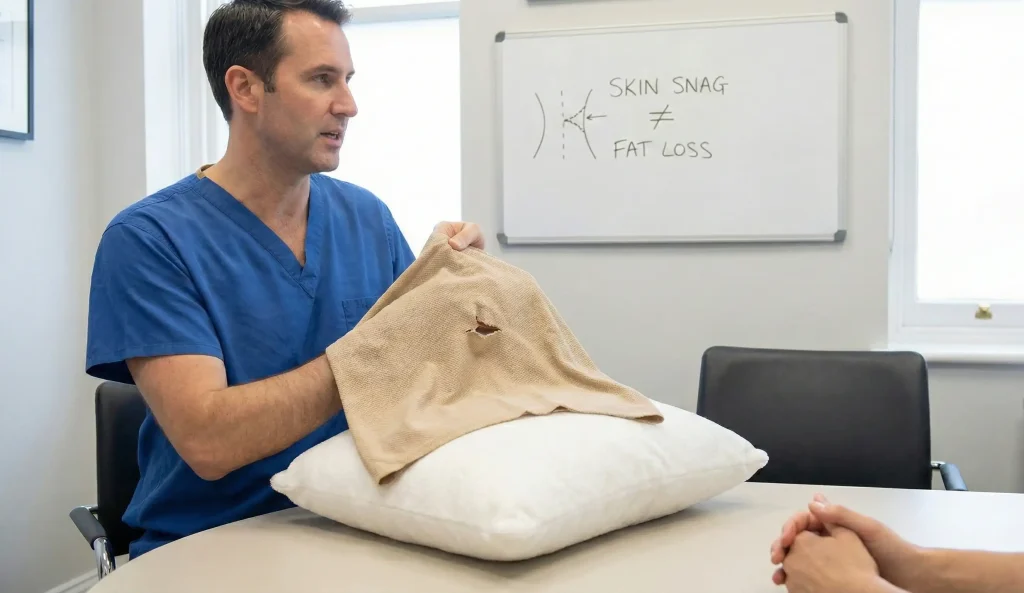
When talking about stretch marks, it is of utmost importance to understand that they come in two stages.
- Striae Rubra (Red/Purple): These are the recently formed stretch marks which are still active. Their red color is due to the fact that they are inflamed and the blood flow is increased in order to heal the tear. These react best to treatment. The use of vascular lasers (V-Beam or IPL) can quickly reduce the redness by collapsing the blood vessels.
- Striae Alba (White/Silver): These are the well-formed, aged scars. The redness has disappeared and the blood vessels have diminished. They are much more difficult to treat as the ”wound healing” mechanism has already ceased. Liposuction does nothing in terms of the color. In the case of white marks, our aim is to improve the texture (make them less shiny/wrinkly) e.g., through using microneedling or plasma therapy (PRP), rather than to make the color right.
Lin Health Europe Clinic: VASER Skin Tightening in Turkey
When you are thinking about getting rid of stretch marks, but still, you are not qualifying for a Tummy Tuck (either you do not have enough loose skin or you want to avoid the scar going hip to hip), here is what we do at Lin Health Europe Clinic in Turkey: we resort to the use of VASER Liposuction to improve your condition.
There is quite a big difference between traditional mechanical liposuction which merely suctions fat and VASER which employs ultrasonic energy. This energy develops heat that not only helps break down the fats but at the same time stimulates the collagen fibers in the skin layer. This cellulite-induced skin retraction (generally 10-20% more tightening comparing to regular lipo) is a great way to help the patient reduce the risk of the ”deflation” problem. It doesn’t really get rid of the stretch marks but VASER makes sure that the skin will be firmer after the procedure as compared to the standard lipo, thus minimizing the striae being more prominent and crepey. For patients who want to lose fat but not the aggressive scarring of excisional surgery, it is a compromise that is just right.
Frequently Asked Questions About Stretch Marks and Liposuction
Not only. Liposuction only extracts fat from under the skin, so it doesn’t affect the skin surface. Also, taking away the volume can sometimes make stretch marks appear more wrinkled or noticeable due to skin laxity.
It can be said that a tummy tuck only removes the stretchmarks from the skin that is cut off – which is generally the skin between the navel and the pubic hair. However, stretch marks above the belly button are still there even though they are usually pulled down and the area looks tighter.
In case you have bad skin elasticity and a great number of stretch marks, regular liposuction can result in the skin hanging so that the marks will look creped or scrunched up. Incorporating VASER or J-Plasma helps you in avoiding this risk.
Absolutely. We sometimes carry out “multimodal” sessions where liposuction is done first, and then the skin is immediately treated with Morpheus8 or Fractional Laser to stimulate collagen production while you are still under anesthesia.
It can be done but it is not advisable. Pregnancies that will take place after the surgery will make the skin stretch again thus, break the skin again and negate the effect of the surgery. You should wait until your family is complete.
Shiffman, M. A., & Mirrafati, S. (2001). Aesthetic Surgery of the Abdominal Wall. Springer.
Alster, T. S., & Tanzi, E. L. (2009). Laser treatment of hypertrophic scars, keloids, and striae. Dermatologic Clinics.
Di Giuseppe, A. (2013). Ultrasound-Assisted Liposuction: Physics and Techniques. Clinics in Plastic Surgery.