
Yes, early breast ptosis can be normal.
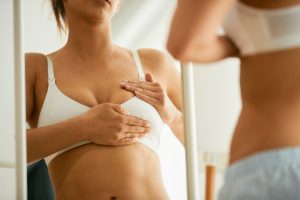
Looking in the mirror at 22 or 25 and seeing breasts that appear “tired,” droopy, deflated is a quiet, often shameful insecurity that is shared by thousands of young women. A social media filter and a lingerie campaign instill in us the idea that breasts that are high, round, and self-supporting are the biological setting of youth, and that the breasts (ptosis) of mothers or women over 50 only are to be sagging. As a result, a young woman noticing a breast shape going down or nipples pointing to the south should be deeply ashamed and not sure whether she did something wrong or that her development is a medical defect.
The answer to “Is it normal?” is an unequivocal yes. There are so many different breast shapes and so few “perky” standard ones. Although severe and deep slump at the age of 20 is statistically less common than at the age of 40, mild to moderate ptosis is biologically normal for a lot of women, especially those who naturally have bigger breasts, softer skin, or particular genetic features. At Lin Europe Clinic, we have patients who haven’t given birth, haven’t breastfed, and haven’t aged much, but still, they get affected by gravity. Knowing why this is happening is the first step in throwing the self-blame away and choosing whether you want to change it or not.
Your Genes: Cooper’s Ligaments
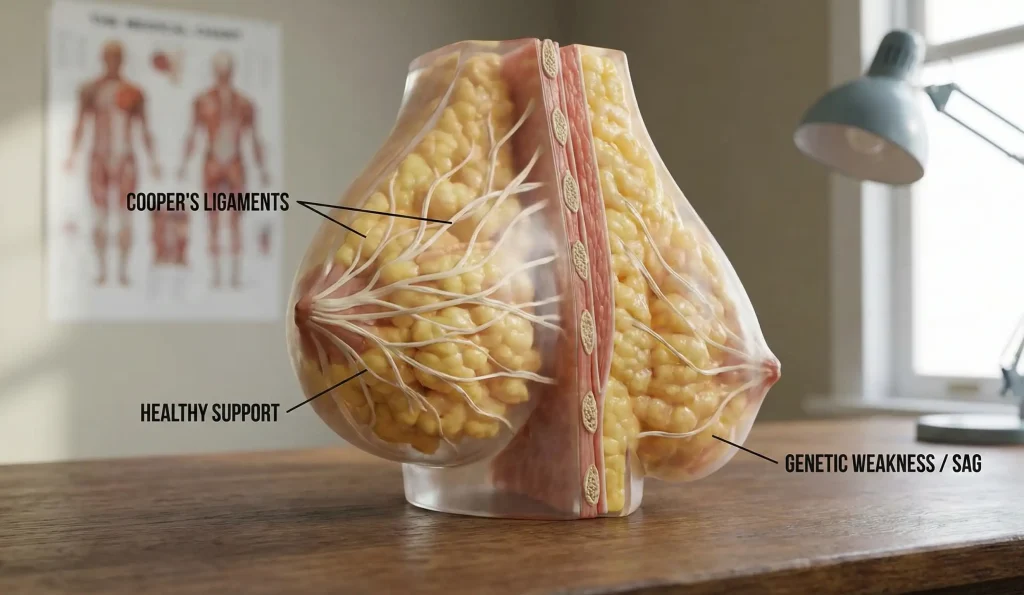
The main reason for early sagging is not your bad posture or your bra choice but rather your DNA. Your genes determine the quality of your collagen as well as the tensile strength of your Cooper’s Ligaments, which are the internal fibrous bands that run through the breast tissue and connect it to the chest wall. Imagine these ligaments as your body’s internal bra.
In some women who are lucky, these ligaments are genetically thick, short, and tough, no matter what the size of the breasts is. For others, the connective tissue is from the beginning more elastic, long, and lax since puberty. If your mother or grandmother has experienced early sagging, it is quite probable that you have got a similar tissue quality. So no amount of chest exercises or “miracle firming creams” is going to tighten the ligaments because they were never tight. It is just your unique anatomy.
Hidden Among Other Causes: Tuberous Breast Deformity
In fact, a lot of young women attributing a “sagging” look to the breasts are actually suffering from a congenital developmental condition called Tuberous Breast Deformity. This is not a result of gravity, but a tightening ring at the base of the breast that does not allow the tissue to enlarge normally during puberty.
Here, the breast can hardly develop along the side and gets a pointed nipple in the end, which gives it a tubular shape instead of round. Moreover, this deformity combines the issues of a very high inframammary fold (the line of a fold under the breast) and a herniated nipple complex. Tuberous breasts patients usually feel at a very tender age that their breasts are ‘droopy’ or peculiar. It is important to know this because conventional breast augmentation is likely going to make tuberous breasts look worse; a special surgical release of the tissue below the skin is necessary for reshaping the constricted breast tissue.
Rapid Growth and Weight Fluctuations
During adolescence and, to some extent, the early 20s, the human body undergoes many changes, some of which can be quite abrupt. It is well known that breasts develop at puberty, and some of them grow quite rapidly. The skin can become immediately less elastic if it stretches too fast to the maximum size of the glandular tissue, and the process is similar to that of a rubber band that has been stretched and cannot go back.
The biggest enemy of female breast perkiness is “yo-yo dieting”. When the weight is gained, the skin of the breast gets bigger. On the contrary, if one loses weight very fast, then the fat disappears from the breast, but the skin that had been stretched remains the same. Hence, the top of the breast is hollow, while, at the bottom, the skin surface is greater than the volume (this results in a sagging appearance or “pseudoptosis”). In the current world with many fitness craze penetrations, such a case of the skin envelope aging caused by rapid body composition changes is no longer a rarity.
Lifestyle Factors: Smoking and Sun
While genetics are responsible for the part of the gun that is loaded, the lifestyle choice made pulls the trigger. Out of the many reasons defining the most significant cause of breast sagging in young women, smoking can be considered one of the greatest contributors. Nicotine causes the breakdown of elastin, a protein that makes the skin able to snap back after stretching. Young smokers are forced to witness the loss of breast firmness quite a few years before non-smokers. Another thing is that too much uncovered sun exposure (tanning beds or topless sunbathing) results in the destruction of collagen network in the slender chest skin, and, therefore, the weakening of the “envelope” that keeps the breast weight is the result.
Going to Turkey to Fix the “Unfixable”
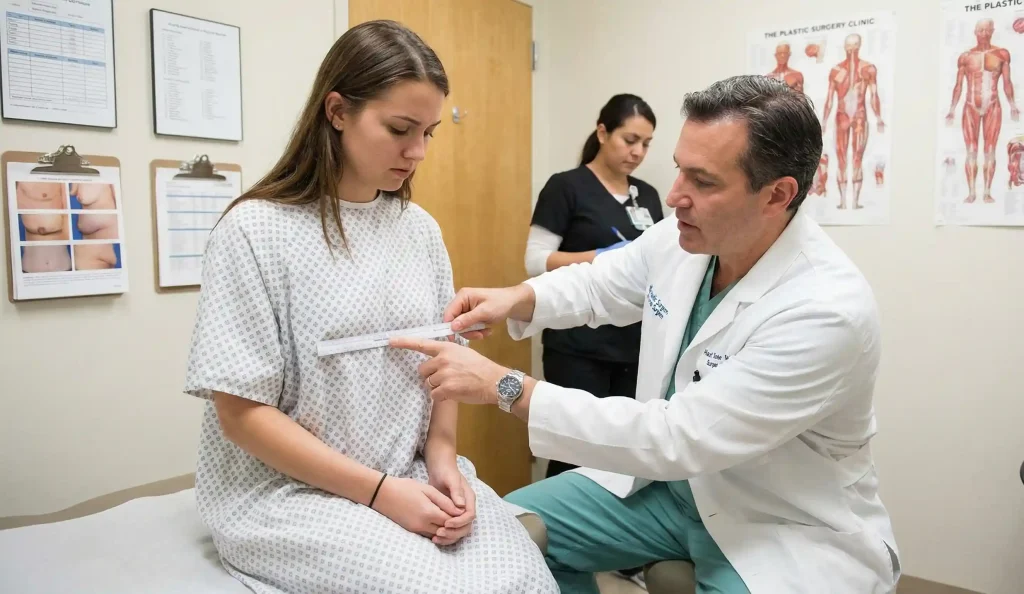
As you look for the best Lin Europe Clinic surgery center for your correction operation in Turkey, you can be sure that we approach early breast ptosis with the right amount of sensitivity and individuality. We understand that for a 24-year-old, to choose a full breast lift (Mastopexy)—which leaves a vertical or anchor-shaped scar—is a very heavy psychological decision. Giving up on self-perfection scars and choosing shape is not a very easy decision, one that we understand very well, and that is the reason why we don’t take it lightly.
We thoroughly assess your skin to figure out the “minimum effective dose” of the operation.
- For “Empty” Breasts: In case of volume loss of the chest due to weight changes, simple Breast Augmentation will be sufficient to fill the skin envelope and lift the nipple without skin removal.
- For Tuberous Breasts: We release the ring of constriction that forms the deformity along with an implant to finish the breast shape.
- For True Sagging: A lift will be done if the ligaments are truly loose and lax; with refinement of the suturing methods, the scar lines will be as fine white lines so young people can enjoy their youth without letting their scars take away their confidence.
Frequently Asked Questions About Early Sagging
There is no medical proof that wearing a bra stops the ligaments from being stretched by gravity over time; on the other hand, not wearing a bra doesn’t cause sagging either because it is mostly a matter of genetics and skin condition.
Exercises such as push-ups focus on the chest muscle under the breast, which might cause the breast slightly to protrude as the muscle gets bigger, but they are not capable of tightening the skin or shortening the ligaments that are already stretched and causing the breasts to sag.
Yes, it is physically safe for you. However, you must take into account that if you get pregnant and breastfeed, your skin may stretch again, and you might have to get a touch-up operation later on to keep up the results.
No, sleeping without a bra has no significant effect on sagging since when you lie flat gravity pulls differently; most of the damage has been done by the weight of the breasts when you have been standing upright over the years.
It is very typical and normal for breasts to be asymmetrical as the ligaments and skin’s elasticity on the left and right sides of your body may have matured differently during puberty, which might be the cause of one breast being lower than the other.
Rne, M. (2010). The genetics of breast ptosis. Aesthetic Surgery Journal.
Qiao, Q., et al. (2009). Management of the tuberous breast. Aesthetic Plastic Surgery.
Campanile, G., et al. (2013). Smoking and the effects on breast shape and ptosis. Aesthetic Plastic Surgery.