Different tissue strength or healing rates cause uneven dropping.
For a woman recovering from breast augmentation, checking oneself in the mirror is probably the most common thing to do in the morning. In fact, checking the progress through the mirror might be the first thing you choose to do in the morning. Most definitely, in the first few weeks, this fixation with the mirror leads to a confused mix of emotions—on the one hand excitement and on the other hand a slight panic. You are aware that there is going to be some swelling but you are certainly not prepared for the two different looking breasts that you see. One implant has perfectly settled giving a fully round and natural curve whereas the other one is still elevated, firm, and square, resembling a shelf right under your collar bone.
At Lin Europe Clinic, this particular worry is perhaps the first concern we hear after post-operative checkups. “Was the operation wrongly done? Is one fixed/blinded?” The simplest answer is no. It can certainly be disheartening to be visually asymmetrical but it is very common, this happens all the time and thus one implant dropping faster than the other is just normal. Your body is not a robot and hence biology does not follow a precise timeline. Knowing the physiological factors that cause this “delay” will give you the power to calm down and be more patient once your body gets used to the new shape.
Muscle Dominance Theory
The most common reason why one implant drops faster than the other is that people tend to use their dominant hand more. On the other hand, if the implant is submuscular (located under the pectoralis major muscle), then the healing is totally dependent on the state of that muscle. The pectoral is a very strong muscle and just like any other muscle, after trauma, it reacts with a contraction or spasm.
A strong muscle is also a tight muscle, so if you are right-handed, your right pectoral muscle is going to be naturally stronger and more developed compared to your left. You use your right hand for various things such as opening doors, carrying shopping bags, etc. Because it is very strong, the muscle is going to react more violently. When the surgeon inserts the implant under the dominant one, your muscle goes into protection spasm which is much more intense than the other side, being the weaker one. You can imagine it as a tighter fist that is holding the implant. Therefore, the dominant side is going to need more time to relax, get the implant down into the pocket and let go. It is not unusual at all for a right-handed patient to notice that their left breast is completely down already by the third week whereas their right breast still looks high until the sixth or seventh week.
Flattening the Pre-Existent Symmetry Myth

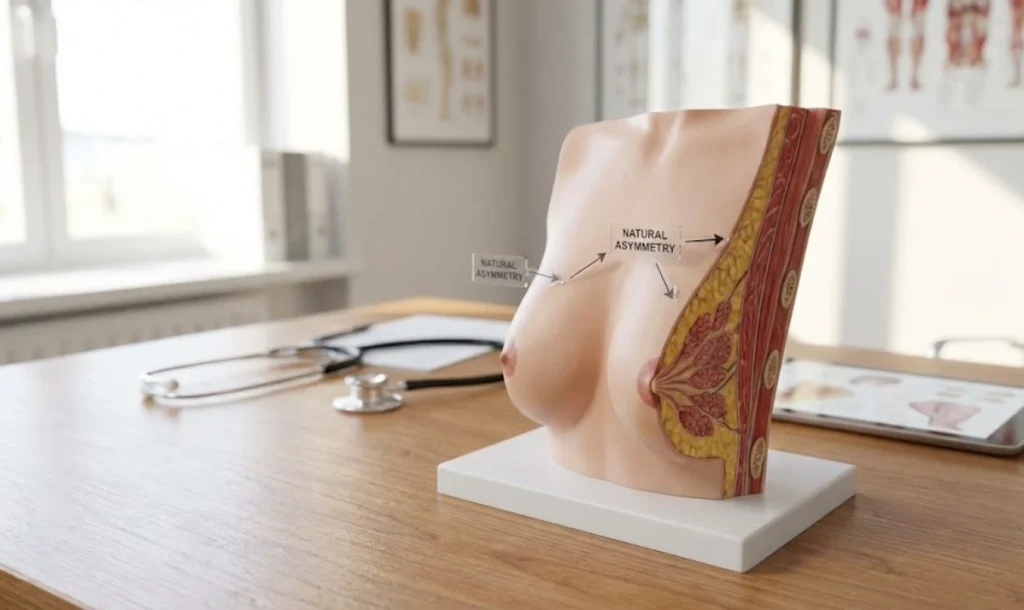
What the recovery process also brings into the light is the natural unevenness of your skeleton. Prior to the operation, only very few ladies look at their breasts with the surgeon’s eyes. It might have been that you had never noticed that your ribs were slightly curved or that one side of your chest wall protrudes more than the other due to a mild form of scoliosis.
Just like lenses, implants will highlight these skeletal discrepancies. For instance, if the left side of your rib cage is a bit concave (dipped), the implant can easily find its way there and thus will settle faster. If the right side is more convex, than the muscle is going to be tighter across the ribs. This is going to result in the delayed drop. To add to that, breasts are always different in size and shape before the surgery. You might remember that the right breast had slightly tighter skin than the left one. Hence, after the operation, it will take longer for the right breast to accommodate the new volume simply because the skin and the underlying tissue must be stretched more.
The Extent of the Wound and Swelling Patterns
Any type of surgery is a trauma to the body, and one of the body’s responses to trauma is inflammation and this may not happen symmetrically. Even if the doctor performs perfectly the same procedure on both sides, your lymphatic system may be working differently when it comes to draining fluid. One side may be more swollen and purple than the other side. Or, as a matter of fact, it may be that there is a minor bruise on one side while the other side has none.
Fluids take up space, there is no other way to say it. So, if there is more fluid inside the breast, the pressure in the breast will be higher. As a result, the implant will be pushed up and hence it will look bigger and higher than the other one. This is especially important if you are used to lying on only one side of the two, since gravity will make the fluid pool on the underside. As the swelling goes down unevenly during the first month, the dropping rates often get aligned.
The Prohibition of “Mirror-Checking”
Psychologically, it is a bit hard to go through this period because of the phenomenon called “Cyclops Effect” which refers to the tendency of obsessing over one single flaw so much that you actually stop noticing the rest of the things. While you were admiring the beautiful result on the left, all of a sudden you see the shelf on the right and that is all you focus on. Keep in mind that the whole process of “dropping and fluffing” is not a short burst but rather a long-distance run. The final sitting of your implants can only be approximated correctly three to six months post-op.
At Lin Europe Clinic in Istanbul, Turkey, we encourage our patients to believe in the process. Unless there are symptoms of infection or hematoma (rapid swelling accompanied by pain in the breast), asymmetry during the first three months post-op is almost always a temporary soft-tissue problem and not a surgical failure.
Speeding Up the Lagging Side
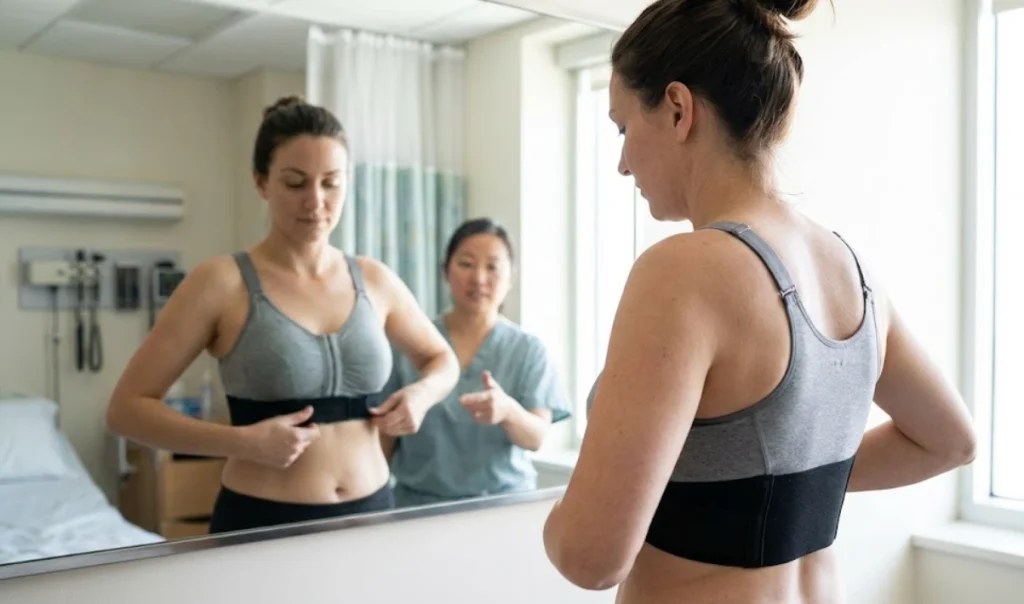
Even if you have to rely on patience most of the time, being physically active will help balance the two sides. This is also when a breast stabilizer band becomes invaluable. If one side refuses to cooperate, the doctor may ask you to tighten your band so that more pressure is applied on the side that is higher. Also, if you have healed sufficiently and the initial recovery phase is over, using heat (such as a warm compress) on the affected muscle can promote blood circulation and therefore help the muscle relax.
Still, be very careful not to massage the high side too much if you do not have the green light from your doctor. Before the implant pocket is healed, pushing aggressively on a high implant can result in an inflammation. Above all, the intention is to make the muscle give up gently rather than to force the implant down.
Breast Implants in Turkey
Getting breast implants in Turkey means that you will not be left to guess why one side looks different during the recovery. We at Lin Europe Clinic in Istanbul, understand that surgery is just the first step. Our medical professionals are committed to checking on your symmetry throughout the recovery period. We offer tailor-made post-operative programs to our patients which also include the exact instructions on how to wear the breast stabilizer to fix the issue of uneven dropping.
Frequently Asked Questions About Uneven Dropping
The most common cause is that your dominant side muscle is stronger and tighter. For instance, if you are right-handed, your right side muscle would be stronger and tighter. That is why it holds the implant in a spasm longer than the weaker side.
Most of the asymmetry disappears in about 6 to 12 weeks. Although sometimes it could take as long as 6 months for the “drop and fluff” process to be completed and the two breasts to appear symmetrical.
Only if your surgeon has given you such specific instructions. Typically, you carry the band across your whole chest, but on the high side, you might pull it just a little lower or tighter to put more pressure there.
Of course, it is. In fact, the main reason why the breast is high is because the muscle is in a tighter spasm. That spasm results in more pressure and pain when compared to the side that has already relaxed and dropped.
Absolutely. For one thing, if during the early period of your healing you sleep on the same side, that’s the side that gravity will pull the implant sideways or down, and the swelling will be concentrated in the lower breast. Thus, the best thing to do is to sleep on your back, elevated, for the first few weeks.
Adams, W. P. (2008). The process of breast augmentation: Four phases of care. Plastic and Reconstructive Surgery.
Bengtson, B. P. (2011). Complications, adverse events, and reoperations in breast augmentation. Clinics in Plastic Surgery.
Spear, S. L. (2010). Surgery of the Breast: Principles and Art. Lippincott Williams & Wilkins.