No, implants usually require replacement earlier.
If a young woman in her twenties goes for a consultation to have breast augmentation, planning for the next 40 years is usually the furthest thing from her mind. The attention is on the upcoming summer, the wedding dress, or the confidence she will have during the best years of her life. However, as time inexorably goes on, the twenty-something patient turns into the sixty-something grandmother, and very often is still carrying medical devices that were implanted decades ago. This raises a really interesting and medically complicated question: “Can you keep breast implants for 40 years?“
Besides being a Lin Europe Clinic practice, we also value sincere and long-term planning. The short answer is that physically you can have an implant inside of you for 40 years. Every so often, there are patients coming with their flawless “vintage” implants that somehow managed to live a few decades without any troubles. On the other hand, the medical answer would be more prudent. The truth is, while you can keep them, betting on a 40-year lifespan is a gamble on the statistics. Breast implants are made to last, but they aren’t eternal. It goes without saying that for your own safety and peace of mind it is good to know what happens to the device and to your body after almost 50 years.
The “One Percent” Rule of Rupture
Knowing the failure rate, you will be able to understand more the risk factor of keeping implants that long, up to 40 years. Normally, the implant lifespan is figured out by the manufacturers and regulatory authorities such as the FDA to be 10 to 20 years. This is not a day for throwing away the implants; they are not going to disintegrate on their own. However, several studies have revealed that the risk of rupture increases by roughly 1% yearly.
Therefore, by the tenth year, at the latest, around 10% of women will have had their implant rupture or have come across some other complication. After 40 years, the chance goes up even more. Basically, you would be asking a synthetic shell to be kept intact for 40 years, during which time it will experience friction, compression, hugging, sleeping, and working out. During this time, the inside of the silicone shell gets its shell fatigue. It’s the same thing when you walk carefully your favorite shoes will last for some time but inevitably their soles will wear away; the implant shell also gets weaker. Although there are women who get lucky, 40 years of implants means that you are more than likely that the device has been compromised even though you don’t have any symptoms.
The Aesthetic Mismatch: The “Time Capsule” Effect
Let us say you are the one in the million who did not have any trouble with her implants for 40 years, the fact that your skin will eventually fail is an absolute certainty. Implants after all do not age; they do not wrinkle, sag or shrink. Your body is, on the other hand, a very different story.
Think of implant as a glimpse into your younger days. A small (300cc) implant that was inserted into a tight, supple breast of a 25-year-old will not be the same as a 65-year-old’s breast. For more than 40 years, the force of gravity will have its say. Besides the natural breast tissue continuing to thin (atrophy), strengthening the process and making it more gradual, the skin loses its collagen snap and thus the soft tissues droop. Typically, the implant remains where it is because it is held in place by the scar capsule, while the natural breast tissue slides out and hangs below it.
This is why you will often see women who have kept their implants for 40 years coming in for surgery, very rarely is the device the issue, but rather the aesthetic mismatch has become so that it cannot be concealed under clothes. In fact, they have the volume of a 20-year-old inside the skin of a 60-year-old.
The Hidden Risks: Calcification and Gel Bleed

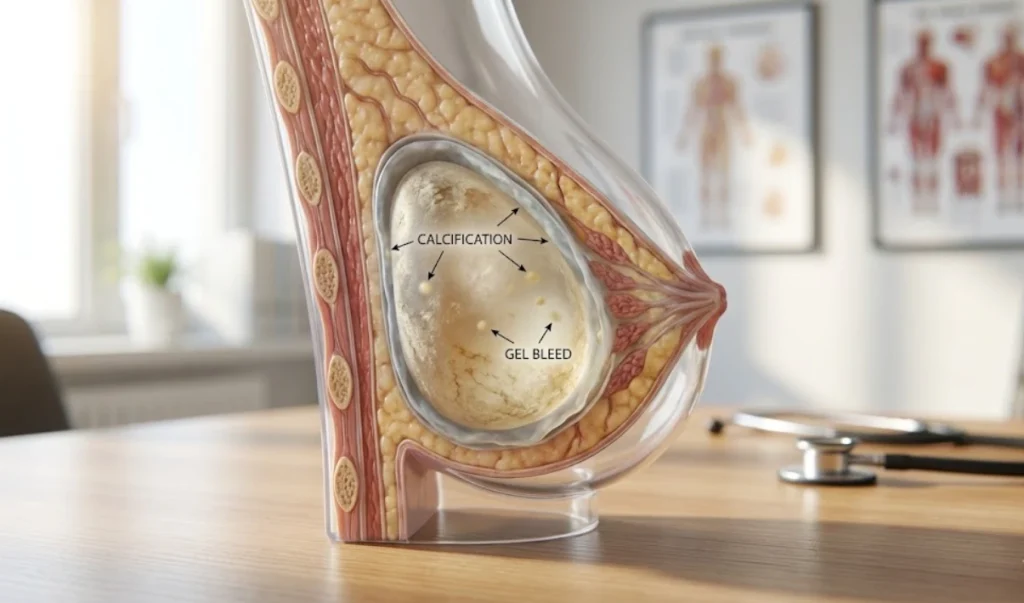
Today, if you would happen to be the owner of 40-year-old implants, you are actually carrying around 1980s technology. Such implants from the past are very different from the current “gummy bear” cohesive gels. The older silicone shells were more permeable, which can explain “gel bleed”.
It has been known that over time, even an intact shell can release microscopic silicone oils. Scar capsules around the body usually contain this leakage but the downside is that the capsule gets thicker and calcifies. This explains the fact that women with very old implants often say that their breasts feel as hard as a rock and that they are “crunchy”. What is calcification after all? It’s the body’s method of isolating an aging foreign object. Although not a mortal threat, it can be difficult to interpret a mammogram and a rude awakening when it comes to physical intimacy. What is more, if an aged liquid-silicone implant ruptures, the mess is something old-style silicone disperses while new-style gel stays put, which means any inflammation of the lymph nodes can be caused by the migration of the former.
The “If It Ain’t Broke” Dilemma
What if you have had breast implants for 30 or 40 years and they feel good, is it necessary to remove them? No, not exactly. Having asymptomatic implants is not an indication for prophylactic removal by medical guidelines. You are free to leave them there if they are soft, you like how they look, and there is no discomfort.
Nevertheless, it is a risky attitude to “set and forget” in this situation. Should you decide to hold on to your implants for this long, you would need to become committed to active surveillance. It is very important that you carry out high-resolution ultrasound or MRI to make sure there is no “silent rupture” that might be hiding. After all, you wouldn’t be able to detect it by yourself as a rupture can go unnoticed even for years.
Modernizing Your Silhouette in Turkey
At Lin Europe Clinic in Istanbul, Turkey, management of long-term breast augmentations is our main focus. A good number of the patients we see are people who are convinced that 20, 30 or 40 years is enough and that they are due for a change.
You will be able to decide between swapping your “old-timer” implants for modern, cohesive gel bio-mimetic devices or simply getting rid of them and going for a breast lift (mastopexy) to regain the natural look. Our team of expert surgeons is not only fully capable of dealing with the complexities of aged capsules and thinned tissue but also will make you feel relaxed. Turkey has become a go-to place for these revision breast surgeries where you can get cutting-edge imaging and surgical care delivered in a friendly and compassionate environment. We are looking forward to seeing you in Istanbul, where the state of your implants will be evaluated to help you pave the way for a safer and more confident future chapter.
Frequently Asked Questions About Implant Longevity
Physically, yes, it is possible, but statistically, it is rare to go that long without a complication. The risk of rupture and aesthetic deformity increases significantly after 20 years.
No. They do not “expire” on a specific day. However, they are considered medical devices with a limited lifespan, typically estimated at 10-20 years by manufacturers.
The outer layer (envelope) can gradually lose its strength (shell fatigue), which may cause tiny leaks (gel bleed) or ruptures. The scar tissue that forms around the implant usually becomes hard (calcifies) over many years.
Indeed, modern “cohesive gel” implants represent a considerable safety advance. They maintain their shape, have better shells, and the gel will not spread even if the shell breaks contrary to the liquid silicone used in the past.
Yes, but if your implants are 40 years old, surgeons will recommend replacing them during the lift. It makes little sense to keep a 40-year-old device that could fail soon after your new lift.
Food and Drug Administration. (2020). Breast Implants: Local Complications and Adverse Outcomes.
Gabriel, A., et al. (2015). Outcomes of breast implant removal: A 10-year review. Aesthetic Surgery Journal.
Hillard, C., et al. (2017). Silicone breast implant rupture: A review. Gland Surgery.
Spear, S. L., & Baker, J. L. (2011). Classification of capsular contracture after prosthetic breast reconstruction. Plastic and Reconstructive Surgery.