Use hygiene, avoid irritation.
In female aesthetic and reconstructive gynecology, a labiaplasty refers to a surgical procedure that reduces and reshapes the labia minora or majora. As the location of the surgery is intimate, one of the main concerns for patients is what if their period starts during the healing time. When patients ask what will happen to them if they start bleeding after a labiaplasty, the straightforward answer is that although it is not a medical problem, they need to take extra care of themselves and make some changes in their behavior. Menstrual blood, although it is a natural biological fluid, if not managed properly, can serve as a medium for bacterial growth and can irritate the sensitive, healing mucosal incisions.
Postoperative menstrual cycle management is considered a very important aspect of the wound care plan at Lin Health Europe Clinic. We tell our international patients who want to come to Turkey and have surgery that although we try to arrange the operation right after their period to have maximum healing time without any blood, a reaction of the body’s hormones to the stress of surgery may cause the period to come earlier. Our clinic is the leading center for advanced laser labiaplasty in Turkey and here you will be given detailed instructions on how to manage your period safely, keeping your delicate internal sutures protected and your recovery perfect.
The Clinical Prohibition of Tampons and Menstrual Cups
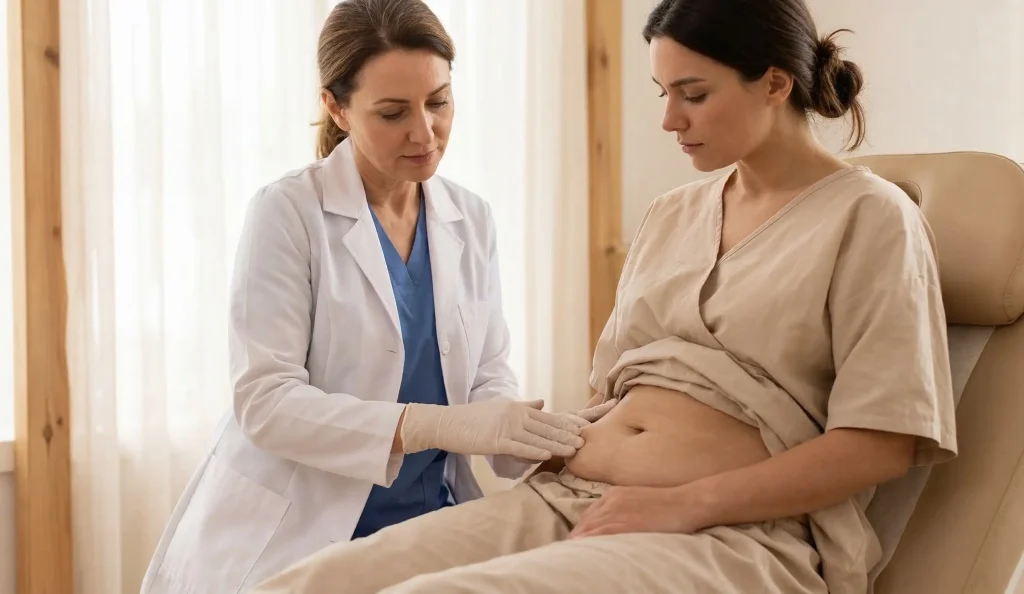
One of the most important clinical rules when menstruating after a labiaplasty is the complete ban on any internal menstrual products. This includes tampons, menstrual cups, or any device that you need to insert into the vagina. There are two reasons why these products are not allowed.
Firstly, the insertion and removal of an internal product involve mechanical manipulation of the labial tissue, which may badly pull the labial incision lines, causing wound dehiscence (the surgical edges separating). Secondly, because these devices are very close to the surgical site, there is a higher chance of introducing bacteria into the vaginal vault which can then get to the external incisions.
At Lin Health Europe Clinic in Turkey, we firmly require the use of soft, unscented, and highly absorbent external sanitary pads. These pads should be changed every 2 to 3 hours, no matter how heavy the flow is, to keep the area dry and to inhibit skin breakdown due to prolonged moisture exposure (“maceration”).
Managing the Acidic Environment and Mucosal Irritation
Menstrual blood has a definite pH and enzymatic profile which may irritate healing tissues to some extent. At the time of neocollagenesis, the new skin forming at the labial margins is extremely thin and sensitive. Contact with menstrual fluid for a long time can cause a burning sensation, increased itching, and local inflammation (edema).
A few of the best things to do in order to reduce all these problems are that at our clinic we have a strict “Clean and Dry” regime. Every time you change your pad or use the toilet, the area should be washed with a peri-bottle (a small squirting bottle) filled with lukewarm water or a very mild, intimate cleanser with pH balance. You must not “wipe” the area with the common toilet paper, as the friction can catch on the delicate, dissolving sutures. Instead, the area should be gently “patted” dry with a clean, lint-free gauze or a soft towel. Besides, the surgical team in Istanbul also advises placing a very thin layer of a prescribed antibiotic ointment or medical-grade barrier cream which acts as a shield and stops menstrual fluid from getting in direct contact with the incisions.
The Impact of Hormonal Swelling and Sensitivity
Periods are characterized by systemic hormonal alterations—specifically an increase in prostaglandins—which physiologically leads to the body retaining fluid and greater pain sensitivity. This may cause a brief “flare-up” of swelling and discomfort that you have after the labiaplasty for a patient.
It is perfectly normal to have labia feeling more “throbbing” or tight during the initial days of your cycle. At Lin Health Europe Clinic, we encourage our foreign patients to keep on with their cooling mechanisms (apply cold compresses over their underwear) at this time as well. This way, they fight the hormonal swelling and get a comforting effect on their irritated mucosal tissues. Besides, we stress that this swelling is an increase only temporarily and it disappears after your menstrual cycle peak passes, if you keep doing your head-up, feet-up resting positions to stimulate lymphatic drainage away from the pelvic area.
Distinguishing Menstrual Blood from Postoperative Bleeding
Most patients are at a loss when it comes to identifying which blood is the one from their natural period and which is the one resulting from a surgical complication such as a hematoma or a secondary hemorrhage. Distinguishing one from another is psychologically alleviating for you and of utmost importance in terms of your clinical safety.
- Menstrual Flow: It follows a regular pattern, there is uterine cramping, and you most probably get used to having small blood clots and a particular color.
- Surgical Bleeding: Generally, it appears as “bright red” blood, that is continuous and only the one single point on the incision line is affected. In case you notice a sudden, rapid flow of blood which fills the pad in less than an hour, or the swelling is very hard and predominantly one-sided, these are definitely not signs of a period; rather, they indicate a medical condition which requires your immediate attention.
In Turkey, Lin Health Europe Clinic also has teams to help international patients live the postoperative period 24/7. We show you how to differentiate between a healthy biologic cycle and a situation that calls for medical intervention so that your recovery is safe and stress-free.
Labiaplasty in Turkey
At Lin Health Europe Clinic it is our perspective that the best gynecological surgery in the world cannot be achieved without a thorough understanding of female physiology and equal dedication to patient comfort. Our center in Turkey is the temple of medical excellence where you find expertise in advanced laser surgical methods along with the highest standard of international patient care. The hospitals we work in are our partners in medical excellence and are highly recognized worldwide for the quality of their care and our status as leaders of the medical tourism and female intimate rejuvenation.
Selecting Lin Health Europe Clinic is deciding on the most capable, well-trained hands in Istanbul. Our professionals recognized worldwide always place a priority on preserving the anatomical structure and providing the most unobtrusive, naturally looking outcomes for every international patient. The professional thoroughness and elite hospitality that have made us the leaders in aesthetic medicine will remain with you from your very first hormonal workup and surgical preparation until you finally get that beautifully healed result. Even during your period, your path to physical comfort and self-assurance is going to be looked after by the best in the world if you choose us.
FAQ:
The arrival of your period doesn’t constitute a medical emergency, nevertheless, it calls for a switch to exclusive use of external sanitary pads and sticking to a strict hygiene regimen. Post each bathroom use, it is necessary to irrigate the region with lukewarm water to stop menstrual blood from causing discomfort in your healing incisions in Turkey.
It really isn’t allowed to use any internal menstrual products for the duration of 4 to 6 weeks after the surgery. The physical stress due to inserting and removing can pull on the delicate stitches and significantly increase the chance of infection or wound opening, our Istanbul team informs.
During menstruation, the hormones fluctuate and water retention takes place which collectively can lead to a temporary upsurge in the swelling and sensitivity of the area affected. This is a completely natural biological process and we advise you to carry on with your cooling treatment to alleviate the soreness until the end of your menstrual cycle.
The best way to clean this area is to use a peri-bottle for gently flushing the area with lukewarm water each time after you change pads. Do not rub or wipe the wounds with toilet paper; instead gently пat the area dry with a piece of sterile gauze in order to safeguard the dissolving stitches and the stage of neocollagenesis.
Menstrual blood usually arrives with your normal menstrual cycle and is accompanied by uterine cramps. Contact our team in Istanbul if after the surgery you get sudden, heavy bleeding of bright red blood from your labia that soaks a pad in less than an hour, you need to get a medical check-up right away.
- Alinsod, R. M. (2011). Aesthetic and functional labiaplasty. Journal of Sexual Medicine.
- Goodman, M. P., et al. (2010). Is the labia minora reduction a safe procedure? Journal of Sexual Medicine.
- Motakef, S., et al. (2015). Labiaplasty: the anatomy and evidence-based treatment. Plastic and Reconstructive Surgery.
- Triana, L., et al. (2011). Labiaplasty: a review of the literature. Aesthetic Surgery Journal.
- Hamori, C. A. (2011). Aesthetic surgery of the female genitalia. Clinics in Plastic Surgery.