Fat transfer to the breast can typically be done twice.
Fat transfer is an excellent way of achieving a more natural look and feel when compared to breast implants. Unfortunately, a typical session will not enlarge your breasts drastically, which is why you may want to ask yourself, “How many times can you do fat transfer to the breast?” Although it is possible to do the procedure a couple of times, according to most surgeons at Lin Europe Clinic, the limit is two to three sessions. That’s how we can create volume in a safe and sustainable manner without compromising your health.
Fat transfers do not work like implants as they are based on the body’s biology. The transfer fat cells have to create a new blood supply to survive. Since very few cells actually survive the transfer, we sometimes need to layer the results until we get close to your target. It is crucial to understand the biological limitations of the procedure, as this would allow you to plan your journey effectively. This article deals with the underlying biology of the multiple sessions and helps you decide whether the multi-step approach would work in achieving your aesthetic goals.
Why Multiple Sessions Are Often Necessary
The main reason for multiple fat transfer sessions is the survival rate of the transferred fat. Fat cells in grafts are deprived of oxygen at least temporarily. As a result, the survival rate of the injected fat is generally between 50% and 70%. Over time, the body absorbs the fat that was not used to the last droplet during the first couple of months after the surgery. So, after the swelling goes down, a single operation may yield an increase of only half a cup size.
Adding up multiple transfers is necessary to get a whole cup size or even more. We usually view the first treatment as setting a foundation. After these cells become stable and the breast tissue has stretched, we can give it a second coat of fat. With this gradual method, the newly introduced cells will have sufficient space and will get enough oxygen to survive. Trying to put too much fat in one go will finish the cells off, instead of increasing the volume.
The “Three-Month Rule”: Timing Between Procedures

You are going to need quite a bit of patience in this situation. It is not possible to undergo a fat transfer surgery one right after the other. Your body needs time for the wounds at the donor sites to heal, and the breasts need to recover completely. At Lin Europe Clinic, we follow a strict rule that there has to be at least 3 to 6 months after the last session before switching to the next session. During this time, your breasts will have completely de-swollen, and we’ll be able to measure the genuine volume.
If a second surgery is done too early, the risk for complications will be increased. The tissues have to be soft and have healthy circulation again before they can receive another graft. If fat is injected into tissues that have been previously inflamed, the survival rate will decrease significantly. We track your progress with ultrasound examinations, and based on those findings chose the best time for the next treatment.
Donor Site Limitations: Running Out of Fat
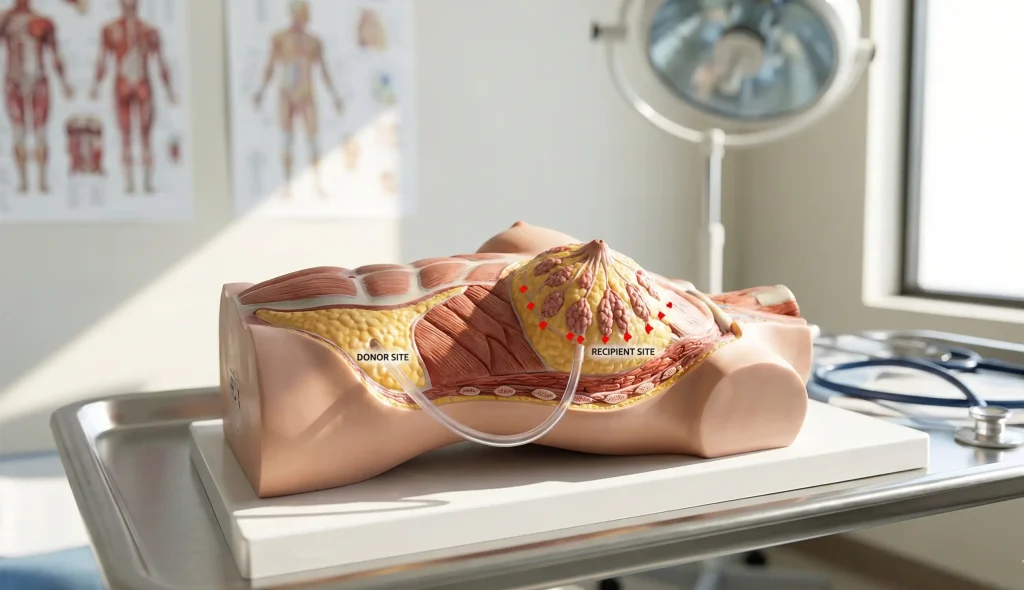
The refinement on the number of times you can do fat transfer to the breast is totally dependent on the fat that is in your body. This is a very important factor as you need to have a lot of fat for harvesting. Thin patients, on the other hand, may have just enough fat for one small session. Once the belly and thighs fat are used up, it is no longer ethically acceptable to have further fat transfer operation.
Your fat is sometimes called “liquid gold” by the surgeons, and it is because of its value that we must be very careful when harvesting it so that the donor area still looks smooth, not hollowed out. In this way, your surgeon will give you a more realistic estimate of how many sessions can be physically possible for you after he has evaluated your total body composition. If no more donor fat is available, then the process is finished officially.
Skin Elasticity and Tissue Capacity
The skin on your breasts can be compared to a pouch that can only be stretched so far at one time. If the skin is very tight, it exerts pressure that may kill the delicate new fat cells. The volume per session is another reason why we limit it to only the necessary amount. The first operation will cause the skin to stretch a little, so that it can accommodate the second graft more easily.
On the other hand, the breast skin one normally gets after breastfeeding or losing weight is rather loose, and that is why larger amounts of fat can be accommodated without any problem. We may be able to achieve more during less sessions at these times. However, if the skin is too loose, we might consider a breast lift along with the fat transfer to reshape the “envelope” while filling it.
Safety and Risks of Repeated Procedures

Fat transfer, on the whole, is a safe procedure. However, overdoing the surgery increases the chances of certain complications. Calcification is by far the most common risk in very aggressive fat grafting. This is when dead fat cells become hard and form one or more small lumps. The risk of calcification can be significantly reduced by keeping the volume per session moderate.
Besides that, every operation entails typical risks such as anesthesia and infection. Physically, it is pretty hard to go under general anesthesia three times within one year. We consider the advantages of the extra volume against the disadvantage that comes with the strain on the body. A priority at Lin Europe Clinic is to achieve a result that is natural both visually and in feeling without endangering your long-term breast health.
Fat Transfer vs. Implants: Knowing When to Switch
There are situations when the response to “how many times” should be “no more”. If you want a really big change – from two to three cup sizes – then fat transfer is probably not the right choice. Besides being too costly, it would be too many surgeries. Implants, on the other hand, are far more efficient and predictable in these kinds of situations.
We see a lot of patients who initially opted for fat transfer but later decided to switch to a composite approach. It combines the benefits of an implant guaranteed volume, and the soft, natural coverage of the fat. Knowing the limitation of fat grafting at an early stage will spare you from frustration.
Fat Transfer to Breast in Turkey
Turkey is revolutionizing the field of regenerative medicine. Lin Europe Clinic in Istanbul is active in the use of Advanced Techniques such as vaser, which not only ensures the highest possible fat cell viability but also preserves the integrity of the donor site. These gentle methodologies shield the fat cells during the extraction process and directly impact the amount of volume that remains in the breast. The clinic combines scientific knowledge with artistry to shape your donor areas, while simultaneously enhancing your curves.
By choosing Lin Europe Clinic, you will be able to experience this high level of care in a luxury setting. We know that entrusting your cosmetic surgery to us requires a certain level of trust from you, as you have to travel to get the surgery done. Our “all under one roof” principle guarantees that your plastic surgeon and nursing staff will be on the same wavelength when it comes to your repeated sessions. You can confidently embark on a body renewal journey together with a team that puts precision and patient safety above all else.
Frequently Asked Questions About Fat Transfer Sessions
Fat transfer to the breast can usually be done two or three times. The exact number depends on how much donor fat you have and how your skin stretches.
One operation typically results in a half-cup to one full cup size increase. More dramatic volume changes require several fat transfer procedures.
Minimum time between procedures should be three to six months. This period is necessary to allow the swelling to go down and the new blood supply to the breast to become stable.
Absolutely, fat cells that successfully survive the transfer are permanent. That said, if you lose a lot of weight after your breast fat transfer, there would be a loss of volume.
Yes, it is safe if the sessions are properly spaced, but the risk of calcification rises with volume. After each fat transfer session, your doctor will check the health of your breast tissue.
Coleman, S. R., & Saboeiro, A. P. (2007). Fat grafting to the breast revisited: Safety and efficacy. Plastic and Reconstructive Surgery, 119(3), 775-785.
Delay, E., & Guerid, S. (2015). The role of fat grafting in breast reconstruction. Clinics in Plastic Surgery, 42(3), 315-323.
Khouri, R. K., & Khouri, R. K. Jr. (2014). Current clinical applications of fat grafting. Plastic and Reconstructive Surgery, 134(4), 502e-513e.
Spear, S. L., & Wilson, H. B. (2012). Fat injection to the breast: Technique, results, and indications based on 880 procedures over 6 years. Aesthetic Surgery Journal, 32(3), 324-330.
Yoshimura, K., & Sato, K. (2008). Cell-assisted lipotransfer for cosmetic breast augmentation: Supportive use of adipose-derived stem/stromal cells. Aesthetic Plastic Surgery, 32(1), 48-55.