Yes, it’s safe with an experienced injector.
We have all seen it: the dark circles under the eyes that even the best concealer and the longest sleep just won’t get rid of. This “exhausted look” is mainly due to a loss of volume in the tear trough – a deep indentation that extends from the inner corner of the eye down to the cheek. Although hyaluronic acid (HA) fillers seem to be a wonder that instantly changes everything, when you look up the treatment online, you are more likely to come across extremely scary reports of blindness and vascular complications.
Well then, is it safe? A straightforward medical answer would be: safe only in the hands of experts. The under-eye region is often referred to as the “anatomical minefield” and even the most skilled injector has to be very careful there. At Lin Health Europe Clinic, we believe that understanding anatomy is more important than the ability to create art. You should know why this area is dangerous and what medical protocols we follow to eliminate the risks and turn a scary process into a simple beauty session.
The Anatomy of Risk: Why It’s Dangerous
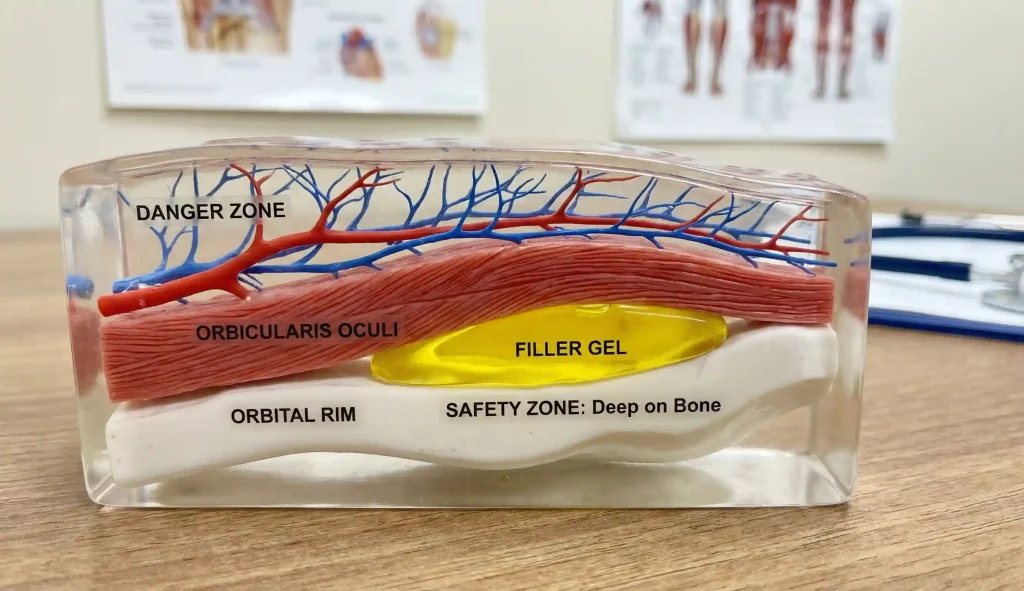
The tear trough is far from being just skin and bone. It is basically an intricate and vulnerable tissue comprised of skin, ligaments, and blood vessels. Two important blood vessels, Angular Artery and Infraorbital Artery, are the main source of danger. Incidentally, these arteries are connected straight to the ophthalmic artery (the blood supply to the eye).
If the needle gets inside one of these arteries by mistake and filler is injected directly into the blood vessel (“intravascular injection”), the gel may go upstream and block the blood supply to the retina. That’s how a very rare but very serious condition, blindness, comes about. Moreover, the skin around the eyes is the thinnest of all the body. Hence, if the filler is administered very superficially (too close to the skin surface), it will be uneven, visible, or lead to a permanent bluish discoloration, the so-called Tyndall Effect.
Needle vs. Cannula: The Safety Tool
The single greatest determinant of Tear Trough Filler safety is the choice of the instrument used by the injector. Previously, sharp hypodermic needles were the norm. Although very accurate, sharp needles are able to cut through tissues which means that the injector can easily accidentally damage a vein or an artery without even realizing it.
At Lin Health Europe Clinic, a Micro-Cannula is our first choice in all cases to treat the delicate skin below the eyes. Simply put, a cannula is a long, skinny piece of plastic or metal with a blunt tip. Since the tip is rounded, it cannot be used to easily puncture a blood vessel. Thus, if a cannula runs into a vein, it will just slide along the wall of the vessel or gently move it aside. So this is not only a huge reduction in the probability of bruises but actually a great lowering of the chance of discharging the filler material into a blood vessel.
The “Puffy” Problem: Lymphatic Obstruction
It is not only the circulation but the drainage that determines the safety of a treatment. The part of the face below the eye is a major drainage area for lymphatic fluid. The most frequent problem after Tear Trough Filler is the appearance of “malar bags” or persistent swelling that develop several months later.
What happens is that the injector allows too much filler or places it too close to the surface, thus effectively constructing a blockade for the lymphatic flow. Hence, the liquid is retained and forms the bags forever under the eyes. That is the rationale behind the dictum “less is more” in this area. Our first procedure typically involves some under-correction of the hollow since we are aware that HA fillers cause hydration by drawing water in during the first couple of weeks. It is more reasonable to apply a little bit extra later on than to overfill and thus, impair lymphatic flow.
The “Undo” Button: Why Reversibility Equals Safety

Reversibility is probably one of the most crucial safety features of the contemporary tear trough procedure. We solely choose HA fillers as they have a corresponding antidote, Hyaluronidase, which is literally the molecular “undo” button.
In the incredibly unlikely event that a blockage of blood flow occurs due to filler injection or if the results look uneven, we can give Hyaluronidase which will immediately dissolve the filler. The gel is broken down in the form of tiny water particles that the body can easily get rid of. It is not the case with permanent fillers such as silicone or Bellafill or with fat grafting that this safety net is available. Complications become surgical emergencies in case permanent products are used in such a high-risk area but for HA, the situation can be controlled. That is why we always have a large quantity of Hyaluronidase ready at hand in all treatment rooms so that if, by any chance, we compromise safety, the solution is right there with us.
Pigment vs. Shadow: The Diagnosis Trap
First and foremost, am I right to even consider filler? Safety is about your issue being diagnosed correctly as well. Tear Trough Filler only resolves Volume Loss (the physical hollow) as it works basically by skin lifting, thereby removing the shadow that results from the indentation.
The dark circles are caused by Pigmentation (the skin is brown because of melanin) or by Vascularity (the blue veins are clearly seen) and filler cannot actually help you with that. Its usage may even exacerbate the situation by making the dark veins surface more since the filler pushes the vein closer towards the skin. You could say that truth will always come out if the patient is treated with a filler unknowingly being the wrong clinical candidate. The safest option for pigmentation problems would be chemical peels or laser treatment instead of needles.
Lin Health Europe Clinic: Redensity II
At Lin Europe Clinic in Turkey, we don’t do a cheap trick of using a regular lip filler under your eyes. The skin below your eyes cannot tolerate thick, hydrophilic (water-loving) gels. One of the products in our armory is the special formula Teosyal Redensity II that has been developed in particular for the tear trough.
What is great about the product is that it is made partly of cross-linked and partly of non-cross-linked HA. Moving beyond the idea of HA, it also contains amino acids and minerals. This is a product that has a “low-swelling” attribute (low hygroscopic behavior) thus, it does not draw in as much water as other fillers do. Consequently, the chances of the patient suffering from swelling after the treatment should be very slim. Postoperative care and safety depend on the patient just as much as on the practitioner.
We recommend patients elevate their heads with two pillows while sleeping on their backs for the first 3 nights. This simple position leverages the effect of gravity, essentially preventing fluid buildup in the already delicate under-eye pockets while the filler is settling, guaranteeing a smooth and safe integration without migration.
Frequently Asked Questions About Tear Trough Filler
No, the treatment is generally easy to endure. A blunt cannula is used to limit trauma to tissues, so most patients only feel some pressure rather than pain when the tear trough filler is injected.
Blindness is a complication that can occur in extremely rare cases and is the result of an occlusion of an artery. Nevertheless, the use of a blunt cannula and the possession of deep anatomical knowledge greatly help in lowering the risk of tear trough filler.
It is quite common that the tear trough filler lasts from 9 to 12 months. Since the under-eye area is a zone of limited movement, hyaluronic acid can stay there longer than in other areas like the lips which are quite mobile.
Tear trough filler treatment is a solution for dark circles caused by hollow shadows. On the contrary, if the darkness is a result of pigmentation or genetics, the skin color cannot be changed by the tear trough filler.
The Tyndall Effect which is a bluish discoloration is caused when the tear trough filler is injected too superficially. Due to the scattering of light through the clear gel, a blue tint is formed. This can be fixed by using Hyaluronidase.
Heringer, T. M., et al. (2011). Treatment of the tear trough deformity with hyaluronic acid. Aesthetic Plastic Surgery.
DeLorenzi, C. (2013). Complications of injectable fillers, part I. Aesthetic Surgery Journal.
Goldberg, R. A., & Fiaschetti, D. (2005). Filling the periorbital hollows with hyaluronic acid gel. Ophthalmic Plastic and Reconstructive Surgery.