They treat different problems.
When patients walk into our clinic and point at their nose, saying, “I hate this,” or “I can’t breathe,” they tend to confuse the terms “Septoplasty” and “Rhinoplasty.” In the general public’s mind, any form of nose surgery is a “nose job.” But from a medical perspective, these are actually two different procedures, each having its own goals, techniques, and recoveries.
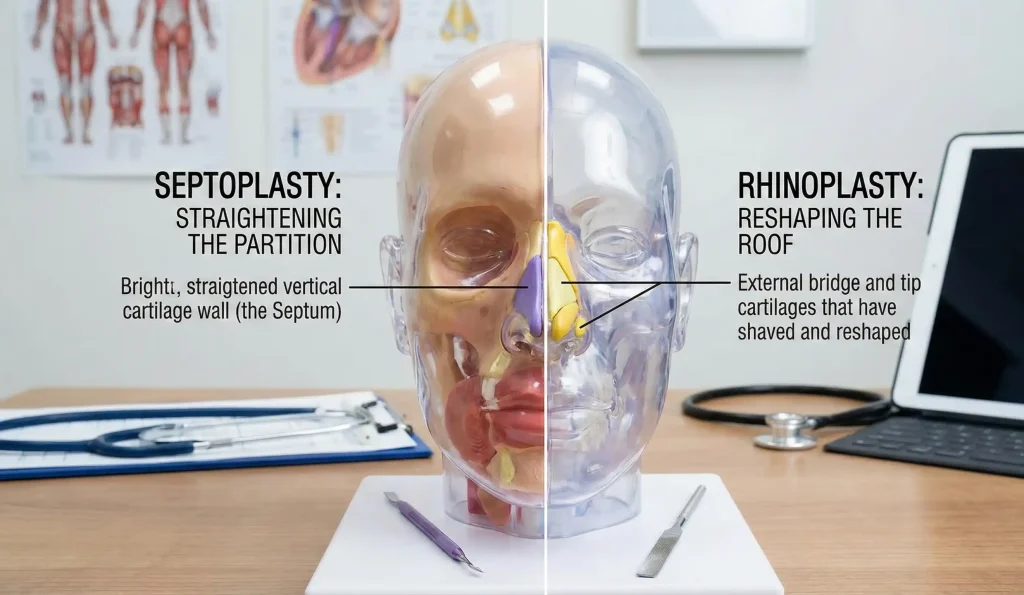
Whether one should have Septoplasty vs Rhinoplasty is “better” is a question for a plumber and an architect. If your pipes are leaking and you contact a plumber, then you might say a plumber is better. If you want to change the look of your kitchen, then the architect is the better one. Septoplasty is a surgery for the nose that intends to correct the function by only fixing only the breathing. Rhinoplasty is mainly a cosmetic surgery aiming to change the shape. Knowing the difference is crucial as it will affect the whole process, starting from your insurance coverage up to what you will see in the mirror after the bandages are removed. We at Lin Health Europe Clinic often combine both operations, but we want you to be aware of the fact that it is two separate surgeries.
The Core Objective: Airway vs. Aesthetics

The main difference is in the target of the procedures. Septoplasty concentrates on the Septum—the membrane of bone and cartilage that separates your two nostrils. This dividing wall when crooked (deviated) becomes a blockage to the airflow. The only reason for the doctor during a septoplasty is to straighten the wall of the nose thus improving breathing. They will not care if your nose has a hump, a bulbous tip, or is too long, so long as the air can freely enter and leave.
The Rhinoplasty mainly focuses on the External Pyramid, which is the nasal bone and the cartilage that affect the overall nose shape. It tries to achieve harmony, balance, and therefore self-esteem. A hump can be removed; the bridge can be narrowed, and the tip can be lifted, i.e., the droopy tip can be fixed. While a rhinoplasty can improve the breathing (mainly by giving more support to the nasal valves), however, the main judging criterion of a successful rhinoplasty is the appearance. If you are looking to both achieve a better appearance and better breathing, then one is not necessarily better than the other for you; you are more likely a candidate for a hybrid.
The Visibility Test: Will My Nose Look Different?
Most of the patients become disappointed because they expect a completely different nose after a septoplasty. If a patient limits the surgery to a stand-alone Septoplasty, then after the operation he/she will look exactly like was before surgery. The reason being that in this surgery the septum is straightened from the inside of the nostrils and no external changes are made. So, your bump is going to be there; your nose is going to be crooked as before.
With Rhinoplasty the change is very obvious since it is deliberate. We mold the scaffolding which then affects how light and shadow fall on the face and the overall facial profile. You might have an externally twisted nose caused by a severely deviated septum, but a septoplasty alone will not fix the external twisted nose. To mend a “C-shaped” or “S-shaped” nose you have to break the bones and straighten them; hence it becomes a rhinoplasty procedure.
The “Crooked Nose” Trap: When Function Meets Form
The situation here is that the line is not so clear. Most patients think that their crooked nose would straighten if their septum was fixed. This is not the case most of the time. The deviated septum is generally only one factor that contributes to the formation of a twisted nose. The other nasal components i.e. the nasal bones and the upper lateral cartilages are also frequently twisted alongside.
Visible distortion of the nose indicates that Septoplasty alone would not be enough. You need the assistance of a Septorhinoplasty. During this dual procedure, the removed cartilage during the septoplasty (which is normally discarded) is used as cartilage grafts structurally to be able to straighten the external nose. It is considered the “gold standard” technique because with it the cosmetic changes are reinforced by using your own spare parts. Here, the combined surgery is “better” than either one alone acts as it repairs both the engine and the car body.
Recovery and Pain: The “Black Eye” Factor
Recovery is a significant factor that distinguishes the two. Generally, the recovery of a Septoplasty is less complicated. The nasal bones are not fractured during the operation, so there is hardly any bruising or swelling from the eyelid that is often the aftermath of the eye bone fracture. The main discomfort will be associated with the congestion and the dull pain inside the nasal cavity. The majority of patients resume their work after 3 to 5 days.
Rhinoplasty consists of osteotomies and extensive skin exfoliation, where the nasal bones are broken in a controlled manner. This procedure results in a great deal of swelling and bruising with the duration of 10-14 days. There will be a visible cast on your nose, which you have to wear for a week. Not necessarily more painful, but the “social downtime” for rhinoplasty is much longer due to the fact that physically you look like you have gone through surgery.
Lin Health Europe Clinic: Functional Aesthetics
At Lin Health Europe Clinic, we initial belief is that function comes first, then form. You might rarely see a rhinoplasty that does not include a septum check, and you will certainly never see a septoplasty that disregards the accompanying aesthetic support. We are experts in Structural Septorhinoplasty where the nose is treated as a whole organ.
Using Piezo-tech ultrasonic, we achieve reshaping the bones without the trauma of the traditional hammers, thus minimal bruising which is usually one of the symptoms of rhinoplasty. Regardless of whether the nose is blocked or there is a cosmetic desire, we check both. We operate to make sure that the nose not only functions well but also looks good if you are going under anesthesia to have the nasal surgery. We don’t pit beauty against breathing; we combine the two.
Frequently Asked Questions About Septoplasty vs Rhinoplasty
Both procedures are quite safe. However, Septoplasty vs Rhinoplasty entail slightly differing risks. For instance, septoplasty has a lower likelihood of dissatisfaction with appearance because the shape is not altered, whereas rhinoplasty carries risks of asymmetry or irregularities in the contour.
Simply put, a septoplasty cannot change your nose’s shape as it is a functional procedure only. It works by straightening the wall inside the nose to facilitate breathing. To alter the size, bump, or tip, you need to combine rhinoplasty with the operation.
Somewhat, yes, but it is still not painful, more like unpleasant. Rhinoplasty is associated with more swelling and bruising (black eyes) than septoplasty because, in most cases, the nasal bones are left or even reset. The case with septoplasty is that you simply feel like you have a very bad head cold.
No. A typical septoplasty operation involves the surgeon removing or reshaping only the cartilage and bone inside the septum. On the other hand, during a rhinoplasty procedure, the outer nasal bones are frequently deliberately fractured (osteotomy) to make the bridge narrower or straighter.
Certainly, and in fact, it is often suggested that you do so. A Septorhinoplasty is the correct term for this. It provides an opportunity for you to correct both your breathing issue and your outer look using a single session of anesthesia and one healing interval. This is frequently considered a “better” way than doing them separately.
Fettman, N., et al. (2009). Septoplasty vs. Septorhinoplasty: Indications and Outcomes. American Journal of Rhinology & Allergy.
Constantian, M. B. (2009). The Incompetent External Nasal Valve: Septoplasty Is Not Enough. Plastic and Reconstructive Surgery.
Rhee, J. S., et al. (2014). Evidence-Based Clinical Practice Guideline: Rhinoplasty. Otolaryngology–Head and Neck Surgery.