Yes, it is safe with an experienced surgeon.
It is often said in plastic surgery that you can turn back the clock but the battery will inevitably run out. A decade or so after your first facelift, you probably looked in the mirror and felt great about the “newly” refreshed and youthful you. But, just like everything else, the clock doesn’t stop ticking and eventually, the effects of biology take over. So, your jawline gets less defined again, the “turkey neck” bands reappear, and you find yourself in front of the mirror, pulling your skin back with your fingers and wondering if you can/should do it all over again.
This culminates in a perfectly reasonable and common dilemma: “Do you think it is safe to have a second facelift?” On a regular basis, at Lin Europe Clinic, we see patients who have been through a “secondary facelift” or “maintenance lifts.” Simply put, yes it is safe and most times very effective. But a second facelift is not the same medical procedure as the first one. It needs a plastic surgeon with advanced technical skills, a gentle touch, and a thorough understanding of post-facelift facial anatomy changes.
Scar Tissue – The Main Difference
There are significant differences between the first and second facelift, with the main one being the condition of the facial tissues. The facial tissues during the first facelift are “untouched,” so to say, which means that they are healthy with well-delineated planes between the skin, muscles, and fat that can be separated easily. With a facelift for the second time, the normal tissue layers are stuck to each other by the body’s natural healing process after the first operation which is called scar tissue or fibrosis.
There is a sharp focus demand for the surgeon to meticulously and slowly dissect the facial tissues and isolate nerves from the denser scar tissues, blood vessels, etc. However, this scar tissue isn’t always a negative. For an experienced surgeon, the fibrosis can sometimes be an advantage. Because the tissue is tougher, it provides a stronger anchor for stitches. Besides that, the fibrosis will make the face hold the “lift” more firmly than soft, untouched tissue, so sometimes the results of the second facelift can last even longer than the first.
Plastic Surgery Overdone Look
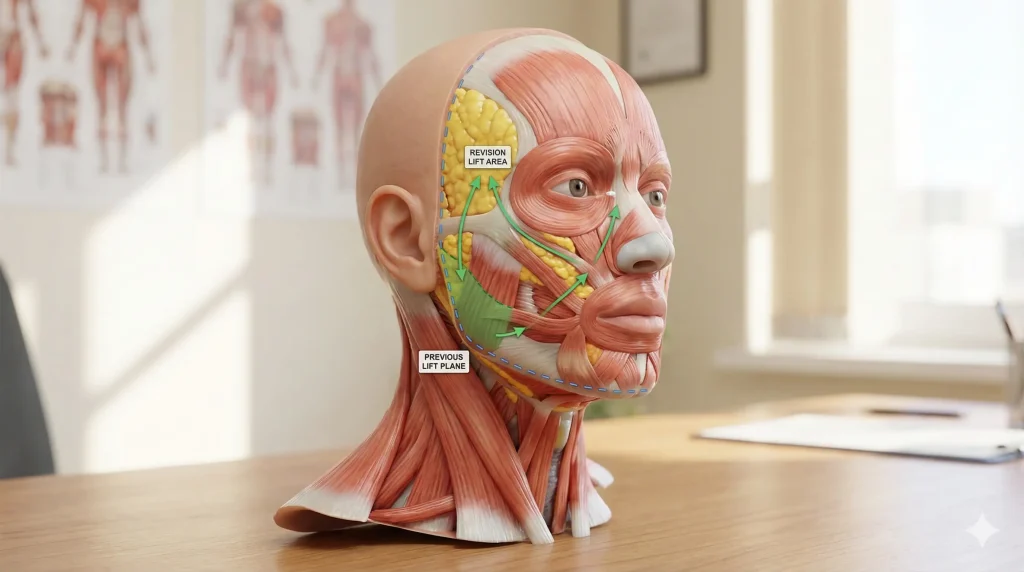
What patients usually worry about the most prior to a second facelift is acquiring a “weird,” “plastic,” or “windblown” look. We have all heard or seen clips of celebrities who have crossed the border of good cosmetic surgery and thus lost their natural essence. This kind of deterioration of the natural face happens, for example, if a surgeon only stretches the skin without any lifting of the underlying structures.
When the time comes for a second facelift, the skin inevitably has less elasticity and collagen than during the previous one. Plus, the skin becomes thinner and less forgiving. If a doctor only resorts to skin cutting and pulls achieving a certain tightness, then the outcome will be that the face looks overstretched, ears look pulled, and mouth will be distorted. The truth about a perfectly natural secondary facelift is that it hardly considers the skin and makes the SMAS (the deeper muscle layer) the main focus. At Lin Europe Clinic, we employ Deep Plane or High-SMAS methods for revision facelifts. When the heavy work of the face is lifted upwards the skin can be laid down gently without tension. Thus, you stay looking like a refreshed version of yourself, not an exaggeration.
Don’t Forget About the Neck
Many times, a second facelift is not primarily focused on the face, but the neck. The neck platysma is very resistant to change. Even with a perfect first surgery, the neck bands loosen quicker due to gravity than the cheeks. Therefore, in a revision surgery, the neck can be the focal point with the surgeon possibly performing a platysmaplasty, which is a kind of neck tightening method that works by pulling the muscles in the middle together (like lacing up a corset) and sideway releasing. This brings back that wonderful angle of less than 90° right under the chin that is considered a youthful profile and keeps skin sagging and fatty deposits at bay.
Pixie Ear Correction
In addition to what was discussed above, one of the great benefits of a second facelift can be a chance to fix the old mistakes. “Pixie ear” is one of the most obvious signs of a bad facelift and can be corrected perfectly at the time of revision. The earlobe is connected to the cheek and in this way, it looks stretched, or elongated which is unfortunately quite an unattractive look.
This occurs because the surgeon stretched the skin too much around the ear when doing the previous facelift. We can open the area in a second facelift and both uniquely reshape the earlobe and bring it to where it should be, naturally and aesthetically. Tweaking these marks of the previous surgery is a priority for many patients along with the facelift itself.
Post-op and Longevity

It is somewhat paradoxical that the healing period after a second facelift is often easier than after the first one. Since the skin is already familiar with the process and the sensory nerves have already adjusted, the patients generally report feeling less pain or numbness after the facelift than their first experience. On the other hand, the swelling may last a little longer because pressure on the old scar tissue acts like a block in the lymphatic drainage pathways.
Usually, a second facelift extends the period of 7-10 years back into the future. Even though the tissues by the second time are old and less elastic, the secondary lift’s structural support is strong. In fact, it is a perfect type of maintenance that results in a graceful aging process from a quickly higher level.
Why Turkey for Your Secondary Surgery?
A secondary facelift done with the skill and a helper’s hands can be a very welcoming project, but definitely not a learning case. Turkey global reputation as a center for facial surgery has started with the great number of complex cases handled here successfully. At Lin Europe Clinic in Istanbul, our teams are expert not only in anatomical changes but also in functioning of the previously operated face. Our concept of second facelift is more of a careful and sympathetic restoration of facial architecture where safety, nerve preservation, and natural movement are the main focus besides the surgery itself.
Frequently Asked Questions About Second Facelifts
Generally speaking, a second facelift is safe if the surgery is done by a highly skilled surgeon. However, the procedure becomes more difficult because of the scar tissue formed after the first surgery.
Around 10 to 15 years is the typical time that most people wait before getting a second facelift. That’s usually how long the first facelift results last and when aging becomes noticeable again.
By using deep-plane techniques, a surgeon can deliver very natural results with a second facelift. Deep-plane means lifting the muscle and not just pulling the skin, thus avoiding the “windblown” or “joker” look that is often associated with repeated surgeries.
Recovery from a second facelift is fairly similar to the first. The only difference is that swelling might take a bit longer to go down due to scar tissue. On the other hand, the majority of patients state that they experienced less pain the second time around.
In reality, there aren’t any set rules. However, most plastic surgeons agree that a patient can have a second facelift and maybe a third one. But remember, the more surgeries, the bigger the risks of skin thinning or unnatural appearance.
Stuzin, J. M. (2008). Restoring facial shape in face lifting: The role of skeletal support in facial analysis and midface soft-tissue repositioning. Plastic and Reconstructive Surgery.
Hamra, S. T. (2002). The role of the composite face lift in secondary facial rejuvenation. Plastic and Reconstructive Surgery.
Kamer, F. M., & Frankel, A. S. (2007). SMAS rhytidectomy versus deep plane rhytidectomy: An objective comparison. Plastic and Reconstructive Surgery.