Gentle care, nutrition, and time help recovery.
Surgery recovery doesn’t only involve managing post-operative pain, swelling, and scars, but a big majority of patients get shocked by an unexpected side effect – hair loss. Approximately three months post-surgery, right when patients finally regain their energies and witness the surgical outcome, they find hair clumps on their pillows or the shower drain filled with strands. Such an experience can be devastating emotionally and often-act as an indication of anesthesia having damaged the body or a sign of nutritional deficiency.
However, the truth is that hair loss after surgery is very rarely permanent. It is actually a natural physiological reaction to stress, called Telogen Effluvium, which has been documented extensively. This sensation is more like “hair shedding” and not “hair loss” in the traditional sense of balding. Basically, the stress from the surgery, the body’s demand to heal, and anesthesia together lead to a very high amount of hair follicles entering the resting phase prematurely. Even though it is just temporary, the wait for its cessation can be very painful. At Lin Europe Clinic, your beautification through surgical procedures should never be your hair loss’s price, which is why we regularly support our patients with the best practices and treatment options to actively deal with hair loss and shorten the shedding period.
Understanding the Mechanism: What Is Telogen Effluvium?

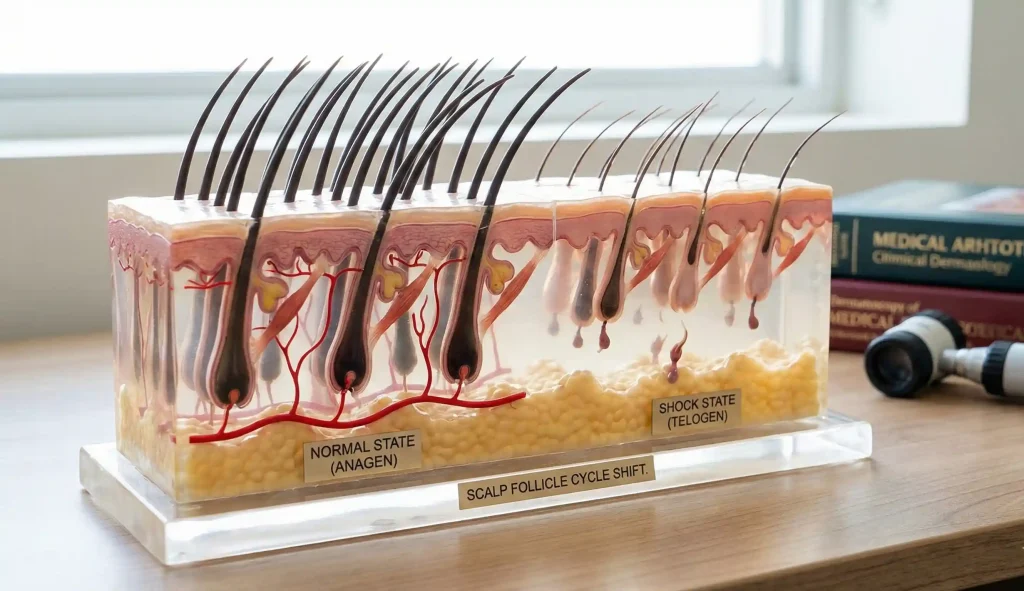
A good understanding of the mechanism behind the problem is the first step towards treating it and also enhances your emotional control. Human hair follicles function through cycles, the Anagen (growth), the Catagen (transition), and the Telogen (resting); approximately 90% of the hair is growing and only 10% is resting at any given time.
Body trauma results in the body going into shock, leading to systemic stress, causing the body to cut down energy-requiring functions that aren’t essential to survival and healing of wound exposition, to bare only the essential functions e.g. the immune system. The body therefore will send a signal to the hair follicles that long and lush hair is not necessary, hence, follicles stop growing and go into the resting phase. As a result, the body could have around 30-50% hair in the Telogen phase at once.
Hair in the resting phase of the hair growth cycle is not released right away. The follicle keeps the hair attached to the scalp for around three months before it is finally shed to give space to new hair. So, the answer to the question “why does hair loss appear 3 months after surgery?” is that it’s the hair that used to be in the later phases that is now falling out, although the trigger for this was the surgery. One must understand that a temporary synchronization error in your growth cycle, rather than permanent follicle death, is to blame. This will help you manage your condition calmly and sufficiently without stressing yourself (which, ironically, can induce even more hair loss).
The Nutritional Rescue: Protein and Iron Prioritization
The best cure for shedding after surgery is internal and specifically concentrating on the diet of the body during the recovery period. After surgery, your body has an extreme need for protein to be able to close the incisions and reconstruct the tissues. In case your diet does not provide enough protein, the body will borrow amino acids from your hair to fix your skin.
In order to stop the shedding and encourage quick regrowth, one has to increase their protein intake significantly. We sometimes suggest collagen peptides or whey protein supplements as a means to guarantee that one is reaching the metabolic level needed for not only wound healing but also hair production.
Besides protein, iron and zinc are two other important minerals that are usually totally depleted after the surgery. Your ferritin levels (which indicate where you have excess iron stored) will be lowered due to the blood loss that happens during the surgery (even if it’s minimal). Hair follicles are very sensitive to ferritin, if the stores fall, hair growth stops. Please ensure that you get your blood work done. If your ferritin is on the lower side, taking a superior iron supplement (paired with Vitamin C for better absorption) can be equal to switching the growth phase on again. Zinc, on the other hand, is vital for cell division; a deficiency which happens to be a frequent symptom when the immune system is working overly hard to fight off infection, will cause your hair to be weak and dry. Therefore, the first step in any effective treatment plan is the repletion of these deficiencies.
Reducing Mechanical Stress: The Gentle Care Protocol
One of the most effective methods in preserving your hair during the time your hair chemistry is getting balanced is the change of your hair handling physically. Hair that is still quite healthy and tightly attached to the scalp is most prone to damage. Therefore, excessive brushing, very tight ponytails or heavy hair extensions might be the sources of traction from which the hairs that have become weak may be pulled out earlier than they should. We suggest getting a wide-tooth comb and gently detangling the hair starting from the ends to the roots so as to reduce the pull on the roots. Also, you should give time for loose, natural hairstyles rather than wearing tight ‘snatched’ buns that are liable to cause hairlines to recede.
You should refrain from using chemicals on your hair during this vulnerable period. Hair dying, bleaching or chemical relaxing has compounds that are harsh on the hair shaft as well as the scalp. Your scalp may already be sensing the systemic inflammation brought about by surgery, and thus, by adding chemical burns, shedding can become worse. We suggest you wait at least six months post-op or until the shedding has visibly normalized before going back to bleach or relaxers. In the meantime, pamper yourself with hydrating masks and scalp oils that replenish the skin barrier and allow a healthy environment for the hair that is struggling to break through.
Clinical Interventions: PRP and Topical Stimulants
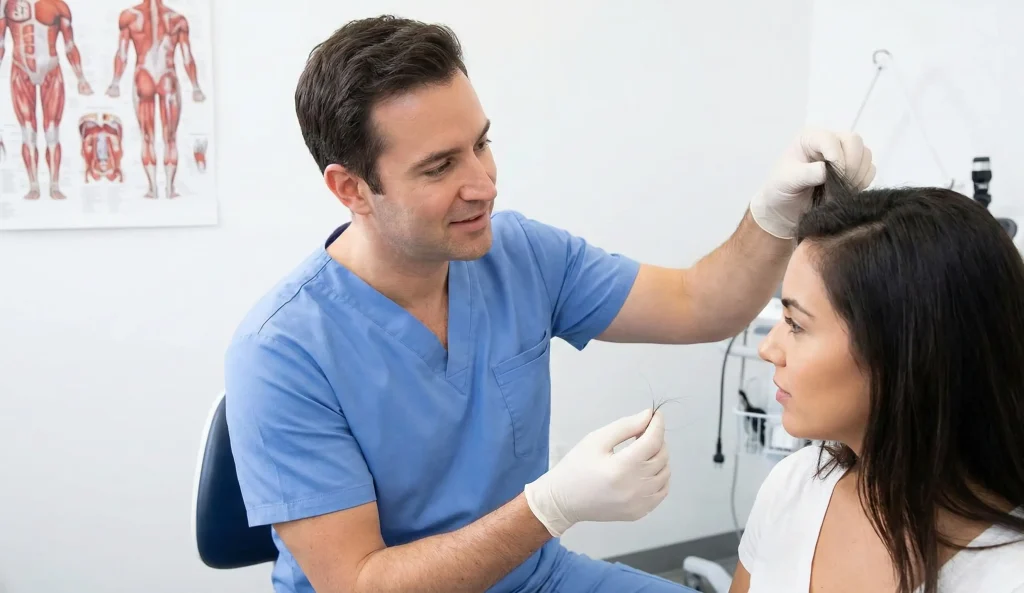
In cases where the shedding lasts longer than the usual six months, or the patient wishes to be more aggressive in treatment, clinical interventions will be very applicable and effective. The most advanced non-surgical hair restoration procedure is Platelet-Rich Plasma (PRP) therapy. It involves the extraction of a small amount of blood from the patient which is then placed in a centrifuge to separate the growth factors, after which they are injected directly into the scalp. These growth factors act like a fertilizer, forcefully kicking the sleeping Telogen follicles back into the Anagen growth phase, significantly minimizing the period of shedding if treatment is begun around the third or fourth month after surgery.
We can also resort to topical stimulants such as Minoxidil. This is most often used for male pattern baldness but a low-dose topical solution can be helpful for acute Telogen Effluvium. By increasing blood flow to the follicles and enlarging them, it promotes thicker regrowth. However, this should only be done under the guidance of a medical professional as starting Minoxidil can sometimes cause a temporary “dread shed” before the growth begins.
Low-Level Laser Therapy (LLLT) caps are another non-invasive alternative; after 20 minutes of use daily, these red-light helmets can stimulate cellular respiration in the follicles without any chemicals or needles, thus, they represent a safe adjunctive treatment while recovering.
Lin Health Europe Clinic: Holistic Recovery
We at Lin Europe Clinic in Turkey recognize that people are much more than the sum of their parts. Being a whole system is what defines each patient who trusts us in their body contouring procedure or facial surgery. Apart from preparing the patients for the body responses that may affect their entire system, we also brief them about the possibility of hair loss. We don’t just accept it as “normal” but we provide solutions that are proactive.
Our post-operative care comprises nutritional therapies that are targeted at enhancing hair health, and we ensure that the right balance of macros is recommended to cater to both your surgical wounds and your scalp needs. If you are a patient, who is worried about this potential side effect, we can provide you with integrated packages that may include PRP therapy sessions scheduled for follow-up appointments. We evaluate your blood for iron and vitamin deficiencies during your convalescence check-ups to ensure that any drop in ferritin is averted before it becomes reflected in your hair. The greatest pleasure for us is to be a part of your reveal moment when you see your new body or face for the first time in a mirror surrounded by a healthy, full head of hair perfectly complementing your transformation and self-confidence.
Frequently Asked Questions About Post Surgery Hair Loss
This delay is attributed to the hair growth cycle. Surgery trauma causes hair follicles to enter the resting phase (Telogen), but hair does not fall out immediately as it stays attached for about 3 months until it eventually falls out. This is a form of hair loss called Post Surgery Hair Loss or Telogen Effluvium.
Absolutely. Post Surgery Hair Loss is in most cases a temporary situation. The hair cycle will return to a healthy state once the body is no longer under the stress of anesthesia and the repair process. Hair density comes back in 6 to 12 months without any permanent damage to the hair follicles.
Anesthesia does not have a destructive effect on hair follicles. It results in a temporary cell division disruption, which is responsible for Post Surgery Hair Loss. The follicles are intact and will generate fresh hair after the metabolic stress has lowered.
Biotin helps in making the hair shaft stronger but one shouldn’t rely on it to solve all hair problems. For Post Surgery Hair Loss, Iron and Protein tend to be more important as the body commonly has shortages of these nutrients after the blood loss and tissue repair.
Yes. Platelet-Rich Plasma (PRP) injections are a very effective treatment for Post Surgery Hair Loss. They provide a high concentration of growth factors directly to the scalp, which is an ideal environment for hair follicles to get activated and thus speed up the process of entering the growth phase.
Headington, J. T. (1993). Telogen effluvium: new concepts and review. Archives of Dermatology.
Malkud, S. (2015). Telogen Effluvium: A Review. Journal of Clinical and Diagnostic Research.
Tosti, A., & Pazzaglia, M. (2007). Drug-induced hair loss and hair growth. Drug Safety.