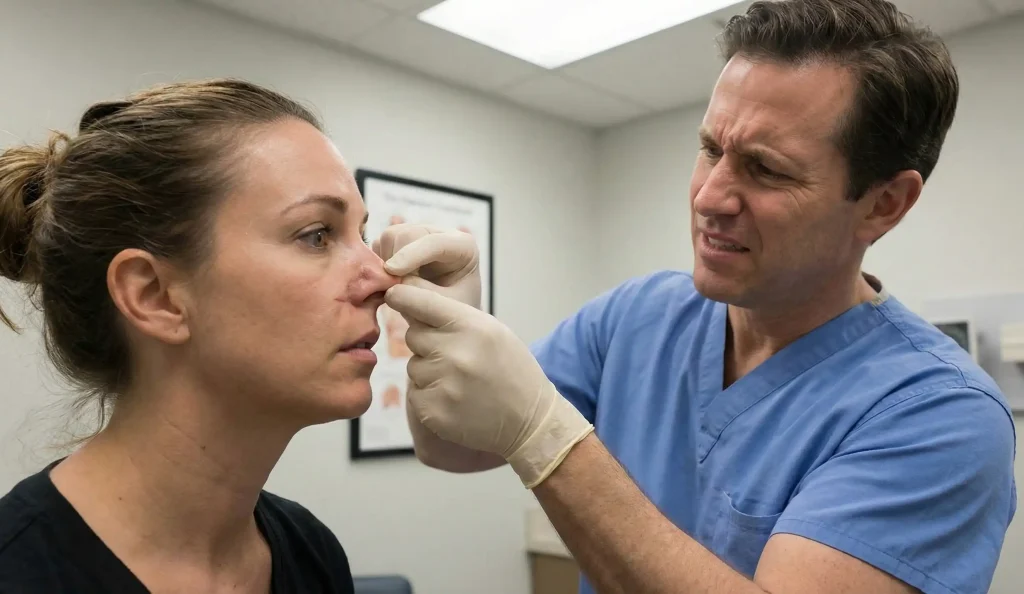
Any corrective nose surgery after a previous rhinoplasty.
There may be no feeling in aesthetic medicine more disappointing than removing the cast after the nose job and understanding that the result is not what you expected. Instead of the feeling of relief, disappointment overwhelms your whole body when you realize that your new nose is still crooked, too pinched, or even functionally broken. This is how patients get entangled in the complicated and emotional world of Revision Rhinoplasty which is also called secondary rhinoplasty. Actually secondary rhinoplasty is generally recognized as the most difficult operation in the whole of plastic surgery because the surgeon is not painting a “fresh canvas” but just correcting the work that has already been changed.
Theoretically, a Revision Rhinoplasty is considered to be any nasal operation carried out on a patient who has already had a rhinoplasty. However, it doesn’t matter if the first surgery was done ten years ago or just now, or even if the first surgery was for cosmetic or medical reasons; the second time you are in the operating room, it is a revision. This designation is not a minor one as it impacts the surgical approach, operation time, cost, and recovery period. At Lin Health Europe Clinic, we are experts in these complicated restoration cases and, through our therapy, patients come to the “botched” to balanced process smoothly.
Clarifying the Scope: From Minor Touch-Ups to Full Reconstruction
“Revision Rhinoplasty” can refer to any surgical intervention ranging from a simple to a very complex one. On the easiest end of the spectrum, we have minor revisions. For instance, they might include filing down a tiny leftover bone spur on the bridge or trimming a slight asymmetry in the nostril. Corrections based on these examples often are little operations whose post-recovery time is relatively short. Yet, major reconstructions make up the majority of revisions that we handle. Such surgeries usually deal with structural issues of major collapses, such as the “inverted V” deformity where the middle vault of the nose has caved in, or the “polly beak” deformity where the area above the tip appears swollen.
There is an essential distinction in both major and minor revision that relies a lot on the obvious and hidden anatomy. The major difference is that, normally, in a primary nose job, the layers of tissues are still fresh and the cartilage hasn’t been used. In a revision, however, the usual anatomical landmarks have been heavily damaged because the surgeon has to find the remaining structures through thick layers of scar tissue. That is why a revision requires not only a profound knowledge of anatomy and patience but also the double skill set of simultaneously repairing both the appearance and the nose function.
The Worst Enemy of Revision Rhinoplasty
The main enemy of a Revision Rhinoplasty is indeed a scar, also known as fibrosis. A surgery inevitably initiates the biological healing process that results in the formation of the new collagen fibers used to suture the wounds. However, if the operation is repeated once or twice, the surgeon will not be simply cutting through a round and tender tissue; he will be separating it, through which rough leather or even a piece of concrete may be further dissected. This scar tissue does what a glue liquid does – it adheres the two surfaces of the skin and the bone and cartilage underneath so that the phase of separation during the surgery becomes very tedious and delicate.
On top of that, scar tissue has much less of a blood supply than the original, healthy tissue. Which is why if the surgeon starts to make incisions that are too deep or large, then there is a higher chance of skin necrosis or poor healing. Besides, the skin becomes a kind of envelope stiffened so that the nose can be less “shrink-wrapped”. When a primary operation is performed, the skin follows the new, smaller shape quite easily. However, a revision results in the skin being firm and retaining an old shape memory; therefore, the surgeon must employ structural grafting techniques to trick the skin into a new form.
To Harvest Cartilage from Rib and Ear:
One of the most astonishing revelations for the revision patients is when they hear that cartilage is taken from their rib or ear. It is necessary because of the “supply shortage” that the initial operation has caused. During the first rhinoplasty, the doctor draws from the septal cartilage (the cartilage wall inside your nose) as the material for grafts. They ideally should leave enough for the structural support of the nose, but it is unfortunate that in a majority of unsatisfactory surgeries, the septal cartilage has either been depleted, damaged, or discarded.
Once we have exposed the nose during a revision, we quite often find what is figuratively termed an “empty shelf“. To build the structure again – whether the issue is that the nose is too short and needs to be lengthened, the tip is collapsed and support is required, or the bridge is crooked and requires straightening – we need to have strong, straight cartilage at our disposal. Since the nose is already depleted, the cartilage has to be obtained from a different source. Ear cartilage is soft and suitable for tip grafting, but when it comes to the bridge, the use of costal cartilage (rib graft) is frequently necessary. That means additional complexity is added to the operation as there will be a surgical incision on the chest for the second procedure, but this is often the only way of providing the extremely strong structural support that is required for the nose to stay in the correct shape over the long term.
Waiting Game: The Non-Negotiable 12 Months Rule

The majority of patients who are dissatisfied with their primary outcome are dreaming of having their shortcomings remedied instantly. Sometimes, they give us a call as early as two weeks following the operation, making a plea for a revision. Nevertheless, ethical and safe surgical practice requires a strict moratorium of usually 12 months from the time of the last surgery before the next procedure can be done. The so-called “one-year rule” is a biological concept and it solely depends on the inflammatory process.
The “shrink wrap” effect of the skin takes one year to become final; all deep swelling (edema) will be gone, and skin will also be able to adjust to the new shape once a year has passed. Now, if a surgeon is daring enough to open up a nose that is still inflamed and swollen with the tissues being friable and prone to bleed excessively, it would be the same to say that he is trying to sculpt the so-called soup. In addition to that, when a mistake is made in locating the problem due to operating too early, tissue damage will be soft and the risk of a bad result is considerably higher. The “soft” and stable nose is what we want in order to proceed with an accurate diagnosis and precise repair. The virtue of waiting patiently is fundamentally a key to the revision procedure in every sense of the word.
Revision Rhinoplasty Turkey
At Lin Europe Clinic in Turkey, we regard Revision Rhinoplasty as a “Structural Restoration” challenge. We don’t believe in using subtractive methods for revision surgeries; mainly, the issue is that too much was taken away the first time. Our aim is to restore the lost support. We employ state-of-the-art Piezo (ultrasound) technology to perform bone cuts without trauma and we are skilled in autologous rib harvesting.
Moreover, we champion honesty as our value. If available, we go over your prior operative reports and employ 3D imaging to help set realistic expectations. The revision procedure is very unlikely to bring you “perfection” in the way that a primary surgery can, but it does have the potential to bring about “a great improvement”. We focus on a result that is visually natural, has perfect breathing function, and most importantly, is sufficiently structurally durable to last a lifetime, thus putting an end to the redo surgery cycle for good.
Frequently Asked Questions About Revision Rhinoplasty
Generally, you are required to wait at least 12 months which is a sensible period for the scar tissue to soften and for the swelling to go down completely. Besides, this will mean that the Revision Rhinoplasty is carried out on stable tissue thus yielding the best results.
Revision Rhinoplasty is a more advanced version of the first one, thus, it requires more time (usually 4-6 hours) and greater expertise of the surgeon to deal with scar tissue and reconstruct the nose, which leads to the use of the rib grafting technique.
Not always but in most cases. If during your first operation the septum cartilage was used up, we are going to need some strong cartilage to maintain the structure. Rib cartilage is the go-to solution in structural Revision Rhinoplasty.
The pain level is the same, but the swelling might take a longer time to go away. Since the lymphatic system is again disrupted, the tip swelling after a Revision Rhinoplasty can take from 18 to 24 months before it completely disappears.
Yes. The majority of Revision Rhinoplasty cases are functional. Part of the internal valves that have been compromised is reconstructed and the septum is straightened in order to regain the normal airflow, thus the breathing is often improved significantly even compared to the primary result.
Toriumi, D. M. (2006). Structure approach in rhinoplasty. Facial Plastic Surgery Clinics.
Gunter, J. P., & Rohrich, R. J. (1987). External approach for secondary rhinoplasty. Plastic and Reconstructive Surgery.
Pearlman, S. J., et al. (2014). Revision Rhinoplasty. Facial Plastic Surgery Clinics.