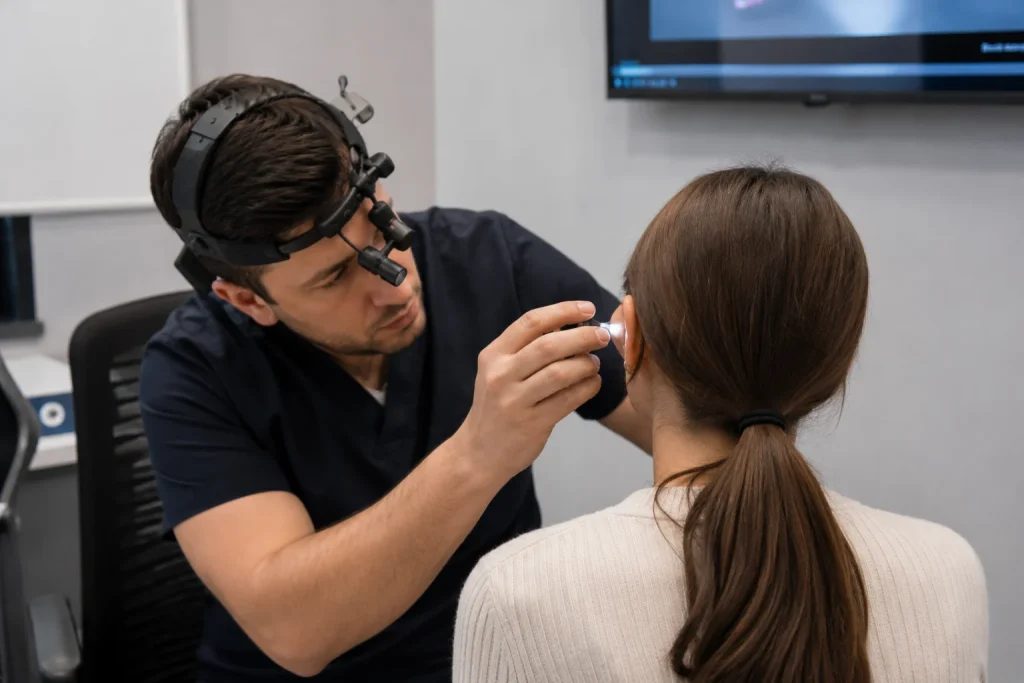
No, otoplasty does not affect hearing.
Separate Anatomical Zones And Hearing Apparatus
In the intricate field of head and face surgery, the line between changing the shape of the outer ear and influencing the ear’s ability to hear should be very clear. When people ask whether otoplasty (ear pinning) could cause hearing loss, the doctor’s answer comes down to a basic anatomical fact: the operation involves only the outer ear’s cartilage, or the pinna (auricle). The hearing apparatus, which is the ear’s complex biological system, is located well inside the temporal bone, away from the area operated on.
Through precise ear reshaping surgery, the surgeon makes tiny, nearly invisible cuts inside the retroauricular fold (natural crease behind the auricle). In fact, the entire otoplasty method involves simply loosening, making folds, or cutting away parts of the antihelical cartilage and conchal bowl so as to move the ear to lie near the head. Since this procedure is not at all near the eardrum (tympanic membrane), the middle ear bones or the auditory nerve bundles inside, it is simply not possible for a usual otoplasty to cause sensorineural or permanent mechanical hearing loss.
Temporary Blockage In Sound Transmission And Swelling After Surgery

Though a permanent loss of hearing is not structurally possible, to be a thorough and honest professional one should still provide full information to the patient about a common, short-term change in their hearing that can be experienced right after the operation. With the locking of the cartilage inside, the external ear parts become at the same time locally swollen (edema) and slightly filled with fluid, which characteristically defines the acute healing stage. This swelling can be so great as to even close off the entrance to the external auditory canal, resulting in a temporary narrowing of the passage through which the sound waves travel.
Besides that, just after the end of the operation, a patient is wrapped in a well-constructed sterile dressing and a compressive headband, both aimed at preserving the shape of the cartilage that has been moved. This heavy compression assembly is a real physical acoustic barrier, basically muffling all the external sounds and thus, causing a mild experience of conductive hearing loss. As your own fluid will be metabolized naturally via your lymphatic system over the first two to three weeks, and when the heavy dressings are gone, your original hearing will be fully and effortlessly restored to exactly the pre-operative level.
Maintaining Harmonious Balance And Your Athletic Look
One of the most important elements of ear remodeling is deeply analyzing how perfectly proportioned ears that are well hidden complement the rest of your overall body proportions and your physical fitness plan that you want to maintain for a long time. For people who work very hard to develop an athletic body— especially those who pay special attention to the lower body and gluteal muscles in order to have a figure with an almost perfect hourglass— the head is a very strong contribution. Having large and sticking out ears can cause a very clear geometric imbalance, thus leading to the viewer’s eye being drawn away from the beauty of your shoulders as well as your slim and well-toned waist.
Through the right use of otoplasty, the ears can be permanently brought to a position away from the head and made more streamlined. The first thing the expert does is to clean up your head shape. The ears, once they have been brought into a balanced and symmetric pose, will now show your upper body as well-disciplined, full of energy, and athletically elegant as your whole body. This mathematically derived structural agreement gets rid of an unwanted visual interference, and so, your athletic silhouette, along with flowing lower curves, will be the focus with perfect, uninterrupted balance from every direction.
Protecting The Ear Canal Vector and Preventing Complications
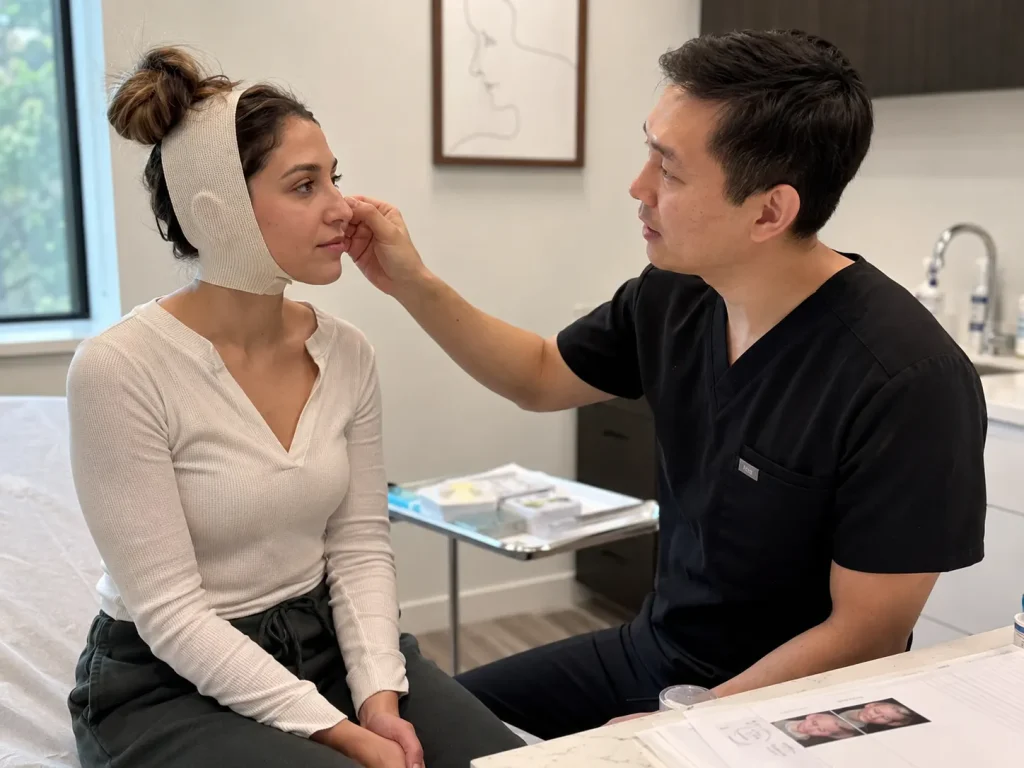
Ensuring maximum safety of the patient as well as an uncompromising healing time requires that the structural entry vectors be manipulated with extraordinary surgical knowledge. When the cartilage hinges are being secured with the help of internal sutures of high strength and permanence, the top-level reconstructive surgeon must pay close attention to the precise tension applied to the conchal bowl. To the extent that if this part of the cartilage is overcorrected or the permanent anchor points are put in wrongly, it may lead to the inner side of the cartilage folding in too strongly and the external auditory meatus (canal opening) getting narrowed.
It is clear that, in the case of a slight narrowing, your internal hearing mechanisms would still remain completely intact; however, an excessively constricted canal can lead to one being unable to get rid of their earwax naturally, which has the side effect of one frequently getting earwax build-ups or being more prone to the development of localized otitis externa (swimmer’s ear). Great experts completely rule out such a clinical risk by taking exact anatomical measurements prior to tying a single knot. This very strict compliance to evidence-based spacing means that your ears, which are newly pinned, will have a completely natural canal opening, hence lifelong comfort, ease of hygiene, as well as uninterrupted acoustic access are ensured.
Otoplasty in Turkey
LIN Europe Clinic is your gateway to a first-class global medical center where your exclusive structural change is carried out with no compromise in clinical skill and with the deepest understanding and care for your feelings. We know that changing your head contours dictates the whole line and level of an overlay of the utmost sophisticated, open, and definitely very much individual practice that has evidence-based medicine as the priority at all times. Located in Turkey, LIN Europe Clinic is a highly advanced facial and body architecture center and one that provides a calm environment where your surgical plan is solely based on elite global safety standards.
In placing your trust deeply in our devoted team of experts in Istanbul, you will be choosing a top-notch medical system that not only accurately measures your facial symmetry and cartilage angles but also, after careful preparations, makes the first cut. We have in place world-class diagnostic capabilities and use tension-free internal suture methods in order to ensure that your otoplasty produces a wonderfully balanced, natural-looking outcome with less downtime. Treat yourself to the exceptional, all-round care that LIN Europe Clinic offers and come away with a great profile that shows the highest level of biological success, which has been carried out safely and expertly in the center of Turkey.
FAQ:
Otoplasty cannot cause permanent hearing loss. The surgical procedure only involves reshaping the outer part of the ear (the pinna) and does not affect the middle or inner ear like the eardrum, bones, and auditory nerves which are well protected inside the skull.
Being unable to hear well or getting muffled hearing after surgery is a natural response of your body. It happens because the swelling of the tissues around your ear narrows the ear canal and also, thick sterile medical dressings you wear during the initial recovery partially block the ear.
You will have your normal hearing back after 2-3 weeks at most. This happens as the excessive swelling resulting from the surgery reduces naturally through lymphatic drainage, and you stop wearing your surgical compression band.
Definitely, the effect is going to last forever. During the surgery, the cartilage was reshaped and kept in position with very strong specialized sutures, so your new balanced appearance will be with you for your entire life.
LIN Europe Clinic offers surgical skills on a global scale and anatomical mapping at a very high level to guarantee completely balanced outcomes. Our highly skilled and dedicated medical team in Turkey employs highly precise, leat-trauma techniques to improve ear projection while maintaining a naturally, perfectly clear ear canal opening.
Mustardé, J. C. (1963). The correction of prominent ears using simple buried sutures. British Journal of Plastic Surgery, 16, 170-178.
Furnas, D. W. (1968). Correction of prominent ears by conchal-mastoid sutures. Plastic and Reconstructive Surgery, 42(3), 189-193.
Elliott, R. A. (1990). Otoplasty: a classic technique. Clinics in Plastic Surgery, 17(2), 247-256.