Yes, if approved by your surgeon.
In this niche, endonasal physiology and high-precision rhinoplasty technique, prescribing antihistamines for recovery is not only acceptable—it is regularly a part of the healing plan that doctors recommend. Post-nose surgery, “surgical rhinitis” is seen most often by patients, which is when the mucous membrane inside the nose becomes very sensitive and reactive to the trauma of the operation, causing sneezing, a stuffy nose, and watery secretion. The role of antihistamines is to inhibit the cells that release histamine in order to give relief from the symptoms of a blocked nose, as well as stop the sneezing that can cause mechanical stress. Nevertheless, this has to be done completely professionally, since if the drying out of the nose is done excessively, it can hinder the very sensitive phase of neocollagenesis that needs a well-hydrated environment for the best tissue remodeling for Turkey.
The Function of Antihistamines
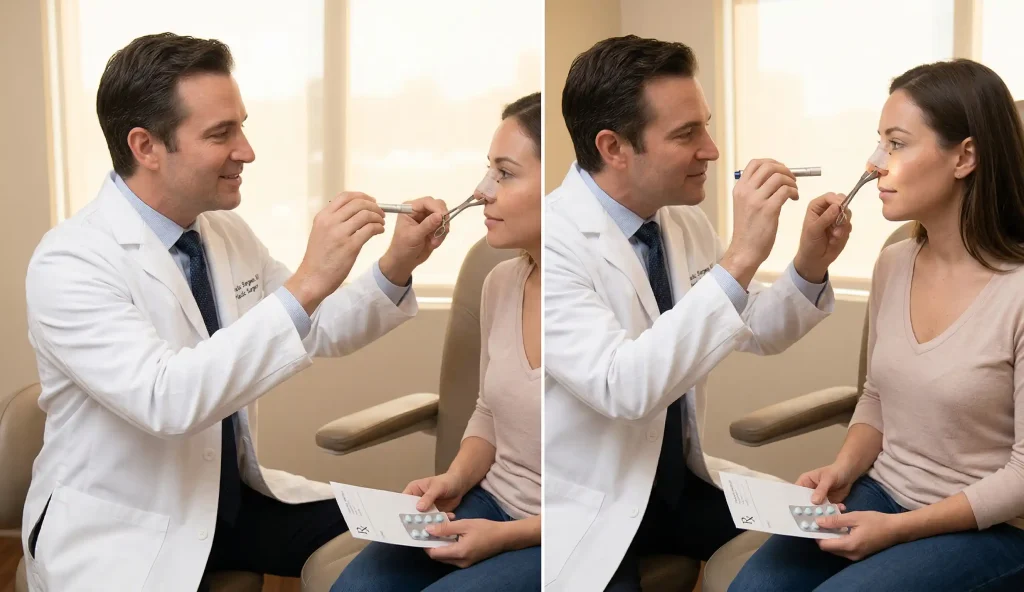
The nasal shells after a rhinoplasty in Istanbul may react the contrary as it was after a very strong allergic encounter. This type of vasomotor reaction simply means that the organism tries to “rinse” the region of the operation through its secretions. Though the resulting discharge is just the body’s way of healing the inflamed areas, one should be aware that excessive blowing or sneezing may threaten the stability of the newly restructured cartilage and bones. Antihistamines act as a pharmaceutical shield against wetting through such secretions and let the nasal splints and sutures lie completely undisturbed.
At Lin Health Europe Clinic, all respiratory issues are viewed as an indication of either smooth or problematic recovery. Our Turkey experts often recommend the use of second-generation antihistamines which are non-drowsy (e.g., cetirizine or loratadine) so as not to cause systemic fatigue as with the first-generation drugs. In Istanbul, a “Mucosal Stability Protocol” is given to each patient which clearly states what drugs are compatible with the internal environment to be at its best while in the phase of neocollagenesis without suffering the irritation of a persistent “surgical cold.”
Danger of Excessive Dryness and Formation of Internal Crusts
Though controlling a runny nose is generally a good idea, the divide between “dry” and “dehydrated” is a rather “thin” one, medically speaking. In case of nose dryness caused by excessive dehydration due to the strong effect of antihistamines, there can be a development of internal crusting which is painful. Besides, those crusts may become a source of bacterial infection, and if they are fixed and hard, they tend to cause bleeding when breaking off. The nasal mucous membrane must have a natural level of moisture for the wound healing cells to be active and for the collagen fibers to be laid down, among other activities.
Lin Health Europe Clinic strategy towards mucosal health is both a science and an art. Our international patients stay in Turkey longer than their procedures necessitate in order to receive care through the delicate post-op stages. When they take antihistamines, they are instructed to use them alongside sterile saline sprays. These mists help keep the tissue hydrated and healthy while at the same time controlling the “runny” sensation. Upon follow-up visits, our Istanbul healthcare professionals will also evaluate the moisture level of your nasal passages because they know how crucial hydration is to the phase of neocollagenesis. This double action method in Turkey is what leads to your recovery not only being comfortable but also being structurally correct.
Selecting the Correct Antihistamine: Sedative vs. Non-Sedative
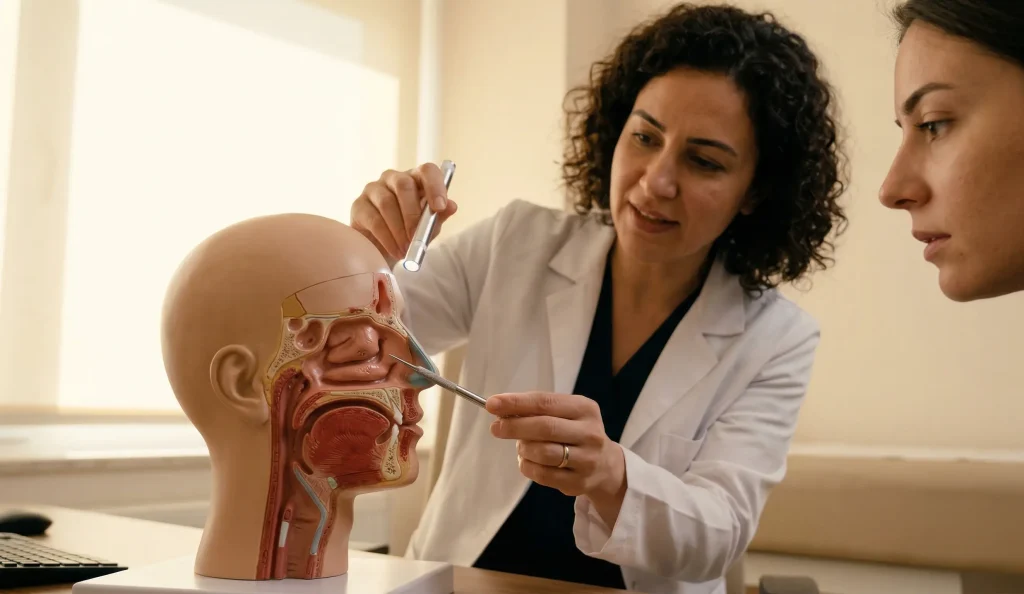
The right choice of an antihistamine depends on your individual biometric requirements and your recovery timeline. During the very initial days of your stay in Istanbul, it is possible that a first-generation antihistamine which causes drowsiness (examples: diphenhydramine) be given at night in order for you to be able to sleep even though you have the discomfort of nasal packing or splints. But the preference for the daytime medications goes to non-sedating types so as not to compromise your alertness and ability to stick to your protocols for mobility and hydration without difficulty.
Be advised: you should be extremely careful not to use any antihistamine which is combined with a “decongestant” (quite often those are labeled as -D or Sinus versions) without your surgeon’s specific permission. These have the possibility of causing elevated blood pressure and heart rate, which may be going along with higher risks of bleeding and/or hematoma after surgery in Turkey.
At Lin Health Europe Clinic, we know your health is the priority; therefore, we give every international patient a detailed “Pharmacy Guide.” In Istanbul, we carefully check your medical history with absolute professional rigor so that there would be no contraindications with your other post-operative medications. We help your body to do its natural repair work by giving you the best pharmacological tools available, which ensures that the phase of neocollagenesis will produce a nasal framework that is not only stable but also of high definition.
Neocollagenesis: Sustaining Tissue Health Over Long Periods of Time
One of the determining factors for your rhinoplasty to be successful in Turkey is the phase of neocollagenesis. During this time, the temporary surgical “glue” is being superseded by a permanent and well-organized collagen matrix. This can be achieved only if the tissue is allowed to work without being subjected to continual stress from sneezing or inflammation. Preserving stable and calm nasal conditions with the help of antihistamines is like creating an ideal “incubator” for your new nose to end up its final and beautiful shape.
Lin Health Europe Clinic is always ready with its 24/7 “Recovery Concierge” service to lead our customers through medication changes in Turkey. We continuously measure your tissue hardening process with ultimate precision in the biometrics of Istanbul so that your breathing is not blocked and your facial symmetry is not lost. For those who travel to Turkey to receive treatment from our medical team, such thorough clinical supervision means that each and every pill and spray is not just any step but is intended and calculated towards a newer, confident and more self-assisted you, all under the best specialists’ management in the world.
FAQ:
It is generally safe to take antihistamines after rhinoplasty and they are a good option to alleviate sneezing and a runny nose that often come with surgical rhinitis. To avoid any potential damage to the freshly healed nose by the force of sneezing, we in Istanbul even advise the use of antihistamines as one of the recovery aids in Turkey.
For daytime, non-drowsy, second-generation antihistamines like Claritin or Zyrtec are usually the best choice. Our devotion to serve you in Istanbul is so great that we compile the list of medications approved specifically for you to ensure they do not interfere with your recovery in Turkey.
Excessive use of antihistamines not teamed with saline irrigation can lead to internal crusting. We in Istanbul carefully schedule the use of your medications along with sterile saline mists so as not to adversely affect the neocollagenesis phase and to keep your nasal environment well hydrated and healthy in Turkey.
Unless your surgeon has specifically given you the go-ahead, it is better to avoid the antihistamines that contain decongestants like pseudoephedrine, etc. such medicines can cause bleeding in Istanbul and hence, as part of our high professional standards, we scrutinize your medicine list very carefully while you are in Turkey.
The majority of patients usually require only these drugs during the initial period of 2 to 4 weeks when the internal swelling reaches its maximum. At Lin Health Europe Clinic, we keep track of your respiratory biometrics in Istanbul and inform you precisely when it will be safe for you to reduce the intake of your medications in Turkey.
Rohrich, R. J., et al. (2011). The evolution of rhinoplasty: managing the nasal mucosa and post-surgical rhinitis. Plastic and Reconstructive Surgery.
Toriumi, D. M. (2006). Structural stability and mucosal healing in advanced rhinoplasty. Facial Plastic Surgery Clinics.
Gunter, J. P., et al. (2002). Dallas Rhinoplasty: Nasal Surgery by the Masters. Quality Medical Publishing.
Constantian, M. B. (2000). Rhinoplasty: Aesthetic and Functional Nasal Surgery. Little, Brown and Company.
Daniel, R. K. (2010). Rhinoplasty: The Art of Revision and Internal Recovery. Springer.