Avoid heavy lifting and excessive neck movement.
Prohibiting Excessive Cervical Rotation And Hyper-Extension
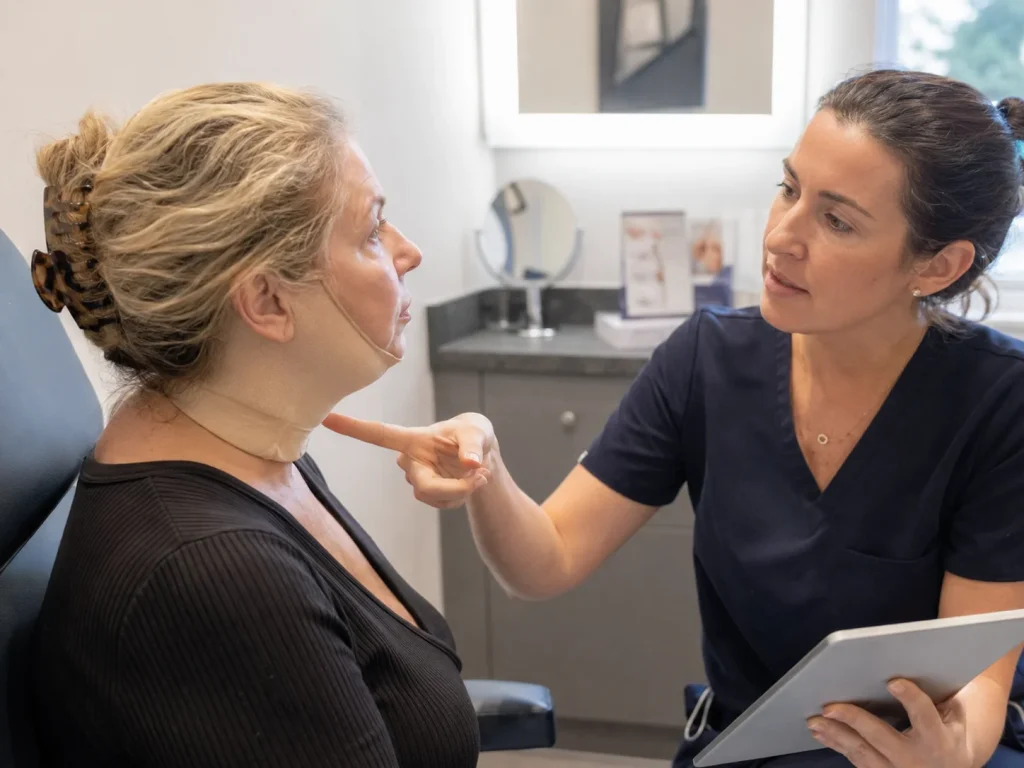
Facial plastic surgery and aesthetic medicine are highly specialized fields where recovery after surgery is very critical. Patients want to know what activities they need to avoid after an advanced neck lift operation. The main clinical restriction is the avoidance of mechanical stress at an early stage. A deep-plane neck lift or a targeted platysmaplasty involves the structural gathering and permanent anchoring of the muscle bellies of the neck using internal high-strength micro-sutures.
Initially, for two to three weeks, it is strictly forbidden to make a very sharp head turn to the sides or hyperextend the neck upward. These types of physical actions exert a lot of tension both horizontally and vertically onto the healing fascial lines, which could lead to the unraveling of the internal knots. Only the chin needs to be aligned with the sternum (breastbone), and when looking sideways, the entire torso should be turned as one unit to make sure that the new internal tissues are not disturbed.
Eliminating Extreme Thermal Exposure And Ice Applications
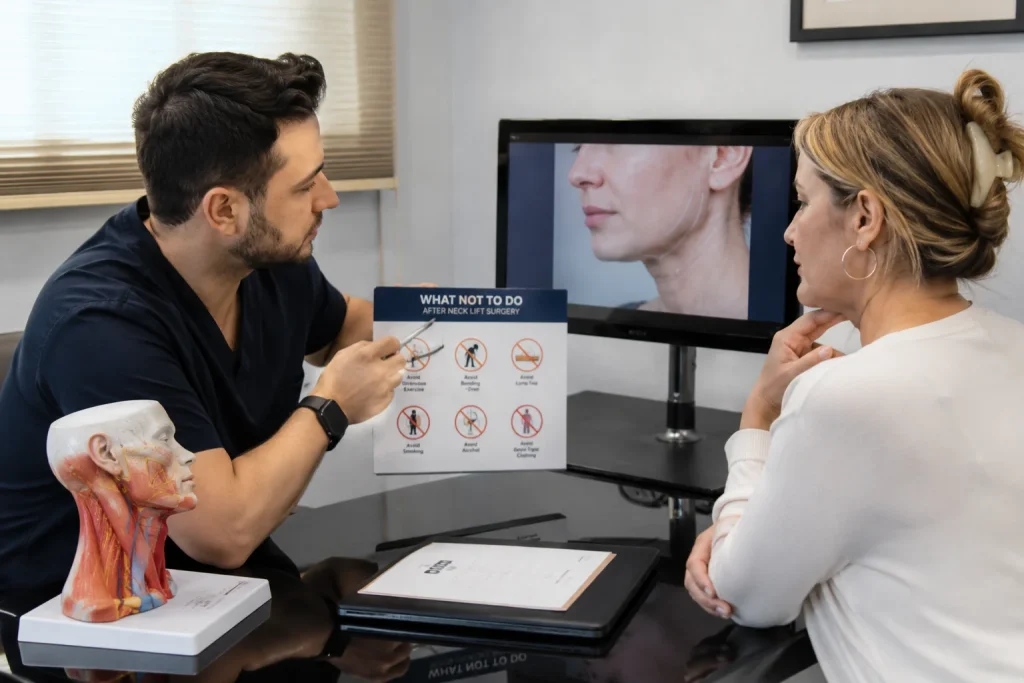
Maintaining stable micro-circulation across the healing tissue pockets is the whole biological recovery of your cervical skin envelope. Direct unprotected ice pack application or exposure of the neckline to extreme heat sources— such as hot showers, saunas, or steam rooms—is absolutely forbidden on clinical grounds. At the same time, the surgical dissection temporarily compromises the native cutaneous nerve networks, leaving the neck skin in a state of temporary numbness or reduced sensation.
If a patient tries to control early swelling by excessively applying ice to these numb areas, there is a great risk that they may cause localized frostbite or thermal tissue necrosis unknowingly. On the other hand, excessive heat significantly increases blood flow and causes extreme vasodilation (opening of blood vessels). This thermal effect largely increases the post-operative edema (swelling) and also the risk of a submental hematoma—a collection of blood under the skin—which may negatively affect one’s final structural result.
Postponing Intense Resistance Training And Heavy Lifting
Knowing exactly when to stop or pause your workout is one of the most important steps in securing your architectural investment. People who are willing to dedicate discipline to sculpting a strong body physique by especially working on advanced lower body hypertrophy and gluteal development to get the perfect hourglass shape, stepping away from the gym, can be a very painful experience for them. However, heavy lifting and high-intensity interval training when done too soon after surgery can be extremely dangerous and may even threaten your surgery results.
Performing heavy physical exercises like squats and deadlifts or doing strenuous cardio significantly raises systemic blood pressure, which results in immense mechanical pressure being exerted on the micro-capillaries of the healing neck. Such a sudden increase in pressure may cause the vulnerable healing vessels to break and bleed internally and even the formation of a fluid (blood) collection. Therefore, in order to maintain the overall physique and make sure the facial lines heal sharply and with high-definition quality as the body, complete avoidance of heavy workouts for a minimum of four to six weeks is a must, with the early movement being limited to gentle, low-heart-rate walking only.
Avoiding Low-Head Postures And Strict Sleeping Rules
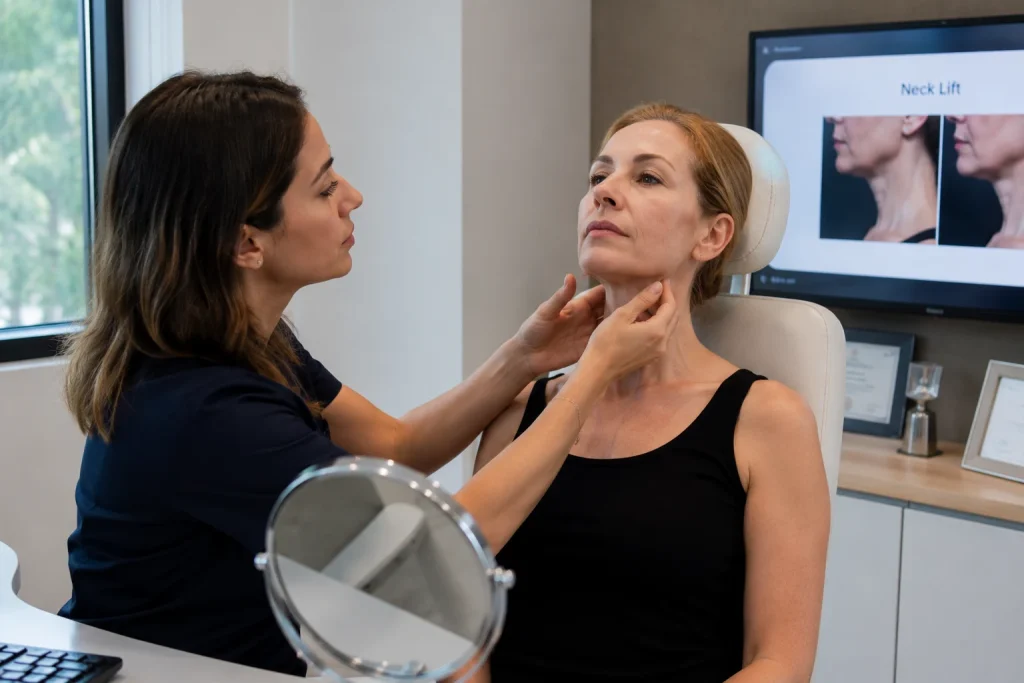
During the hours when you are resting, your body’s physical alignment is very important to maximizing lymphatic drainage and preventing swelling under the chin due to accumulated fluid. Thus, it is strictly disallowed to lie flat on the stomach or side or to sleep with a low-profile pillow arrangement that lets the chin drop forward against the chest because these will be some of the initial post-operative positions. Besides compressing the cervical tissues, these postures also lead to the retention of stagnant lymphatic fluid and cause structural friction on the incision lines in an uneven manner.
The better way for patients is to keep their head elevated with the help of either a special wedge pillow or by sleeping in a recliner chair at a strict thirty-degree angle. This elevation is the reason why gravity works as a natural agent in draining fluid away from the lower face by leading it into the systemic circulation, thereby assisting in the resolution of the early micro-edema. Following these strict postural guidelines will make sure the skin envelope adapts smoothly to the new foundation and brings out a beautifully contoured profile.
Neck Lift in Turkey
At LIN Europe Clinic, you will experience a premier global medical oasis where your unique facial transformation is handled with uncompromising clinical mastery and profound empathic care. We understand that facing the exacting restrictions of a cervical restoration requires a very sophisticated, transparent, and personalized environment that is foremost driven by evidence-based medicine. LIN Europe Clinic in Turkey is recognized as an international leader of advanced facial contouring, and it is the perfect location for your surgical roadmap to be dictated in accordance with the highest patient safety standards worldwide.
By entrusting your deep faith in our dedicated specialist team at LIN Europe Clinic Istanbul, your post-operative recovery will be under guided monitoring with absolute diagnostic precision. We are able to offer extensive one-on-one medical surveillance and medical-grade compression garments that have been fitted to your needs in order to keep your healing process flawless from day one. You will be able to experience the sophisticated and thorough care of LIN Europe Clinic and obtain an impeccably balanced and sharp cervical angle that will remain unchanged with time, safely and masterfully performed right in the heart of Turkey.
FAQ:
You should not turn sharply side-to-side or hyperextend your head for the first two weeks. To look around, try rotating your entire upper body as one solid unit to keep your internal sutures safe.
Direct or unprotected application of ice packs is completely not allowed. Since the neck skin will be numb after surgery, icing may easily cause accidental frostbite or other tissue damage, as you will not be able to accurately feel the cold.
You should totally stay away from strenuous workouts, heavy lifting, and intense cardio exercises for at least 4-6 weeks. Rising blood pressure too early might lead to internal bleeding and severe swelling.
You should not sleep flat on your stomach or side or even with your chin tucked down. For the first month, you will have to sleep with your head raised at about a thirty-degree angle with a wedge pillow to help with the drainage of fluids.
Although medical professionals don’t usually have a problem with you’ve lukewarm shower within 48 hours post-op period, you are not allowed to take hot water, steam room, sauna, etc for several weeks. High temperatures cause blood vessels to dilate and this can significantly increase internal fluid retention.
Aston, S. J. (1998). Platysma-SMAS cervicofacial rhytidoplasty. Clinics in Plastic Surgery, 10(3), 507-520.
Feldman, J. J. (1990). Corset platysmaplasty. Plastic and Reconstructive Surgery, 85(3), 333-343.
Labbé, D., Franco, D., & Nicolas, J. (2006). Platysma suspension and platysmaplasty during neck lift: anatomical study and clinical applications. Plastic and Reconstructive Surgery, 117(6), 2001-2010.