

Yes, implants can improve chest asymmetry.
Within the aesthetic and reconstructive plastic surgical domain, breast asymmetry (anisomastia) is a well-recognized condition that runs the gamut from barely noticeable volume discrepancies to extreme structural imbalances. While slight tonal differences are regarded as physiologically normal, very pronounced asymmetry is typically accompanied by volume, shape, nipple-areola position, and inframammary fold height differences. From a clinical standpoint, the main aim is to make the breasts anatomically symmetrical whilst ensuring the breast tissues remain healthy over the long term.
At Lin Health Europe Clinic, we understand that severe asymmetry is seldom fixed by a single treatment. Although breast implants represent a major part of the therapy, the final result is frequently a “multi-modality” outcome. For Turkey-bound patients, knowledge of how surgeons achieve these balances through differential implant sizing, tissue lifting, and fat grafting is a must. A “one-size-fits-all” mentality is out of question if the two breasts’ baseline anatomic structures are totally different.
The Surgical Algorithm for Severe Asymmetry

Very severe asymmetry correction involves a custom-made surgery plan that addresses three main points: volume, envelope (skin) laxity, and nipple position. When the difference is very large, placing equal-sized implants in both breasts would just continue the imbalance problem. Instead, the surgeons go for different-sized implants or different profiles to “level” breast projection and width.
Regarding therapy, there are cases when one breast is smaller (hypoplastic), and the other is bigger with sagging (ptosis). That is why the surgeon might decide to treat the two breasts differently: to do an augmentation on the smaller breast and breast lift or reduction for the bigger one. In this way, they can assure internal layers being at same vertical level, and the lower parts of the breasts having symmetrical curves. At Lin Health Europe Clinic, we work hard to precisely determine the amount of volume required on each side through detailed preoperative measurements to make a harmonious body figure.
The Role of Cohesive Silicone Gel and Implant Science
When one is dealing with the problem of asymmetry, the prosthesis choice is indeed important. Modern implants use cohesive silicone gel which is a solid material having a comparable density to that of natural breast parenchyma. This firmness is indispensable to asymmetry cases because it provides the surgeon with the versatility of choosing different projections (low, moderate, or high) that correspond to the patient’s unique thoracic wall.
These devices are safe due to their biocompatibility and shell integrity. The high-grade implants in Turkey are created to endure wear and tear and lower the chance of “gel bleed”. This mechanical robustness guarantees that post the correction of asymmetry, the outcome is stable in the long run. At Lin Health Europe Clinic, we only depend on implants that are of superior quality in terms of durability, hence we can assure our patients about the reliability of their reconstruction lasting for years.
Enhancing Symmetry with Fat Grafting and VASER
In very asymmetric breast cases, the employment of implants only can still present some minor irregularities, especially in the upper or lateral borders. To have a perfect connection, the medical team normally performs a liposuction procedure first to take out subcutaneous adipose tissue from the patient’s own body. Next, that fat is reprocessed and then re-injected into the breast area, which is the same as autologous fat grafting or lipofilling.
We apply Vaser technology for the survival of grafted fat at its maximum capability. With the help of VASER (ultrasound-assisted) technology during the harvesting phase, the fat cells’ emulsification is carried out effortlessly which keeps the cells’ integrity more than the traditional suction by hand. Hence, by putting this fat on the implants, the doctor is able to fix the symmetry “just right”, filling in the small hollows that the implant cannot reach. This is the level of care that Lin Health Europe Clinic is known for, a guarantee for a totally natural look and feel.
Recovery and Management of Edema
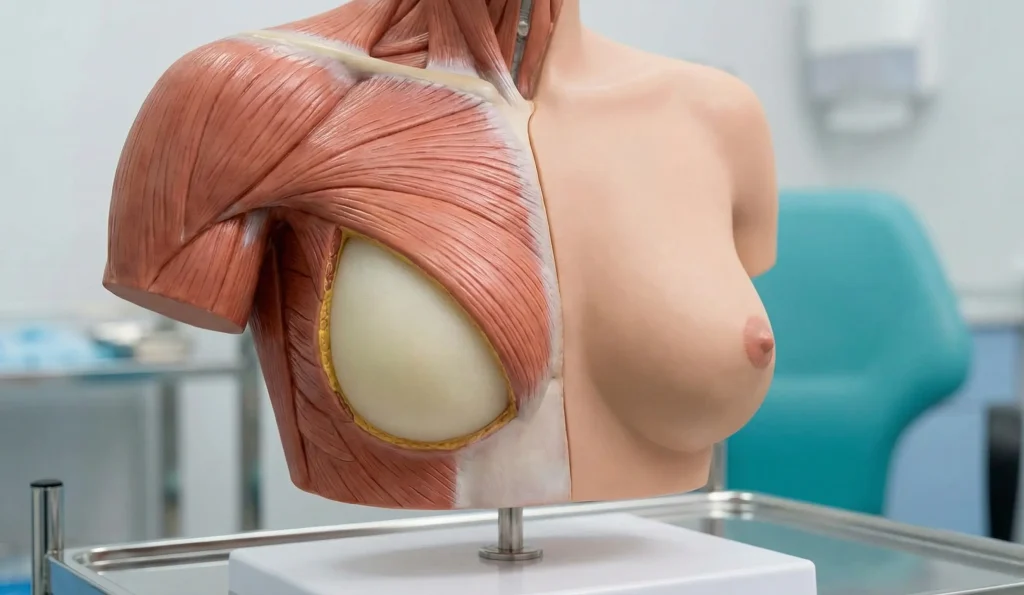
The healing timeframe following asymmetry revision is a bit more complicated than a simple augmentation since the two breasts may be subjected to different procedures. In fact, one side could be done with only a simple incision, while the other side is undergoing cutting, internal rearranging, etc., from a lift. That is why patients can expect to see unequal amounts of edema (swelling) in both sides of their chest during the first few weeks.
Properly controlling the swelling plays a significant role in the eventual look. People living in Turkey or staying there for plastic surgery purposes have to get a post-operative compression garment that fits and applies equal pressure to both breasts uniformly. This aids in the skin getting accustomed to the new volume as well as the two inframammary folds healing to the same level. Despite the fact that an aesthetically pleasing result can be seen early on, the breasts may require three to six months to come into their final symmetrical positions (“drop and fluff”) as the swelling disappears and the tissues become soft.
Breast Implants in Turkey
The correction of severe breast asymmetry is a topical procedure within the plastic surgery field that requires a surgeon who is not only technically proficient but also has an artistic eye for accurately proportioning body parts. This is exactly what we can offer at Lin Health Europe Clinic, which has helped numerous foreign patients with complex reconstructive cases. Our Turkey branch is equipped with state-of-the-art diagnostic devices that can measure tissue thickness and glandular volume very precisely, therefore making it possible to prepare exact surgical maps.
We consider that every female individual ought to be free from any doubt about her figure and experience harmony with her body. By fusing high-quality implants with successful fat grafting and ingenious lifting/reshaping techniques, the entire spectrum of anisomastia patients’ needs is covered. Throughout your relationship with us, from the first consultation till the final check-up, Lin Health Europe Clinic will represent your trustworthy companion to a flattering, symmetrical, and aesthetically pleasing body.
Frequently Asked Questions About Breast Asymmetry
Minor variations most of the time are totally natural, however, if the changes happen all of a sudden or if you have pain, you should seek the doctor immediately. If you come to Lin Health Europe Clinic for a thorough evaluation, they can decide whether the asymmetry is just a matter of aesthetics or if it is something that should worry you.
In cases of drastic anisomastia, implants are mainly utilized to restore the volume balance. When combined with a lifting surgery in Turkey, implants can not only straighten the breasts but also the chest wall will appear symmetrical.
Where one scales are set differently in terms of the profile and volume, the imbalance visible on the chest is removed within the range of the resolution. Furthermore, this method guarantees that the breasts will be consistently shaped and projected over the whole area.
This medical term defines a case where one breast has a volume more than two cup sizes bigger than the other’s, or the two breasts are extremely different in terms of the location of the inframammary fold. In such situations, the patients most of the time have plastic surgery in Turkey to solve the problem of size discrepancy as well as the issue of skin loosening.
That’s right, one of the ways to fix unequal breast sizes is by using implants of various sizes. This will enable your surgeon at Lin Health Europe Clinic to cultivate a figure that is balanced and, most importantly, visually attractive.
Rohrich, R. J., et al. (2006). Breast asymmetry: classification and management. Plastic and Reconstructive Surgery.
Spear, S. L., et al. (2005). Correcting breast asymmetry with implants and fat. Aesthetic Surgery Journal.
Losken, A., et al. (2011). The use of fat grafting in primary and secondary breast surgery. Plastic and Reconstructive Surgery.
Adams, W. P. (2008). Breast Augmentation: The Process of Choosing the Correct Implant. Clinics in Plastic Surgery.