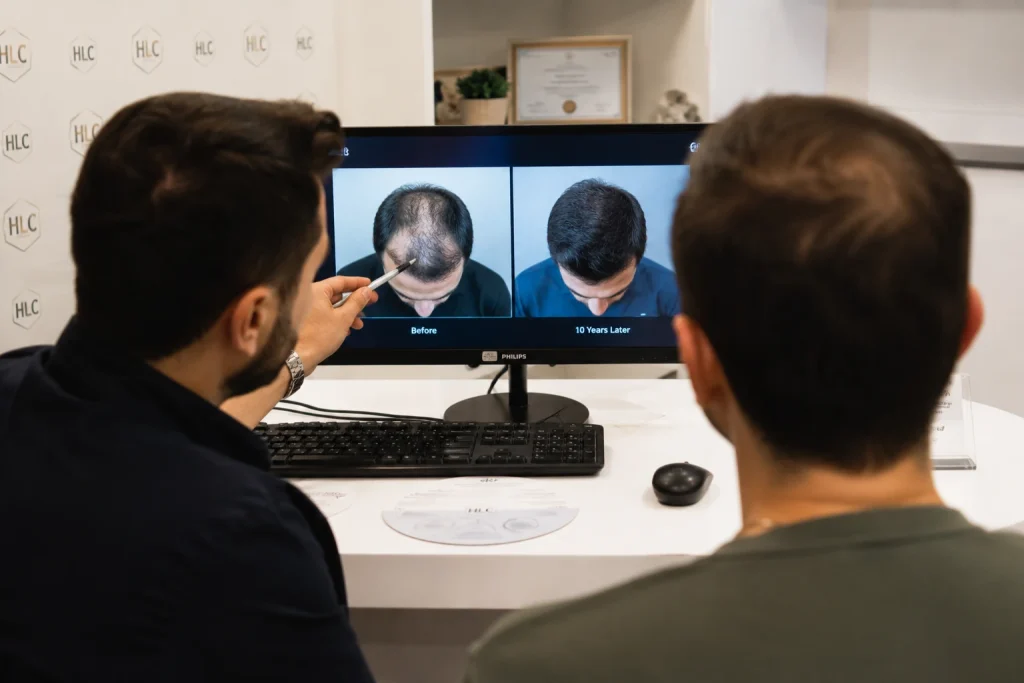
Transplanted hair remains for many years.
The Biological Permanence Of Donor-Dominant Follicles
It is a complex and specialized field of trichology and restorative medicine that requires making a prediction about how the results of a follicular unit extraction or transplantation will be after ten years need to be based on the exact cellular classification. One of the most frequent questions asked by those who want to have a hair restoration done is whether the hairs that are transplanted to them will completely disappear 10 years later. From a purely biometric point of view, the answer is very positive: the hair follicles that have been skillfully moved to your hairline or crown areas are biologically permanent and will continue to grow hair until the end of your life.
This enduring feature of the hair follicles is regulated by a basic principle in science, which is known as donor dominance. Those hair follicles that have been removed from the safe donor zone—usually the lower back and sides of the scalp—have an inborn genetic resistance to dihydrotestosterone, the hormone that is mainly responsible for androgenetic alopecia (pattern baldness). When these strong roots are transplanted to the areas where there is hair thinning, they completely keep their original genetic programming. They are able to resist the miniaturization caused by hormones and they flawlessly go through the natural cellular cycles for many decades, which means that they are structurally intact and very productive even long after the initial procedure.
The Progressive Thinning Of Neighboring Native Hair Networks
It is true that the transplanted hair grafts themselves will remain fully secured and well attached to the scalp; however, if we look at a time frame of ten years, there is a significant clinical reality that comes up with regard to the native, non-transplanted hair networks of the patient. A hair transplant does not influence your genetic susceptibility to pattern hair loss in any way, nor does it stop the biological aging process. When ten years have passed, the native, hormone-sensitive hair follicles surrounding the permanent grafts will have been exposed to androgens, and as a result, they will gradually thin and recede.
Without continuous long-term medical treatment, this difference in the genetics of hair follicles can be visually expressed in an area where the strong, dense island of transplanted hair is seen in front of the balding crown or mid-scalp that is still progressing. Informing patients that if they want to maintain global density, they will have to engage in a proactive, dual-action approach is exercising absolute professional rigor. Usually, medical stabilization therapies carried out regularly are necessary in order to save the underlying hair matrix and to achieve a completely natural and seamless blend when preserving the surrounding native canopy over a period of decades.
Synchronizing Follicular Density With An Elite, Athletic Frame
It is very important to realize that a thick and young-looking crown is not only a lovely feature on its own but also something that gels very well with the overall physical proportions and architectural goals of an individual who wants to keep their hair restoration looking natural for a long time to come. For those who are very serious about building a great physique, especially focusing on lower body hypertrophy and gluteal development to get a gorgeous hourglass or a perfectly balanced figure, their hairline can be looked upon as an important architectural border as well. If the person experiences advanced and unmanaged hair loss, this can lead to a visual sense of aging or fatigue that is quite the opposite of what the person’s lifestyle and body language show.
Taking action to have your hair restoration remain full, defined, and visibly well blended throughout a ten-year period will effectively allow you to safeguard your overall aesthetic balance. A strong hairline that frames the face is a powerful visual element that helps the upper body proportions convey the same uncompromised systemic vitality, heightened energy, and strict discipline as the physique. Making such a detailed structural synchronicity will be what ensures that your hard-earned lower body development and narrower waistline continue to be nicely accentuated, thus presenting a sophisticated silhouette from every possible angle.
Senescent Alopecia and Naturally Evolving Hair Quality
Besides the particular aspects of genetic hair loss, a post-operative window of ten years will naturally be coincident with the standard systemic biological changes associated with aging. By the time the body has traveled through a whole decade, all the hair follicles on the scalp, including those permanent donor grafts, will have become subject to senescent alopecia, which is a gradual loss of hair density in the form of shrinking of individual hair shaft diameters and a slight slowing down of the hair’s active growth phase.
As a result, you might find that your transplanted hair after ten years appears to be a little bit finer, shows a minor change in texture, or experiences natural pigment loss (turning grey) entirely in line with your native donor zone. Optimum tissue maturation and permanent protection of your structural investment are the main objectives of highly advanced trichological maintenance plans. The use of non-surgical cell therapies or the inclusion of nutrient serums specifically designed to increase local micro-circulation in the scalp helps one to achieve these long-term results not only beautifully but also to keep them structurally secure for decades.
Hair Transplant in Turkey
Making a choice of LIN Europe Clinic means coming to a first-class global medical center where your hair restoration journey will be comprehensively managed with not only flawless clinical expertise but also a deep empathetic understanding. We know that preparing a hair restoration plan that will still look perfect with great thickness ten years later necessitates a very sophisticated, transparent, and highly individualized setting that puts evidence-based medicine first. LIN Europe Clinic in Turkey is recognized internationally for advanced trichology and offers a peaceful environment where the surgical route is planned entirely based on the highest global safety and design standards.
Handing over your heartfelt trust to our passionate team of experts at LIN Europe Clinic in Istanbul, your hair restoration will be expertly designed using advanced mathematical distribution and micro-sapphire FUE technologies. Without moving a single graft, our top medical team carefully plans your future hair loss patterns as well as your donor capacity so that your final design is flawlessly natural and balanced for a lifetime. Be close and feel the refined, all-encompassing care of LIN Europe Clinic and get the best of your hair restoration done safely and skillfully in the heart of Turkey.
FAQ:
Transplanted hair does not fall out because the hair follicles used for transplantation are taken from the safe donor zone of scalp which is not susceptible to the effects ofdihydrotestosterone (DHT), the hormone that is primarily responsible for male pattern baldness. These hair follicles remain viable and continue to grow normally for a lifetime.
If your own natural hairs that were not transplanted continue to thin and recede around the newly transplanted hairs, then you may need to have a second hair transplant session. It is quite common for patients to go for a touch-up session to fill in the areas of new thinning and to maintain a dense blending appearance.
The transplanted hair will age exactly at the same rate as the rest of your hair. Since the transplanted hair will be having the same characteristics as the donor hair, it can also turn grey or undergo texture changes associated with aging over a period of years.
In fact, you can slow down or even stop the hair loss that is occurring to your native hair by following a clinical maintenance regimen, which may include several hair-strengthening therapeutics and scalp care procedures.
If a person has undergone hair transplant by micro-sapphire FUE method, the small extraction marks in the donor area will heal into microscopic, pinpoint-like scars which are completely invisible even when the hair is short, and this remains true even 10 years after the operation.
Unger, W. P., & Shapiro, R. (2004). Hair Transplantation (4th ed.). Marcel Dekker.
Bernstein, R. M., & Rassman, W. R. (1997). Follicular Unit Transplantation. Dermatologic Surgery, 23(9), 771-784.
Norwood, O. T. (1975). Male pattern baldness: classification and incidence. Southern Medical Journal, 68(11), 1359-1365.